
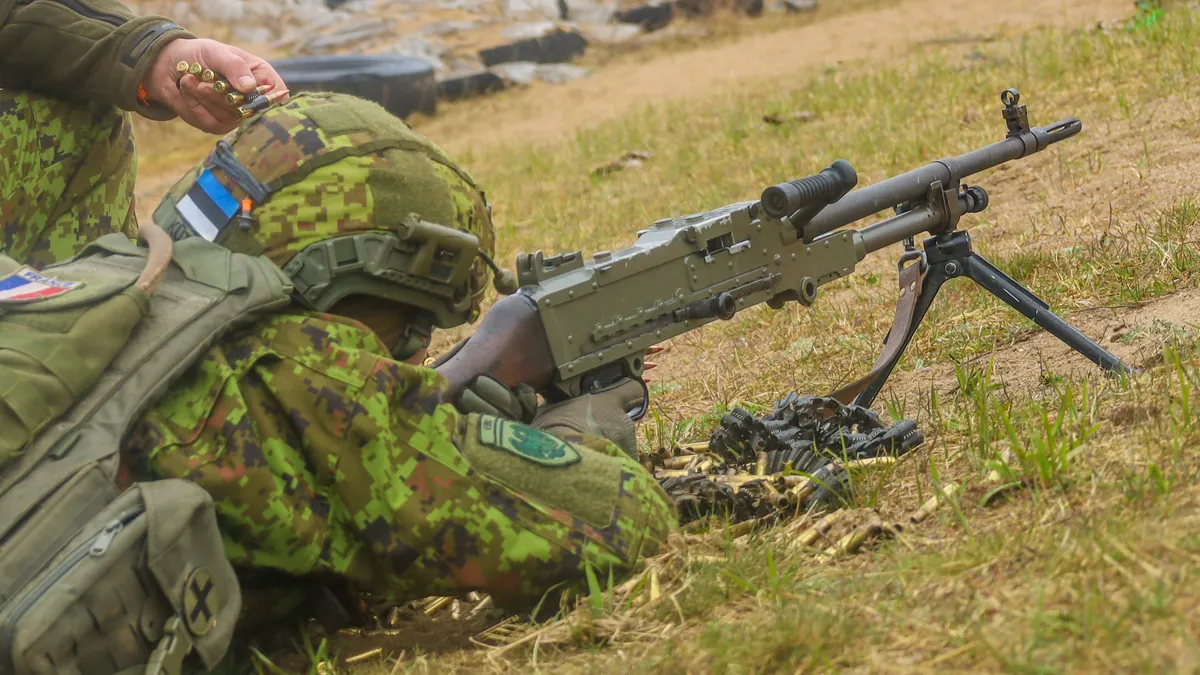
Civilians train with weapons
“I will do everything to ensure that our country remains independent”
May 3, 2026 – 7:42 a.mReading time: 5 minutes

The Estonian defense unit Kaitseliit trains civilians to use weapons. In the event of a Russian attack, they are supposed to help defend the country.
Tobias Schibilla reports from Rutja, Estonia.
With a dull “fump” the grenade shoots towards the Euro pallets. Mait Sander Nõlvak lowers the rifle, which has a 40-millimeter grenade launcher mounted under the barrel, and turns the corners of his mouth downwards. Orange smoke rises far behind the pallets; the shot with the training grenade clearly missed the target. The 19-year-old is visibly dissatisfied with his performance.
Nõlvak belongs to the Kaitseliit, a paramilitary defense unit. Under the supervision of the Estonian Ministry of Defense, volunteers learn how to use various weapons, military tactics and techniques to survive in the wilderness. The Kaitseliit is an important part of the Estonian defense doctrine. It plays an important role in national defense in the event of a feared attack by Russia, because the volunteer unit has significantly more members than the professional army of the small state on NATO’s eastern flank.
The Kaitseliit volunteers train several times a month on the Rutja training field, in the hinterland of the Baltic Sea coast. The weather is particularly bad on this day. With a temperature of around three degrees, the wind whips sleet across the former airport, which is located about halfway between the Estonian capital Tallinn and the border with Russia. Nevertheless, around 30 Kaitseliit members showed up for training. They should train how to use machine guns, stun grenades and fragmentation grenades as well as the grenade launcher of their assault rifle.
To protect himself from the wind for a moment, Mait Sander Nõlvak gets into a car and takes off his helmet, face mask and heavy military protective vest. “I was brought up to be patriotic,” says the 19-year-old when asked why he decided to get involved in the volunteer unit. “When I was three years old, on walks with my family I had to sing parts of the national anthem whenever we passed an Estonian flag.” This upbringing led him to want to become part of a paramilitary organization as a teenager.
Nõlvak says he initially started with the Boy Scouts. There he learned many skills that still help him in Kaitseliit today, such as how to set up a camp in the forest without a lot of equipment. As a teenager, he and three other friends founded a group within the Noored Kotkad, the Kaitseliit youth organization. “With this group we also worked together with the trainers from the Kaitseliit adult unit,” explains the 19-year-old. Shortly after his 18th birthday, he switched from the youth organization to the adult organization.
