
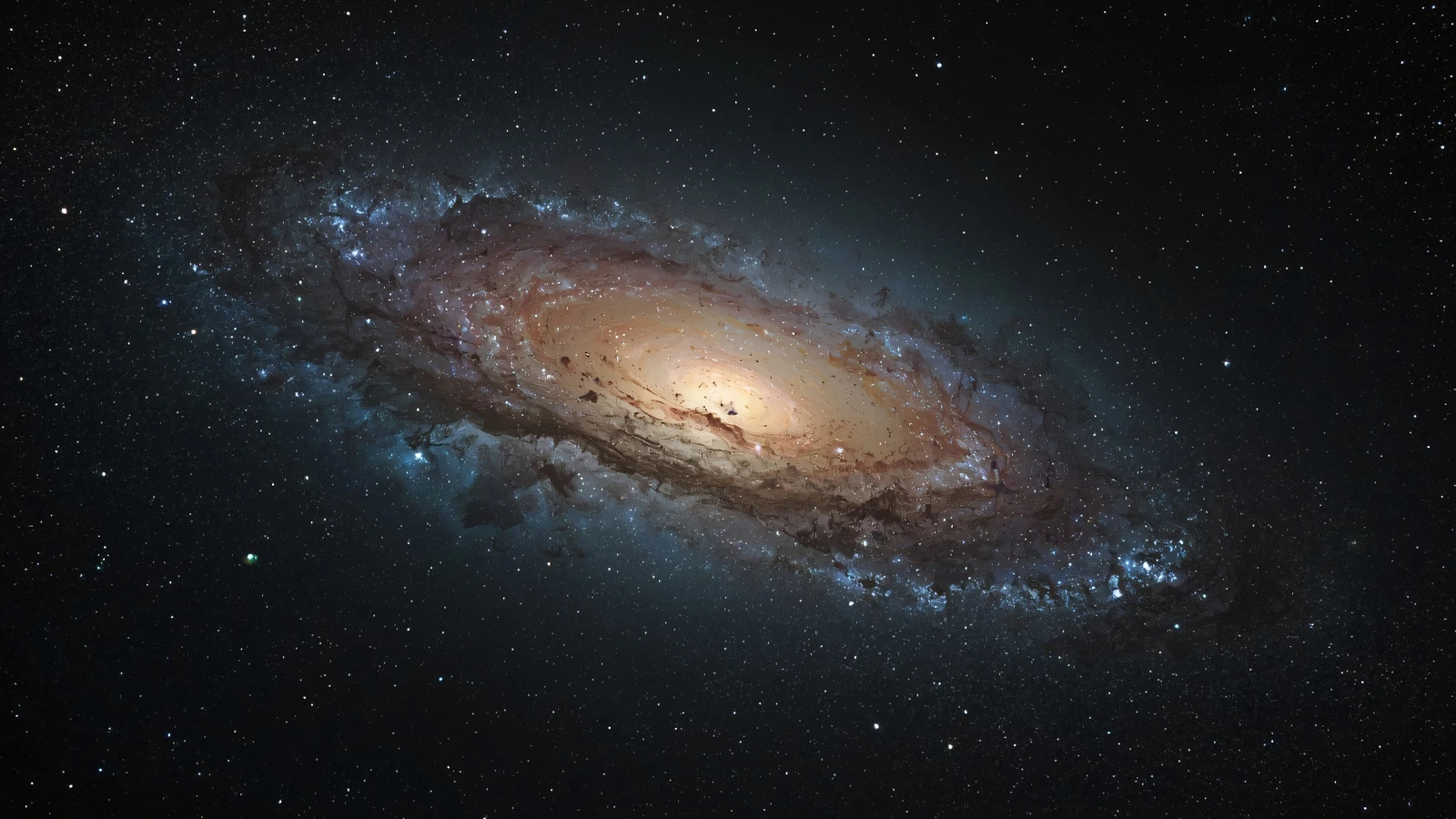
A new study published in the journal Astronomy & Astrophysics has revealed remarkable results about the star formation history of the Milky Way Galaxy. In the study, age data of more than 100 thousand giant stars obtained from APOGEE, LAMOST and Gaia sky surveys were examined.
OLD STARS IN THE CENTER, YOUNG STARS IN THE MIDDLE
The research showed that there is a “U”-shaped relationship between stellar ages in the Milky Way and the distance to the center of the galaxy. Accordingly, the stars in the regions close to the center of the galaxy are quite old. The main reason for this is that dense clouds of gas and dust around the center initiated star formation in the early stages of the galaxy.
REFRACTION STARTS AT 40 THOUSAND LIGHT YEARS
As you move away from the center of the galaxy, the gas density decreases and the star formation process slows down. For this reason, younger stars are encountered in the central regions. But about 40 thousand light-years away, a remarkable change is taking place: stars are starting to age again.
Scientists have determined that most of the older stars beyond this “breaking point” were not actually born here. It is thought that these stars were formed in the inner regions of the Milky Way and were blown to the outer parts over time due to the gravitational effects created by the bar structure and spiral arms at the center of the galaxy. Researchers describe these stars as “immigrant stars.”
THE IDENTITY OF THE MILK WAY HAS BEEN CLEAR
The findings also confirmed that the Milky Way is in the class of Type-II (down-twisted) disk galaxies, which includes approximately 60 percent of similar galaxies in the universe.
This study shed light on our galaxy’s evolutionary history by revealing where the Milky Way’s young, peak star production periods ended and the quieter outer regions of the galaxy began.
