
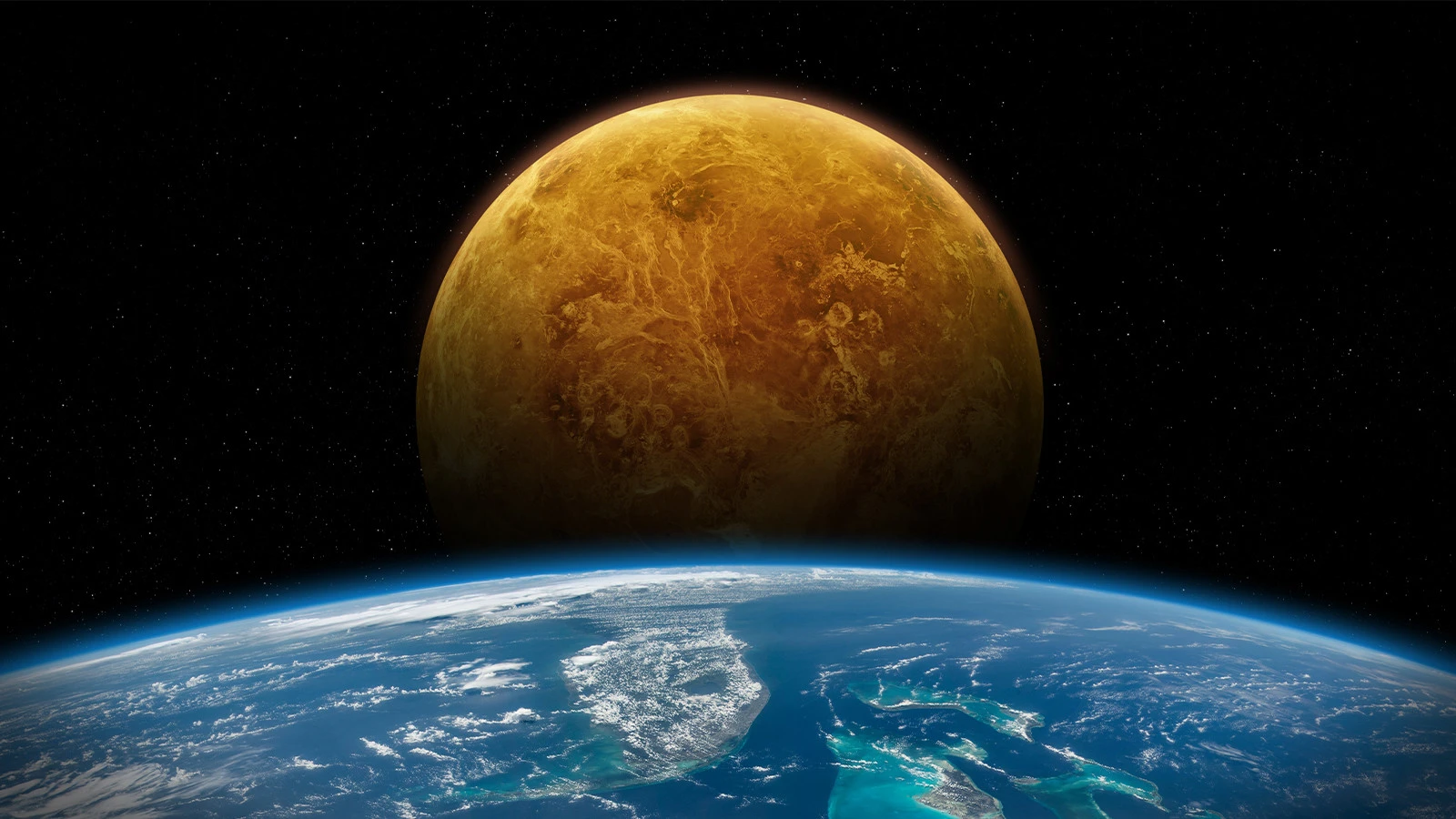
A remarkable theory has been put forward for Venus, one of the most mysterious planets of the Solar System. According to a new study, Venus, which does not have any natural satellites today, may have had a Moon-like satellite in the past. However, the planet’s extraordinarily slow rotation may have caused this moon to move towards Venus over time and eventually be swallowed by the planet. The research was conducted by astrophysicist Stephen Kane from the University of California, Riverside, and was published in The Astrophysical Journal.
VENUS SPINS VERY SLOWLY
The basis of the research is the rotation speed of Venus. Venus completes its rotation around its axis in approximately 243 Earth days. Therefore, the planet has a very different rotational motion than other planets in the Solar System.. Researchers calculated that this slow rotation could change the orbit of a moon around Venus over time. The movements of hypothetical satellites of different sizes around Venus were examined in computer simulations. Models showed that under favorable conditions, the satellite’s orbit could gradually shrink and the satellite could move closer to Venus.
SATELLITE HIT THE PLANET
According to the research, if the process continues long enough, the satellite may move closer and closer to Venus. In the final stage, the satellite entering the planet’s strong gravitational field may break apart or crash directly into the surface of Venus. According to this scenario, Venus may have pulled a satellite it had in the past onto itself instead of losing it to another celestial body.. Researchers estimate that such an event may have occurred within the first 1 billion years after the formation of Venus.
IT HAS NOT BEEN PROVEN TO BE A SATELLITE
According to the information provided, the new study does not prove that Venus has a satellite. Researchers only suggest a physical scenario that could explain Venus’ current moonless state. According to the news, the research opens a new discussion in terms of understanding the history of Venus and how the planets’ satellite systems formed and changed.
