
Parliamentary elections in wartime
Election in Russia ends – how does Putin’s party fare?
Updated 09/20/2026 – 06:29 amReading time: 3 minutes

President Putin wants to have his war course confirmed. In the three-day election for the State Duma, only parties close to the Kremlin are on the ballot. Election observers report some anomalies.
In Russia The three-day parliamentary election ends today. After the exclusion of the opposition, President Vladimir Putin his war course against the neighboring one Ukraine have it officially confirmed. Despite economic crisiswar weariness and widespread discontent among the people, a two-thirds majority should once again be achieved for the Kremlin party “United Russia”, which has been in power for more than 20 years.
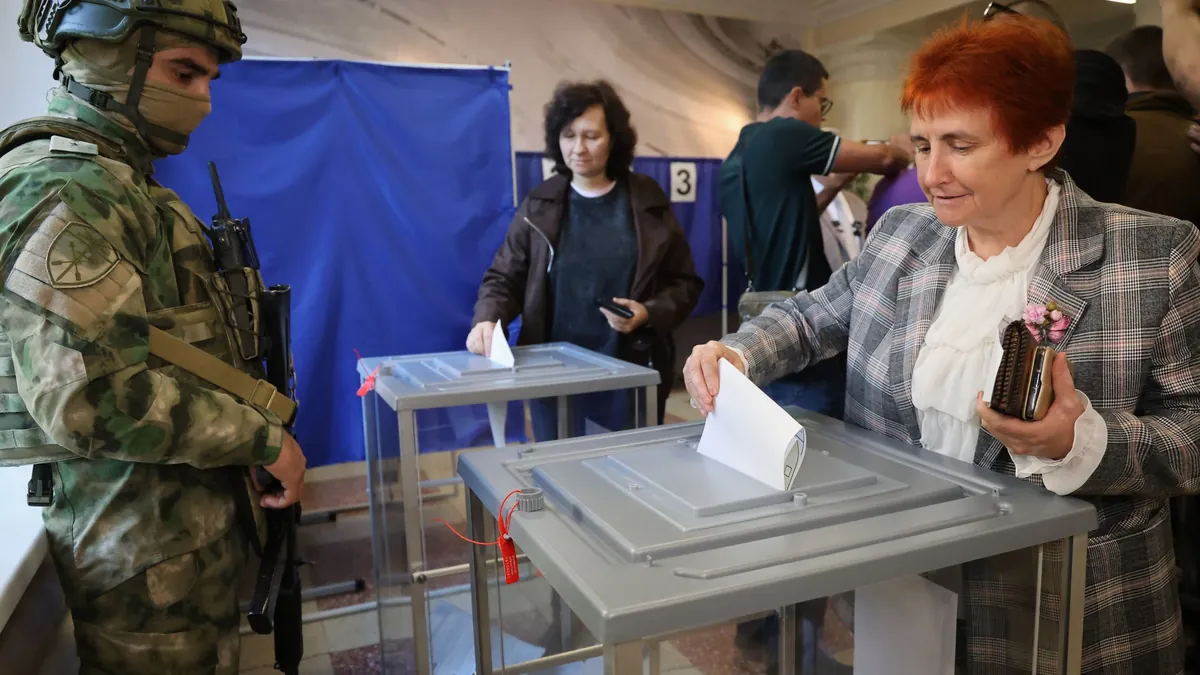
Despite Ukraine’s protests, the election will be held for the first time in the Russian-controlled parts of the annexed Ukrainian regions of Luhansk, Donetsk, Zaporizhia and Kherson. Voting will also take place again on the Black Sea peninsula of Crimea, which was annexed in 2014. The Ukrainian leadership spoke of voting with assault rifles at the ready and does not want to recognize the official result in the occupied territories.
Other critics also point out that there can be no question of a fair and democratic election. The ten parties on the ballot are all considered to be close to the Kremlin and support the war of aggression ordered by Putin in 2022. Opposition forces advocating a peace agreement were not allowed to vote. Independent election observers also reported various attempts at manipulation and other violations of the rules – or were immediately arrested.
Higher voter turnout expected
The first results on the future composition of Parliament are to be announced after the last polling stations in Kaliningrad (formerly Königsberg) have closed at 8:00 p.m. German time. Already at the end of the second day of voting, the central election commission indicated Moscow a higher participation than five years ago. At that time, Putin’s party was awarded 324 of the 450 seats in the State Duma.
According to the electoral commission in Moscow, turnout on Sunday morning was almost 45 percent. For comparison: in 2021, according to official information, 51.7 percent of those eligible to vote had ticked their box by the end of voting.
Election observers report striking values
Independent observers reported noticeable fluctuations in the published data – especially in the southern Russian Caucasus regions of Dagestan and Kabardino-Balkaria, but also in the central Russian Ivanov region. According to media reports, some of them were prevented from monitoring the electoral process. Observers from the anti-war party Yabloko, which was excluded from the election, were not allowed into polling stations in Perm and St. Petersburg or even arrested by the police.
In St. Petersburg, election records did not match the number of voters counted when they cast their votes. Several polling stations also filmed how pre-filled ballot papers were thrown into the ballot box. The BBC’s Russian-language service reported that civil servants in provincial regions had been pressured to vote.
Soldiers monitor ballot papers being thrown in
The head of the Central Election Commission promised to investigate the allegations. According to her, the election went well overall. Although there were cyber attacks on the electronic voting system in Moscow, they were repelled. According to Russian authorities, the fact that armed soldiers monitored the casting of ballot papers in the occupied Donetsk region served to protect voters.
