
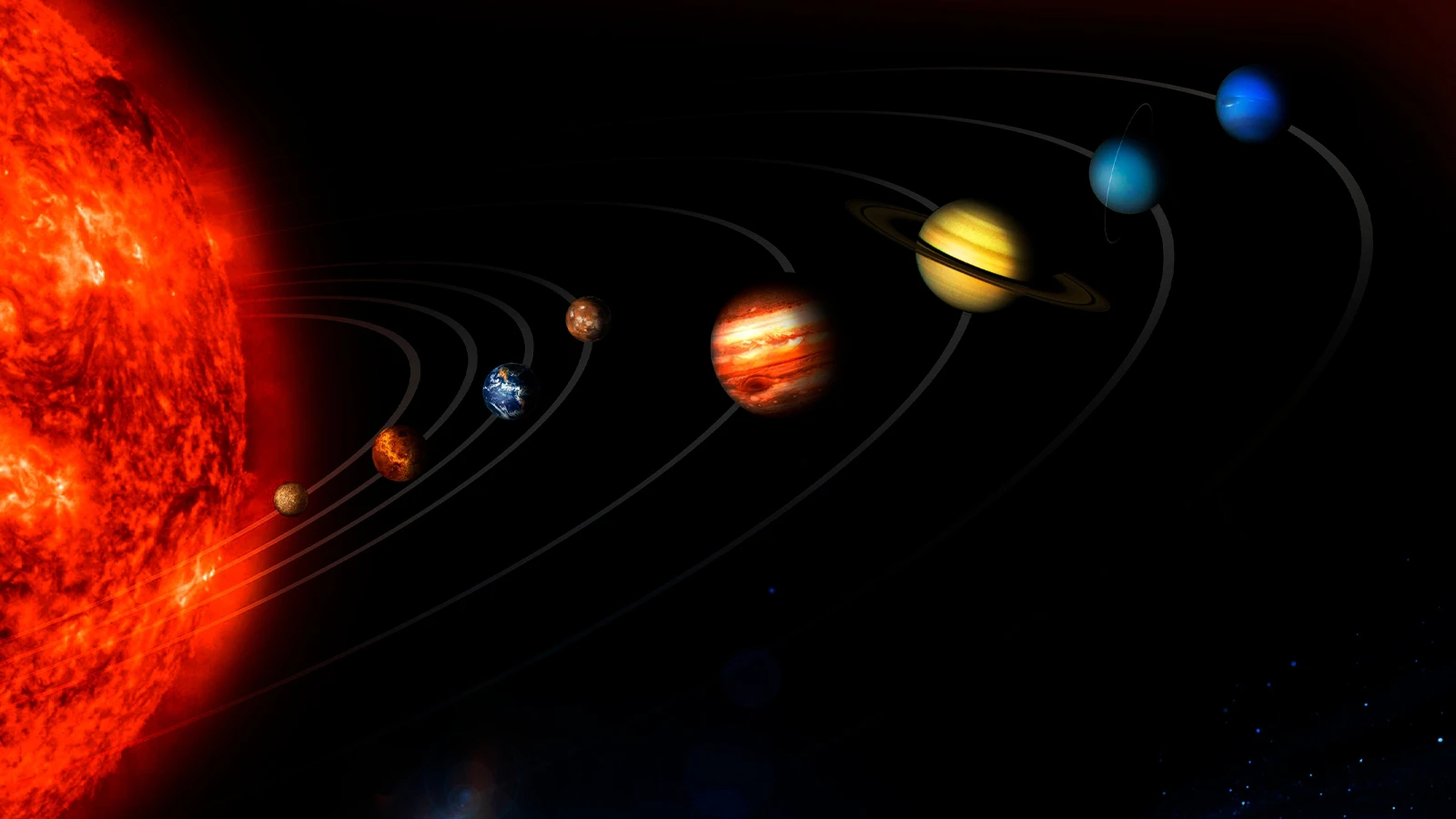
Astronomers have long predicted that our solar system has lost at least one planet in its 4.5 billion-year history. A new study published by Matthew Clement from Johns Hopkins University and his team in the respected astronomy journal Icarus has revealed very important evidence about this mysterious past. According to scientists, the moons of Jupiter and Uranus owe their survival to this mysterious “fifth giant planet”, which disappeared at that time.
CHAOTIC MIGRATION PERIOD OF PLANETS
The findings show that in the early stages of the solar system, 3 to 4 billion years ago, giant planets orbited much closer to the Sun and to each other than today. Over time, Jupiter, Saturn, Uranus and Neptune interacted with each other’s gravity and shifted towards their current positions. But this gravitational “jostle” posed a deadly threat to the planets’ moons.
THE CHANCE OF SURVIVAL WAS 1 PERCENT
According to the information provided by Space; Computer simulations carried out by the researchers showed that the chances of the moons of Jupiter and Uranus surviving this turbulent period are extremely low under normal conditions. In the tests carried out; Jupiter’s moons survived in only 15 percent of the simulations, and Uranus’ moons in only 9 percent. The probability of both systems surviving at the same time without damage was around 1 percent.
“THE FIFTH GIANT” WHO SAVED THE LIFE OF SATELLITES
When experts simulated 122 different scenarios of the early outer Solar system thousands of times, they found only two successful models in which the moons of both Jupiter and Uranus survived to the present day without being destroyed. What these successful scenarios had in common was surprising: The presence of a fifth giant planet in the system at the beginning.
According to modeling, Jupiter’s migration during the system’s first billion years brought it face-to-face with the unlucky ice giant. The gravitational push created by Jupiter’s enormous mass has thrown this mysterious fifth planet out of the Solar system, turning it into a “lost world” that will drift alone in interstellar space.
A COSMIC SACRIFICE
The existence of the lost ice giant, which was expelled from the system, completely changed the migration paths and speeds of the other four giant planets. This shortened the duration of the planets’ gravitational battle, preventing Uranus from making catastrophic encounters with other giant worlds.
THE GREAT SHAKE AND ITS LEGACY THAT LEFT TODAY
Although Jupiter experienced some tremors in the orbit of its satellites during this great rapprochement, it did not suffer a big enough impact to cause the satellites to crash into each other or be thrown into space. Over time, the satellites settled back into their stable orbits.
Scientists state that the solar system reached its current delicate balance as a result of a completely random and very unlikely process of cosmic instability. The findings prove that behind our order in the universe is the dramatic story of a lost planet that is no longer among us.
