
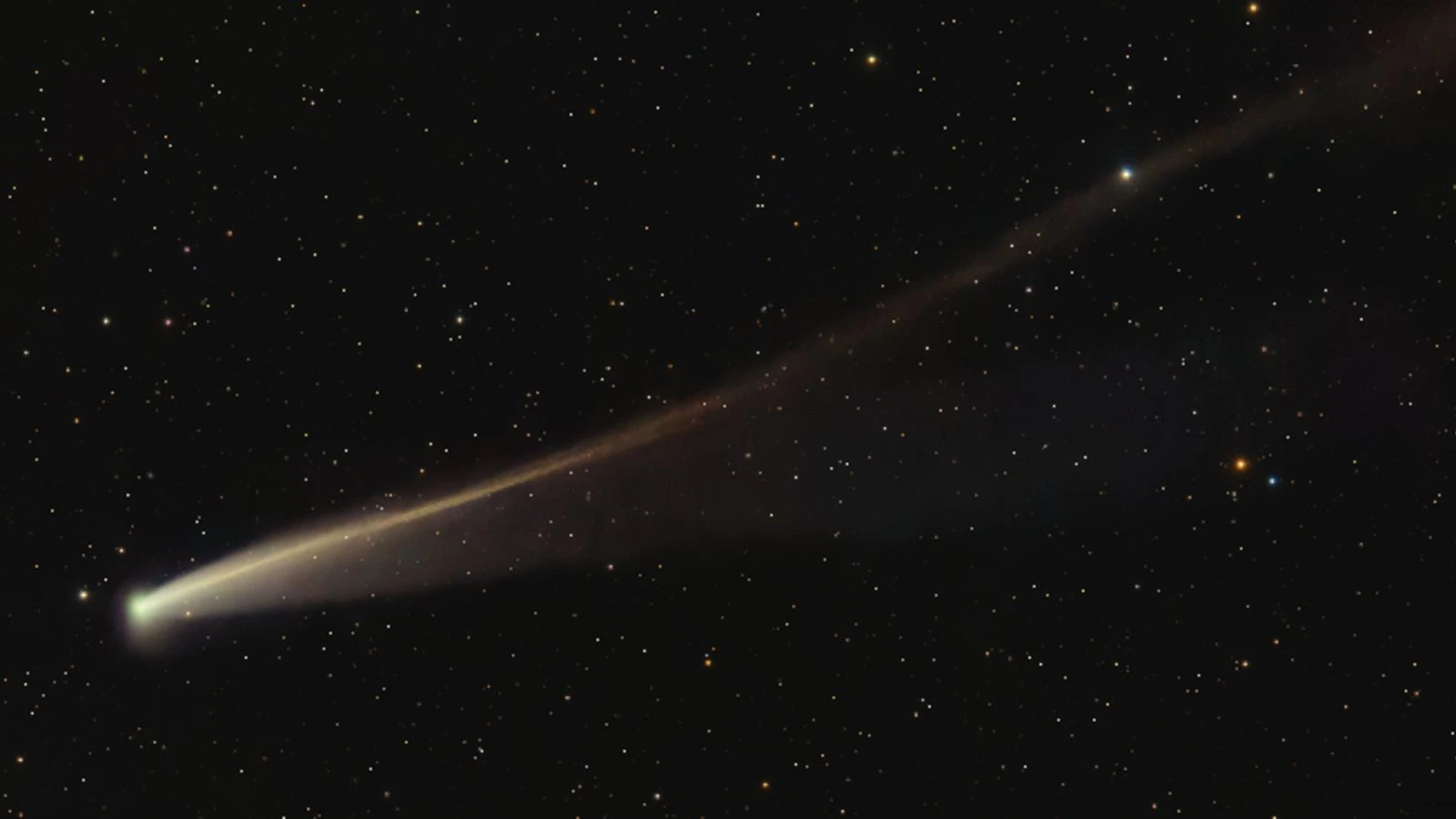
Astronomers have detected that a frozen celestial body called ‘centaur’ orbiting the Sun between Jupiter and Neptune has turned into a comet. The process of the object named ‘450P/LONEOS’, discovered in 2004, evolving into an active comet as it approached the Sun was monitored. Orbit analysis showed that 450P changed in 1992. The object, which passed approximately 4.6 million kilometers close to Saturn at that time, was pushed to a route closer to the Sun by the gravitational effect of the planet. This convergence narrowed the object’s orbit and moved its closest position to the Sun outside the orbit of Jupiter.
The frozen layers on the surface of the celestial body, which was exposed to more heat as it moved towards the Sun, began to warm up. In the examinations carried out with the Gemini North telescope in Hawaii, it was determined that a cloud of gas and dust formed around the core of the celestial body. Data from the James Webb Space Telescope revealed carbon dioxide gas and crystallized ice particles in this cloud. Astronomers have determined that carbon dioxide directly triggers outgassing and comet-like activity at this distance, where there is no water vapor.
NEW GRAVITATION EFFECT COULD TURN 450P INTO A COMET
Frozen celestial bodies located outside the Solar System generally have an amorphous and porous ice structure dating back 4.5 billion years. The gases trapped in these pores are released as the ice crystallizes under the influence of the Sun’s heat, throwing the dust particles on the surface into space with it.
By monitoring this change of 450P, scientists have the opportunity to examine how primitive Solar System materials transform in response to heat and how comets become active at their earliest stages. Researchers predict that the new gravitational effect of the planets may turn 450P into a Jupiter family comet.
