
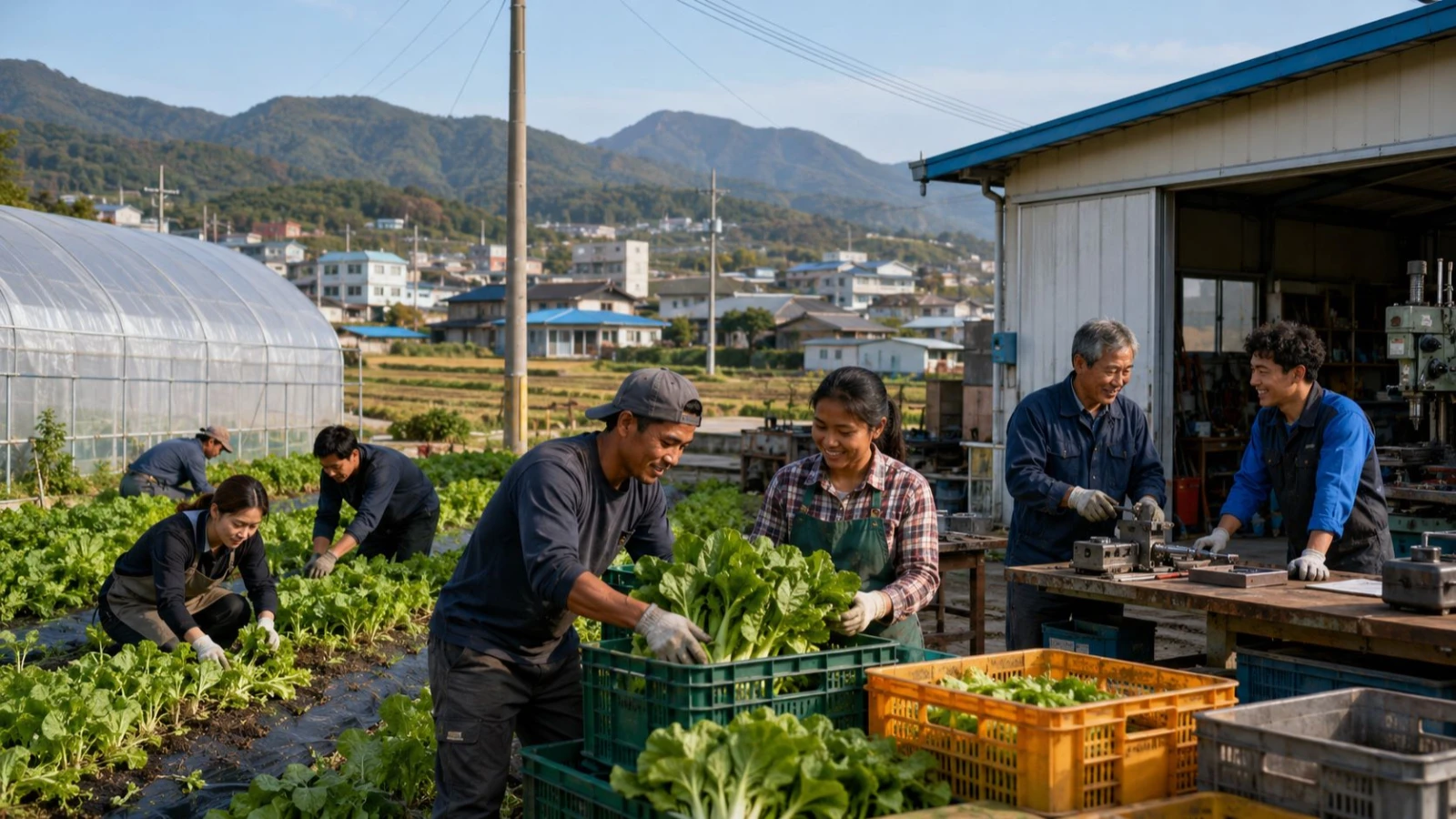
The Ministry of Justice announced the launch of a new application called “Special Employment Exemption for Regional Revitalization” on May 11. This regulation, which aims to alleviate personnel shortages and stimulate the local economy, will come into force on May 18.
The new system allows small tradesmen and agricultural companies in low-population areas to employ foreigners with F-2-R visas if they meet certain conditions.
Until now, the hiring of foreigners with this visa was only allowed in workplaces that already had Korean employees. However, it was stated that benefiting from this system was limited because it was extremely difficult to find local personnel in regions experiencing population decline.
In response, the Department’s Office of Immigration and Alien Policy will allow eligible employers to hire foreigners with such visas, even if they do not have Korean employees on their payroll.
The application will be valid in 89 regions experiencing population loss, such as Muju-gun in Jeollabuk-do province and Hoengseong-gun in Gangwon-do province. Sectors that could benefit from the regulation include manufacturing, retail and wholesale trade, restaurant management and agricultural companies.
In order to ensure a stable working environment, comprehensive criteria will be applied, such as being in operation for at least three years and annual sales volume over 100 million won.
“We hope that this special exemption will help solve one of the biggest challenges of local small tradesmen: labor shortage,” said Justice Minister Chung Sung-ho.
Chung also said, “We will continue to implement migration policies that reflect demands from the field in order to contribute to the revival of the regional economy and the balanced development of the country.”
What is the F-2-R visa and who is it issued to?
F-2-R visa is a regional residence/work-oriented foreign residence visa issued by South Korea to revitalize regions with declining population. In practice, it is used as a “region-specific residence visa”, that is, a region-specific residence visa.
The purpose of this visa is to enable foreigners to live and work or start a business in cities, towns or regions that are experiencing population loss, as determined by South Korea. So it is not a classic tourist or short-term work visa; a tool for regional development and closing the workforce gap.
It is generally given to the following people:
1. Foreigners who have studied in South Korea or have certain qualifications
The applicant is generally expected to have completed at least an associate’s/bachelor’s level education in Korea or meet certain income/qualification requirements. Some local governments may also impose their own additional conditions.
2. People who will work in regions experiencing population loss
The F-2-R visa is subject to the condition of living and working in “population decline areas” determined by South Korea. These people are generally employed in manufacturing, agriculture, service, restaurant, hospitality or local need industries.
3. Foreigners who receive advice/approval from the local government
In this visa, not only the central government but also the local government is important. In most cases the applicant will need to seek advice from the relevant municipality/local authority. Quota and eligibility criteria may vary by region.
4. People who meet the Korean language requirement
Korean proficiency may also be required for the F-2-R. Some programs require TOPIK or Social Integration Program level; For example, in Busan’s 2025 announcement, it was stated that the Korean language requirement for F-2-R was increased from TOPIK 3 to TOPIK 4.
5. Those who undertake to live in that region for a certain period of time
The logic of the visa is based on “stay in this region and contribute to the local economy”. Therefore, the person usually has to live and work in the designated area. In some sources, it is stated that this obligation is implemented as a long-term regional residence/work condition, for example up to 5 years.
Previously, in order to employ foreigners with F-2-R visas, there had to be a Korean employee in the workplace. With the new exemption, some small businesses and agricultural companies in areas experiencing population loss will be able to hire F-2-R holders even if they have no Korean employees on their payroll.
