
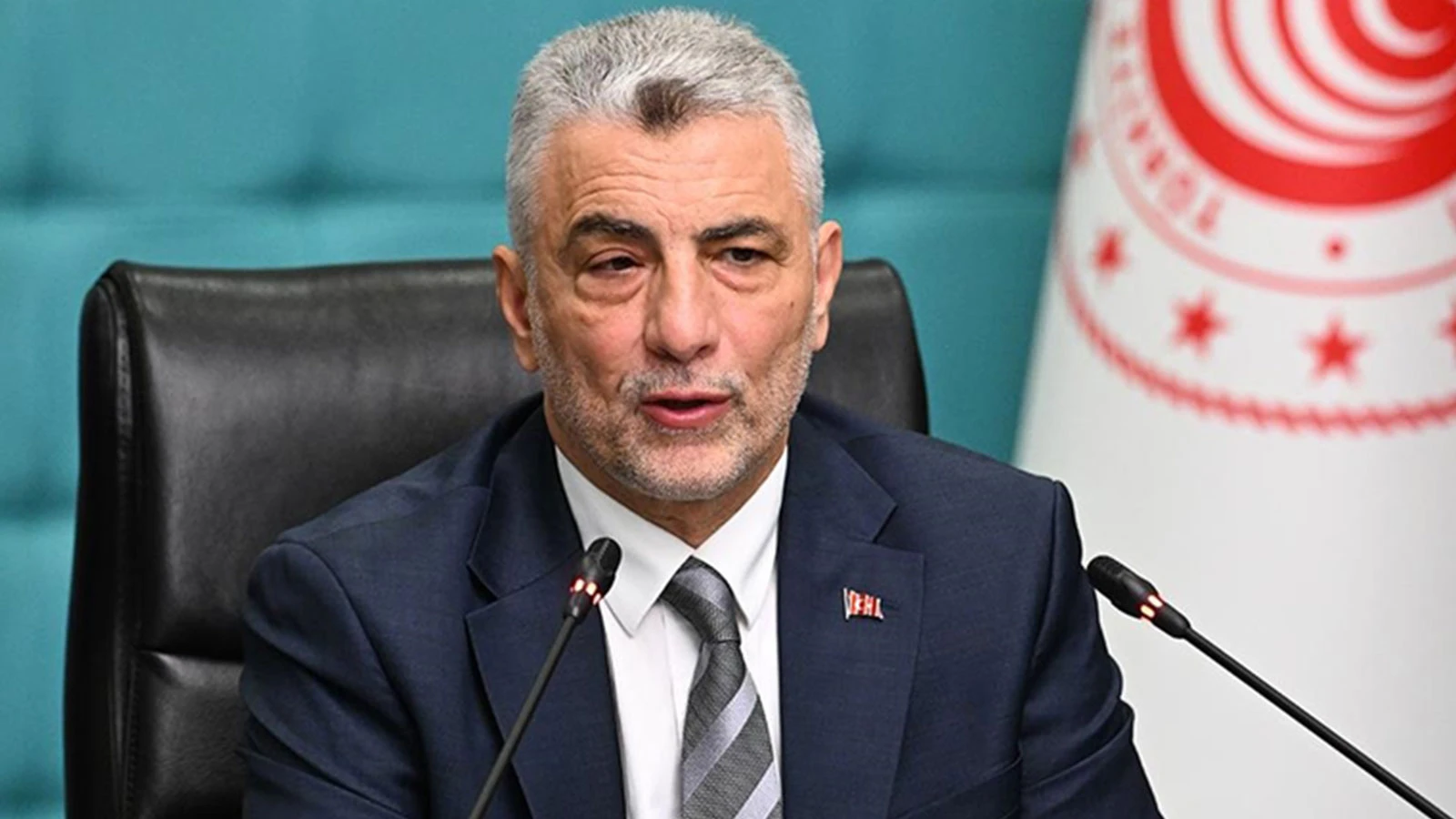
Minister of Commerce Ömer Bolat reported that the e-commerce volume in Türkiye will increase by 52.2 percent on an annual basis in 2025, reaching 4 trillion 567 billion lira.
Minister Bolat attended the “E-Commerce Outlook Report 2025 Promotion Meeting in Türkiye” held at the Ministry of Commerce Conference Hall.
In his speech here, Bolat said that 27 agreements were signed with the Belgian Economic Mission delegation that visited Türkiye under the chairmanship of Queen Mathilde, and that agreements will be signed with more than 30 Turkish companies in the defense industry and technology.
Referring to the developments in the e-commerce sector, Bolat stated that they continue their work to support both e-commerce and e-export, and that 11,500 people made e-exports of more than 10 thousand dollars last year.
Pointing to the e-commerce and e-export programs organized by the Ministry, Bolat noted that international visitors participated in these programs and that the Global e-Commerce Summit will be held in Istanbul on September 3-5 this year.
Stating that 5.1 billion dollars of foreign exchange earnings were achieved in e-Export last year, Bolat continued as follows:
“The e-commerce volume in our country reached 4 trillion 567 billion liras with an increase of 52.2 percent last year. This is a very important figure. It comes to approximately 115.5 billion dollars and represents a 29 percent increase in dollar terms. The share of e-commerce in total trade is around 19.5 percent. This means that total trade is 23 trillion liras. Retail e-commerce will increase in 2025 compared to the previous year “The compound annual growth rate increased by 51.8 percent to 2 trillion 457 billion liras in 2019-2025. The e-commerce sector increased by 382 percent in dollar terms, from 24 billion dollars in 2019 to 115.5 billion dollars in 6 years.”
“75 PERCENT OF THOSE WHO DO E-COMMERCE ARE INDIVIDUAL BUSINESSES”
Bolat stated that in 2025, there will be approximately 6 billion transactions in general e-commerce and approximately 2 billion transactions in retail e-commerce.
Pointing out that tradesmen are now using digital opportunities in their sales, Bolat said, “75 percent of those doing e-commerce are sole proprietorships, 21 percent are limited companies, 4 percent are joint stock companies. This means that there are people doing e-commerce with individual and corporate works of different scales.” he said.
Bolat stated that the share of e-commerce in national income is 6.9 percent.
In this context, Bolat stated that 634 thousand businesses did e-commerce last year and emphasized that this figure will be 559 thousand in 2023 and 600 thousand in 2024.
Bolat also gave information about the sector distribution of e-commerce companies and said:
“20.3 percent of e-commerce in 2025 took place in the food sector. 128 thousand businesses are engaged in e-commerce in the food sector. Approximately 14 percent, that is, 87 thousand 500 businesses, are engaged in the clothing, shoes and accessories sector. A wide range of clothing, shoe and accessory companies, from boutique businesses to large retail chains, are in the e-commerce arena. The third place is the electronics sector. It also gets a share of 12 percent, 75 percent. “1,500 businesses are engaged in e-commerce in the electronic field.”
“56 PERCENT OF E-COMMERCE EXPENDITURES ARE MADE BY WOMEN”
Emphasizing that in terms of expenditure distribution, the sector with the highest e-commerce volume is clothing, shoes and accessories, Bolat stated that this sector ranks first with 428 billion liras.
Bolat said that the electronics sector follows with 304 billion liras, and the airline industry follows the clothing, shoes and accessories sector with 285 billion liras.
Sharing data on the gender distribution of e-Commerce expenditures, Bolat said, “56 percent of e-Commerce expenditures are made by women on a volume basis. When we look at the quantity, 75 percent of the expenditures are made by women and 25 percent by men. The group with the highest consumption tendency is between the ages of 25 and 34.” he said.
Bolat stated that 2/3 of the payments are made with card systems, and this method is followed by money order/EFT and payment at the door, respectively.
Stating that 64 percent of payments made by card in e-commerce are made with the “3D Secure” security verification system, Bolat informed that in the field of fast commerce, which envisages delivery within hours and minutes, mainly in metropolitan areas, a sales volume of 388 billion lira was reached with a growth of 55.6 percent last year.
Bolat pointed out that this area is also important in terms of employment and said, “The share of fast commerce in e-commerce increased from 1.6 percent in 2019 to 8.5 percent in 2025. The most important area in fast commerce is food expenditures with 70 percent. Food and supermarkets follow with 30 percent.” made his assessment.
“AVERAGE CARGO DELIVERY TIME HAS DECREASED BY 4 HOURS IN THE LAST 2 YEARS”
Emphasizing that e-commerce is growing rapidly in second-hand vehicle sales, Bolat also said the following about e-commerce deliveries:
“The average cargo delivery time in e-Commerce deliveries has decreased by 4 hours in the last 2 years. While cargo arrived in 46 hours 2 years ago, it now takes 42.2 hours. 53 percent of the orders are delivered within 24-48 hours. Only 17 percent of the shipments in e-Commerce are urban.”
Bolat reported that a volume of approximately 22 billion lira was generated in 23 million 600 thousand transactions in customer-to-customer second-hand sales last year.
E-COMMERCE ERA WITH ARTIFICIAL INTELLIGENCE
Stating that 75 percent of e-commerce businesses use artificial intelligence, Bolat stated that, as the Ministry, they will continue to support e-commerce and e-export and work for trade mechanisms in line with market conditions.
Bolat stated that they will expand the base of women and young entrepreneurs and made the following evaluation:
“We will continue to support e-Export businesses with special incentives and enable them to open up to world markets. There are some critical developments here. A new system will come into force in the European Union in July. Since we have the Customs Union, we express these in our negotiations with the European Commission General Directorate of Taxation and Customs Union. We also explained these to the Belgian guest delegation, ministers and deputy prime ministers yesterday. We also told the European Union commissioners when we went to the European Union commissioners a month ago. Turkey is a very important market for Turkey. “It is one of the leading countries in the world in e-commerce and we will continue our work in the Gulf, Middle East and Africa on the development of e-export channels.”
EMPHASIS ON GROWTH IN E-COMMERCE FROM SECTOR REPRESENTATIVES
Adem Başar, General Director of Domestic Trade of the Ministry, said that e-commerce has become one of the fundamental points of life and creates new opportunities for both operators and consumers, but also poses risks.
Bendevi Palandöken, Chairman of the Confederation of Turkish Tradesmen and Craftsmen (TESK), also stated that e-commerce is developing rapidly and that e-commerce contributes to foreign exchange earnings.
Pointing out that developments such as artificial intelligence and e-commerce are rapidly transforming sectors, Palandöken called on consumers to shop from tradesmen during the upcoming Eid al-Adha.
Faik Yavuz, Treasurer Member of the Board of Directors of the Union of Chambers and Commodity Exchanges of Turkey (TOBB), pointed out that e-commerce is gaining more and more importance both in the world and in Türkiye, and stated that they see e-commerce as important for more enterprises from Anatolia to open up to the world.
Yavuz explained that there are problems that need to be solved in fast-growing e-commerce and that the public and private sectors can solve these problems together.
TOBB Türkiye e-Commerce Council President Ozan Acar also stated that e-commerce contributes to the market access of businesses in Anatolia and to the expansion of women entrepreneurs and new businesses to the world. Emphasizing that Türkiye is not only a strong manufacturing industry country, but also has strong platforms, advanced logistics infrastructure and human resources, Acar said, “Türkiye has the opportunity to become the digital commercial center of Europe, the Middle East, Central Asia and Africa.” he said.
Hakan Çevikoğlu, President of the Electronic Commerce Operators Association (ETİD), said that e-commerce has transformed many areas from production to logistics, from financial services to technology. Stating that trade balances between East and West have been re-established, Çevikoğlu stated that they are working to ensure that the sector grows in a healthy, competitive and sustainable manner.
After the speeches, Minister Bolat was presented with a plaque by industry representatives.
