
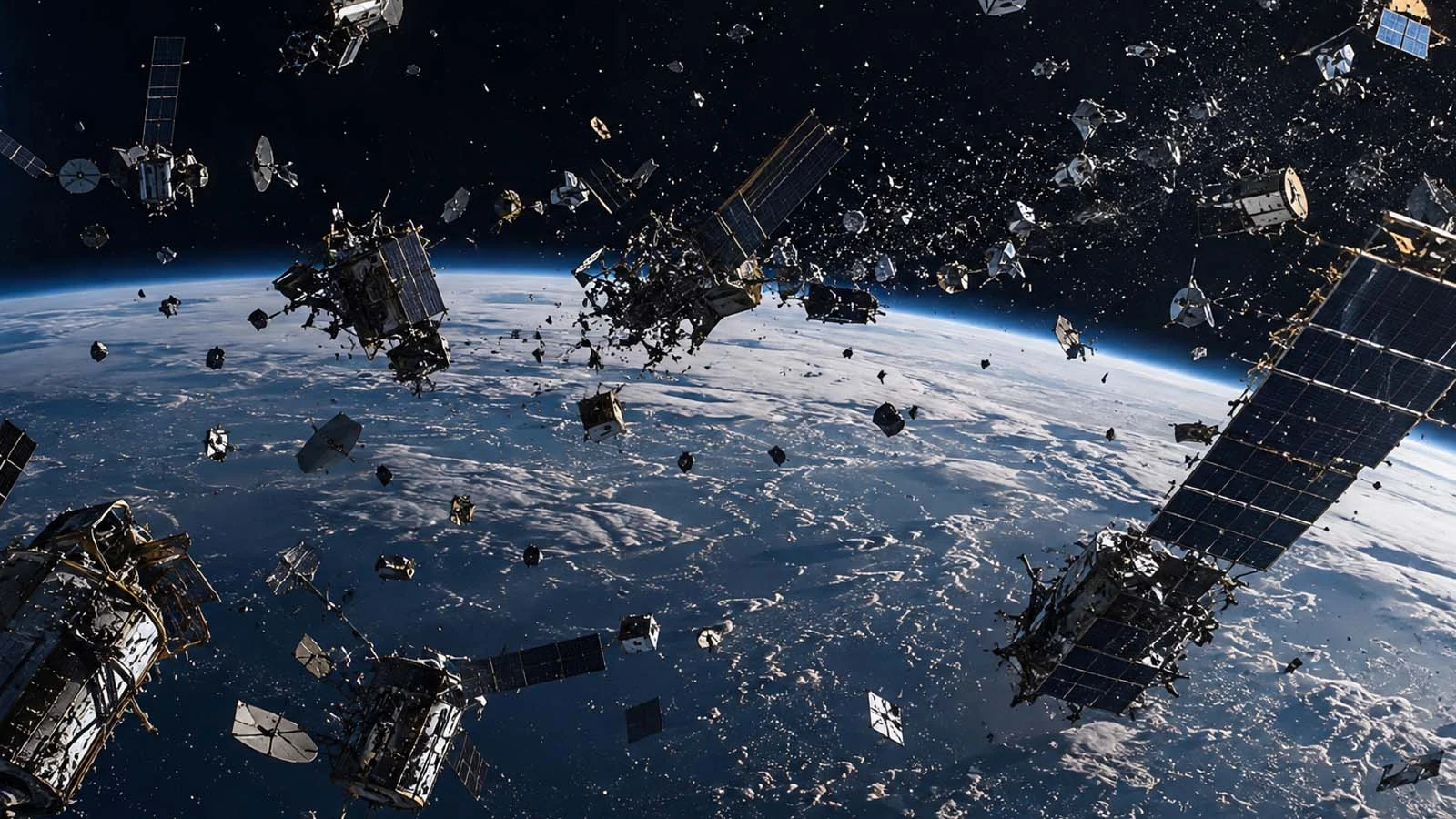
While satellite traffic around the Earth is increasing at an unprecedented rate in history, scientists’ warnings about space debris are also getting harsher.
According to the data of the European Space Agency (ESA), approximately 40 thousand objects are being tracked in orbit and approximately 11 thousand of them are active satellites. However, the actual number of pieces of space debris that are larger than 1 centimeter in diameter and can seriously damage a spacecraft is estimated to be more than 1.2 million.
A COLLISION CAN CREATE THOUSANDS OF NEW PARTS
“Kessler Syndrome” is at the center of the scenario that scientists fear.
Two satellites colliding with each other can break into thousands of pieces. These pieces, which continue to orbit at high speed, can hit other satellites and create new debris. Thus, after the first accident, a self-reinforcing chain collision process can begin.
ESA warns that the growth of this uncontrolled chain reaction could render certain orbits unusable.
Moreover, there is no need for a large piece. According to ESA, a piece of approximately 10 centimeters of space debris has the energy to completely disintegrate a typical satellite, while a piece of 1 centimeter has the energy to disable a spacecraft.
CAN THE INTERNET BE DISCONTINUED?
In such a scenario, one of the most direct risks is communication services provided via satellite.
Damage to satellite networks operating in low Earth orbit can cause connection losses, especially in regions dependent on satellite internet. Maritime, aviation, military communications and communications systems used in remote areas may also be affected.
However, this does not mean “cutting off the entire internet in the world”. A significant portion of global internet traffic is carried via terrestrial and submarine fiber optic cables.
On the other hand, disruption of the positioning and precise timing services provided by satellites can have much wider consequences.
IT MAY AFFECT FROM MOBILE PHONES TO BANKING
One of the invisible dependencies of modern infrastructure is precise time signals from GPS and other satellite navigation systems.
These signals are used in many areas, from synchronizing telecommunications systems to timestamping financial transactions, according to the US National Institute of Standards and Technology (NIST).
Synchronization of base stations in mobile phone networks also requires precise timing. NIST points out that GPS signals play a critical role in many systems such as mobile phone communications, banking transactions and transportation.
For this reason, in case of large-scale and long-term loss of satellite service;
interruptions in satellite internet,
Disruptions in GPS and navigation,
problems in mobile communication networks,
disruptions in air and sea transportation,
Problems in time synchronization of financial systems
It is possible to live.
SO WILL THE POWER BE CUT OFF?
The most striking question is electricity grids.
In modern electrical systems, some monitoring and control infrastructures use precise time information from GPS. NIST notes that the electrical, telecommunications and financial industries depend on GPS timing to varying degrees.
However, it cannot be said that a failure in the satellite system will automatically cause a worldwide power outage.
In NIST’s assessment of the electricity sector, experts reported that even in a hypothetical situation where GPS and other global satellite navigation systems were completely lost for 30 days, experts did not expect a sudden, nationwide outage in the electrical grid. One important reason for this is that many essential devices in the electrical grid do not require direct GPS synchronization to operate.
However, loss of precise timing can make it difficult to monitor the network and detect faults quickly. Therefore, a long-term satellite crisis combined with other infrastructure problems may also increase the risk for energy systems.
DOMINO EFFECT CONCERN IN SPACE
The real concern is not the loss of a single satellite, but the collisions triggering each other.
As the number of satellites and the amount of space debris increases, evasive maneuvers become more difficult. It is feared that if an uncontrollable chain collision process begins, some orbits may become dangerous for new satellites for years, or even much longer.
ESA also points out that to prevent the growth of Kessler Syndrome, simply reducing the production of new space debris may not be enough, and actively removing existing debris from orbit is also necessary.
In short, the warning of the scientific world is not a “the internet and electricity will be cut off tomorrow” scenario. However, if the rapid increase in the number of satellites cannot be controlled and chain collisions begin, serious and long-term problems may arise in the communication, navigation and precise timing infrastructure of the modern world.
