
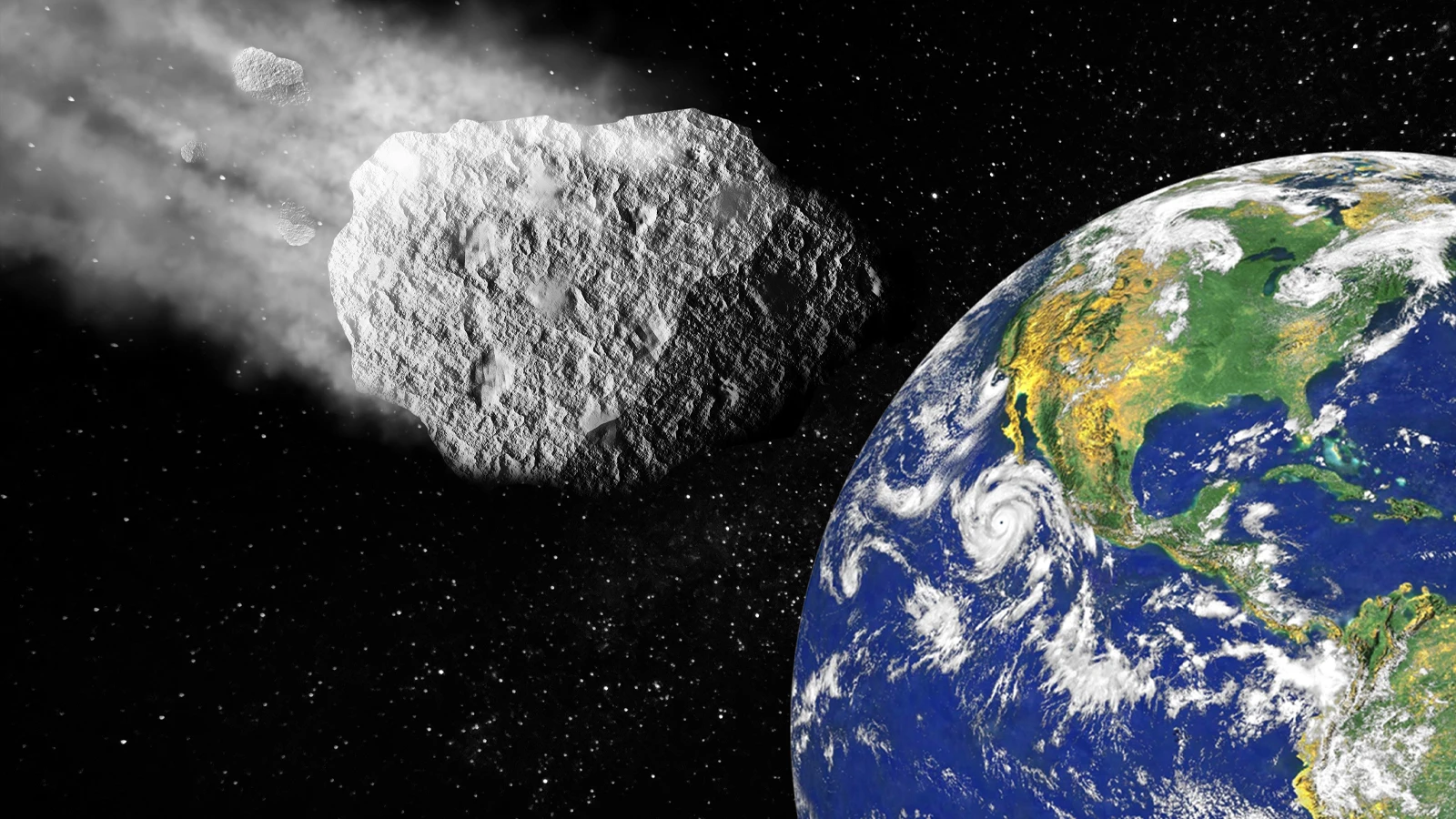
Human history is preparing to witness a first in space observations. The giant meteorite called “99942 Apophis” will approach the Earth at a distance of approximately 31 thousand 600 kilometers. This distance represents a point even closer than the location of the communication satellites operating in orbit. Richard Binzel, a planetary scientist from the Massachusetts Institute of Technology (MIT), emphasized that this is the first time that a meteorite’s approach to Earth can be predicted with such accuracy.
IT WILL SHINE IN THE SKY FOR HOURS
According to the information provided by experts, Apophis will not disappear as quickly as known comets. Instead, it will appear as a bright dot moving slowly across the sky for hours. Visibility maps shared at a scientific workshop held in Italy show that approximately 7.6 billion people can witness this moment if the weather conditions are suitable.
The meteorite, which will follow a route starting from the skies of Australia and extending to the North Atlantic, can be followed with the naked eye for approximately seven hours. The giant rock, which is expected to reach its brightest moment in the skies of Cameroon; It can be easily monitored from a huge geography covering Africa, Asia, the east of South America and part of Europe.
THERE IS NO DANGER TO THE WORLD
When Apophis was first discovered in 2004, the probability of hitting the Earth in 2029 was calculated as 1 in 37, causing global concern. However, NASA data, based on precise tracking over more than twenty years, has conclusively revealed that the asteroid poses no danger to our planet for at least the next century.
Scientists consider this close flyby as a great opportunity to directly study the effects of Earth’s gravitational pull on an asteroid. It is predicted that the gravitational force exerted by the Earth during the transition will throw the meteorite into a brand new orbit around the Sun and, in the meantime, may trigger landslides on the surface of Apophis. Observatories around the world have already begun preparations to record this rare space event.
