
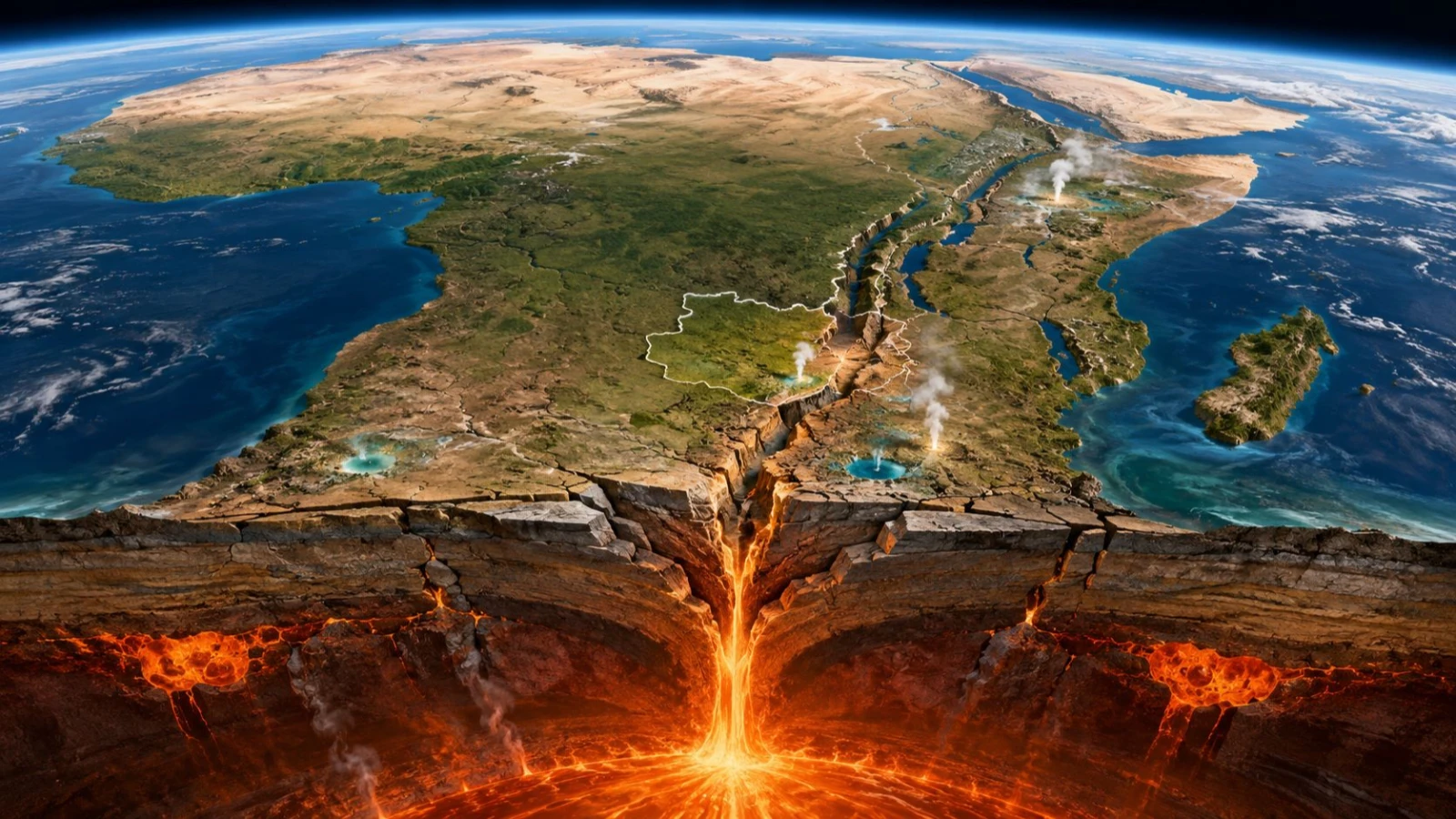
According to the research, this region is not just a depression on the surface. The fracture in the Earth’s crust may extend into the mantle layer deep within the Earth. This means that a new tectonic boundary may form on the African continent within millions of years.
Gases from geothermal sources were examined
The international research team took gas samples from hot springs and geothermal wells in Zambia. Particularly helium isotopes were examined in these samples.
Helium isotopes serve as a geological “fingerprint” for scientists. Because the chemical signs of gases coming from the earth’s crust and gases coming from the mantle deep inside the Earth are different.
Researchers found traces of helium, thought to come from the mantle, in samples from the Kafue region. This shows that there is an outflow of gas from the depths of the earth to the surface.
Mike Daly, lead author of the study from Oxford University, stated that helium isotopes were detected in thermal springs along the Kafue rift, indicating a direct connection with the Earth’s mantle, located 40 to 160 kilometers below the surface.
Why is this important?
The outer layer of the Earth consists of tectonic plates. These plates move very slowly; Sometimes they collide with each other, sometimes they move away from each other. In places where the plates separate from each other, large fracture systems, valleys and even new seas can form over time.
The best-known example of this process on the African continent is the East African Rift System. The Great Rift Valley in Kenya is also part of this system. However, new research shows that a similar process of fragmentation may have begun not only in the east but also in the southwest of Africa.
The Kafue rift is part of an approximately 2,500 kilometer fracture line stretching from Tanzania to Namibia. Scientists have long suspected that this region might be active. However, new helium data was one of the most important evidence that strengthened this suspicion.
Will Africa really split in two?
The research does not mean that Africa will divide anytime soon. Such geological processes proceed very slowly, incomparably with human lifespan. It can take millions of years for continents to break up.
However, the study shows that the Kafue region has the potential to turn into a new plate boundary in the future. In other words, this fracture system detected in Zambia today may be an early sign of a major geological process that could change the geography of Africa in the very long term.
Researchers also detected carbon dioxide levels in the region consistent with fluids coming from the mantle. This suggests that the Kafue rift is in an active fracturing process in the early stages and may be linked to volcanic activity in the future.
Economic opportunities may also arise
The significance of the discovery is not limited to geology. Early-stage rift zones may also be valuable in terms of geothermal energy. There is also the possibility of finding gases with high economic value such as helium and hydrogen in such areas.
For this reason, the Kafue rift may become a remarkable region in terms of energy and natural resource research for Zambia and its surroundings in the future.
Scientists are cautious
Despite this, researchers avoid speaking for sure. Because the study is based on samples taken from only a certain part of a large system that is thousands of kilometers long.
Scientists will now try to understand, through more comprehensive studies, how active this fracture line is and whether it can truly form a new tectonic boundary.
In short, the discovery in Zambia opens an important window into the geological future of the African continent. This process, which is only noticed today with gases coming from hot water sources, may have consequences that can change the map of the continent millions of years later.
