

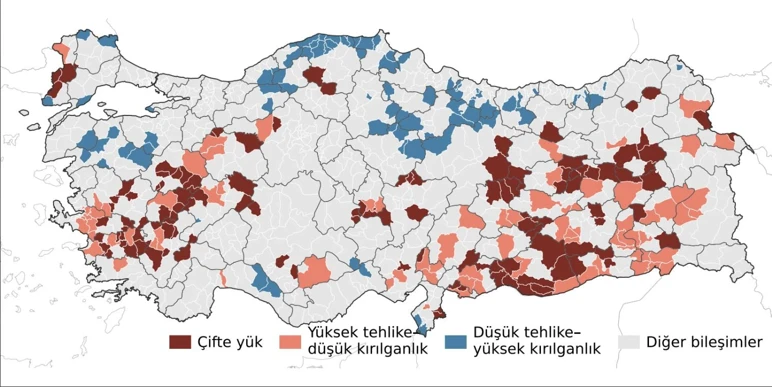
This time, the risk posed by extreme heat in Türkiye was mapped not with the degrees seen on the thermometer, but with people’s opportunities to protect themselves from the heat. According to the research covering 973 districts, high temperature danger and low socioeconomic adaptation capacity were seen simultaneously in 120 districts. In other words, it was understood that approximately one in every eight districts in Türkiye was under “double risk”. In the table pointed out by the research, when the temperatures in the summer of 2026 and indicators of income distribution are added, it is noted that extreme heat is increasingly turning into an issue of social inequality.
44 YEARS OF DATA WERE EXAMINED
Assoc. Prof. published in the journal Climatic Change. Dr. In the research conducted by Doğukan Doğu Yavaşlı, the 44-year period between 1980 and 2024 was examined. Temperature conditions in 973 districts of Türkiye; It was evaluated on seven separate indicators, including the number, duration and severity of heat waves, as well as the hottest day, the number of tropical nights and the rate of increase in temperatures. These data were then compared with TURKSTAT’s income indicators. In the research, more emphasis was given to the lowest income group. The study emphasized that low-income households are more vulnerable to extreme heat in many areas, from access to air conditioning to housing insulation, from working conditions to access to healthcare.
THE CENTER OF THE RISK IS THE SOUTHEAST
In the map resulting from the research, the largest risk cluster stood out as Southeastern Anatolia. According to the results, in addition to Şanlıurfa and Mardin, Batman and some parts of Diyarbakır, Siirt and Şırnak were among the areas where high temperatures and low adaptation capacity were observed simultaneously. While the second biggest risk area stands out as the Çukurova Plain in Adana and its surroundings, one of the remarkable results of the research is that the risk is not limited to Türkiye’s traditionally hottest regions. It was determined that temperature and economic fragility intersect in the high parts of Aydın, Denizli, Kütahya, Uşak, Manisa and Afyonkarahisar and in the low valleys of Malatya, Elazığ and Tunceli.
THE SAME TEMPERATURE IS NOT THE SAME RISK
One of the remarkable results of the research is that the same temperature does not have the same effect in every region. The risk faced by a household that has access to air conditioning in Antalya at 42 degrees is not the same as that of a person working outdoors in the Harran Plain. The use of air conditioning, insulation of homes, working conditions and access to health services are among the main factors that determine the impact of extreme heat. In the research, meteorological data for the summer of 2026 also revealed the extent of the heat danger.
TROPICAL NIGHTS INCREASED
According to the research, one of the critical factors that increases the health burden caused by heat is “tropical nights.” Nights when the lowest temperature does not fall below 25 degrees pose a significant risk, especially on the Adana-Mersin-Hatay line.nor. While the body, which is exposed to temperatures above 40 degrees during the day, needs to cool down and recover at night, this opportunity decreases when the temperature remains above 25 degrees. For this reason, it is stated that evaluations that only look at daytime temperature may underestimate the real heat load, especially on the Mediterranean coasts.
INSULATION PROBLEM IN RESIDENCES
The socioeconomic fragility picture revealed by the research is also important. In addition to income level, the quality of housing is among the factors that affect the capacity to protect against extreme heat. According to TÜİK data, 28.8 percent of the population experiences housing problems such as leaky roofs, damp walls or rotten window frames, while 27.9 percent state that they have heating problems caused by insulation in their homes. Although these data do not directly measure summer temperature or air conditioning use, they show that the vulnerability of housing conditions affects a significant segment of the population.
SITUATION IN TOURISM CENTERS
One of the striking results of the research is that not all of Türkiye’s hottest tourism centers are in the highest risk group. Despite the high temperatures, some coastal districts of Antalya, Muğla, Aydın and İzmir remain in the lower socioeconomic vulnerability group, thanks to their relatively high income level and service-oriented economic structure.On the reverse side of the map, there are high plateaus around Erzurum, Kars and Ardahan and cities such as Tokat, Sivas and Yozgat. In these regions, the current heat hazard is relatively low but socioeconomic vulnerability is high.
(email protected)
