
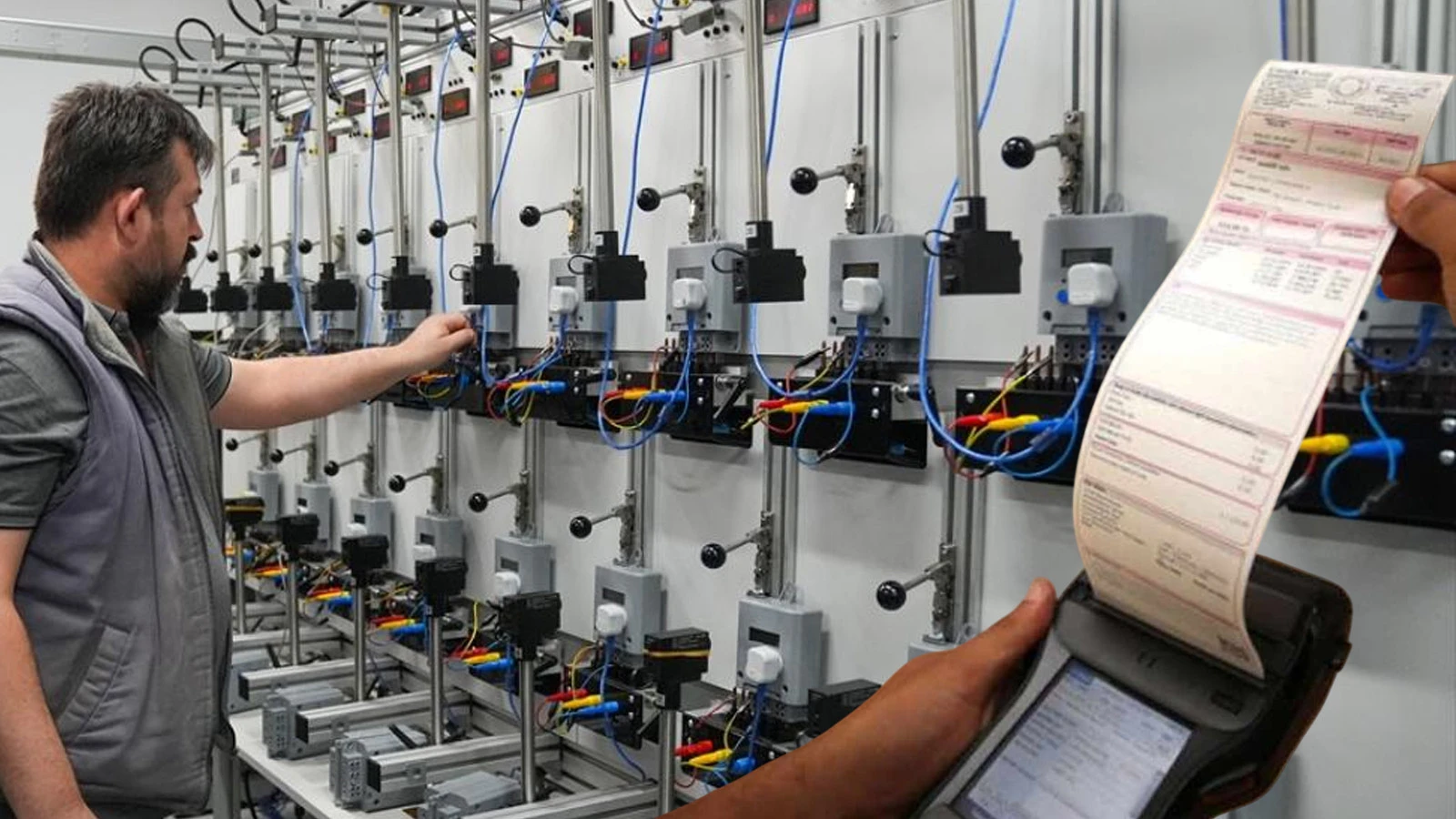
Energy Market Regulatory Authority (EPDK) Chairman Mustafa Yılmaz stated that approximately 2.7 million Smart Meter PRO models are planned to be installed by the end of 2027 within the scope of the National Smart Meter System (MASS), and that it is aimed to include the meters of approximately 7 million subscribers within the scope of remote reading in the two-year period.
In his speech at the “1st Innovation, Dissemination and Entrepreneurship Days in the Electricity Distribution Sector” event organized in cooperation with EMRA and Electricity Distribution Services Association (Elder), Yılmaz said that the energy sector has gone through a major transformation and that renewable energy, electric transportation, storage and distributed generation have changed the way electricity is produced as well as the functioning of distribution networks.
Emphasizing that the main goals of this transformation are stronger networks, better quality service and an energy infrastructure ready for the needs of the future, Yılmaz stated that while the share of renewable resources in electricity production increases, it is important for distribution networks to prepare for new needs.
Yılmaz pointed out that the electricity distribution service spread throughout the country is a critical infrastructure that requires constant investment and maintenance, and stated that a strong investment environment and an effective business approach is needed for 21 distribution companies to continue their services in different geographical and climatic conditions.
In this context, Yılmaz gave information about the regulations for the 2026-2030 period and said, “As EMRA, in the fifth implementation period covering the years 2026-2030, we increased the investment ceiling to approximately one and a half times in real terms compared to the previous period, and the planned maintenance resources to 2.1 times.” made his assessment.
Emphasizing that the quality of the distribution service cannot be evaluated only by the size of the allocated resources, Yılmaz stated that investments should be directed to the right areas, network assets should be managed effectively and planned maintenance activities should produce concrete results.
Yılmaz said, “Because what is important is not only how much you invest, but how this investment is reflected in the service and quality of our citizens.” he said.
Stating that the duration and frequency of outages, technical quality, user satisfaction and occupational health and safety indicators were evaluated together with the quality factor regulation published in April 2026, Yılmaz noted that these indicators also affected the income ceilings of distribution companies.
Yılmaz said, “Our aim is to ensure that investments, maintenance activities and technological developments turn into concrete service quality increases.” he said.
EMRA ACCEPTED 724 R&D PROJECT
Yılmaz also touched upon R&D supports for electricity and natural gas distribution and stated that a total of 2,085 project applications have been made since the July 2014 R&D project period, and 724 of them were accepted.
Stating that 619 of the projects were carried out in the field of electricity and 105 in the field of natural gas distribution, Yılmaz said, “This table shows that our distribution companies have become organizations that not only use technology but also directly participate in technology development processes.” made his assessment.
Stating that the procedures and principles regarding R&D and innovation activities were updated with the regulations published on September 5, Yılmaz said, “We included pre-mass production prototype development, verification tests, pilot applications, field demonstrations, cyber security tests and localization activities within the scope of support under certain conditions. We also made the regulations regarding the protection of intellectual and industrial property rights a part of this framework.” he said.
Stating that a product that is successful in the laboratory should show the same performance in the field, and a new software should work safely and compatible with existing systems, Yılmaz emphasized that completing R&D with P&D is one of the basic steps in turning research results into applicable technology.
Yılmaz said, “The important thing is to ensure that the studies supported by public resources turn into concrete products, domestic solutions and a strong technology ecosystem.” he said.
REGULATORY INCENTIVES FOR DOMESTIC SOFTWARE PROJECTS
Pointing out that digitalization in electricity distribution has reshaped the network management, fault detection and maintenance processes, Yılmaz stated that inter-system compatibility, service continuity and cyber security have become vital for the sector.
Stating that 72 software project applications were made within the scope of the “Domestic Software Ecosystem Call”, for which applications started to be received as of the January 2023 R&D project period, and 26 of them were accepted, Yılmaz said, “In addition, a 5 percent increase in the weighted average capital cost rate for distribution companies using domestic software in the 2026-2030 period is among the existing regulatory incentives.” he said.
Stating that the National Smart Meter System was developed within the scope of an R&D project, Yılmaz said that the system is one of the concrete outputs of the R&D studies supported by EMRA.
Stating that MASS offers new opportunities in terms of fault prediction, risk-based maintenance, loss-leakage combat and network resilience against disasters by improving the possibilities of remote communication and obtaining data from the network, Yılmaz said:
“Smart meter conversion started on March 1, 2026, with the meters developed within the scope of MASS, and the installation of 4 million Smart Meters ECO and 70 thousand Smart Meters PRO was completed by September. In popularizing smart meters, the basic principle is to convert the most meters at the lowest possible cost.”
Yılmaz stated that it is planned to install approximately 2.7 million Smart Meter PRO models by the end of 2027 and said:
“In this context, it is planned to install approximately 2.7 million Smart Meter PRO models by the end of 2027. Thus, in the two-year period, the meters of approximately 7 million subscribers will be included in the scope of remote reading, and within the scope of network monitoring, outage and technical quality data at the connection points of 15 million subscribers will be monitored.”
Stating that the test version of the MASS user mobile application, where all electricity subscribers in Türkiye can receive consumption and production data, outage records, compensation information and planned outage notifications simultaneously with the smart meter transformation, has been put into service, Yılmaz stated that the transformation process will continue with the introduction of different communication methods.
Stating that meter changes will be closely monitored by EMRA, Yılmaz said, “I would especially like to emphasize that necessary measures will be taken regarding companies that are behind the planning in smart meter conversion.” he said.
IT AIMS TO TRANSFORM R&D STUDIES INTO DOMESTIC PRODUCTS
Yılmaz stated that the event, organized in cooperation with EMRA and Elder, brought together the knowledge and experience of 21 distribution companies with researchers, technology developers and entrepreneurs.
Stating that within the scope of the new R&D and P&D regulations, expenses for incubation centers, acceleration programs, training and dissemination activities are also supported under the specified conditions, Yılmaz noted that the priorities of the institution are more reliable networks, more effective investment and maintenance decisions, safer conditions for employees and better quality service for consumers.
Yılmaz said, “As an institution, we will continue to strengthen investment and service quality with our regulations, transform R&D results into applicable products and support the domestic technology ecosystem.” made his assessment.
