
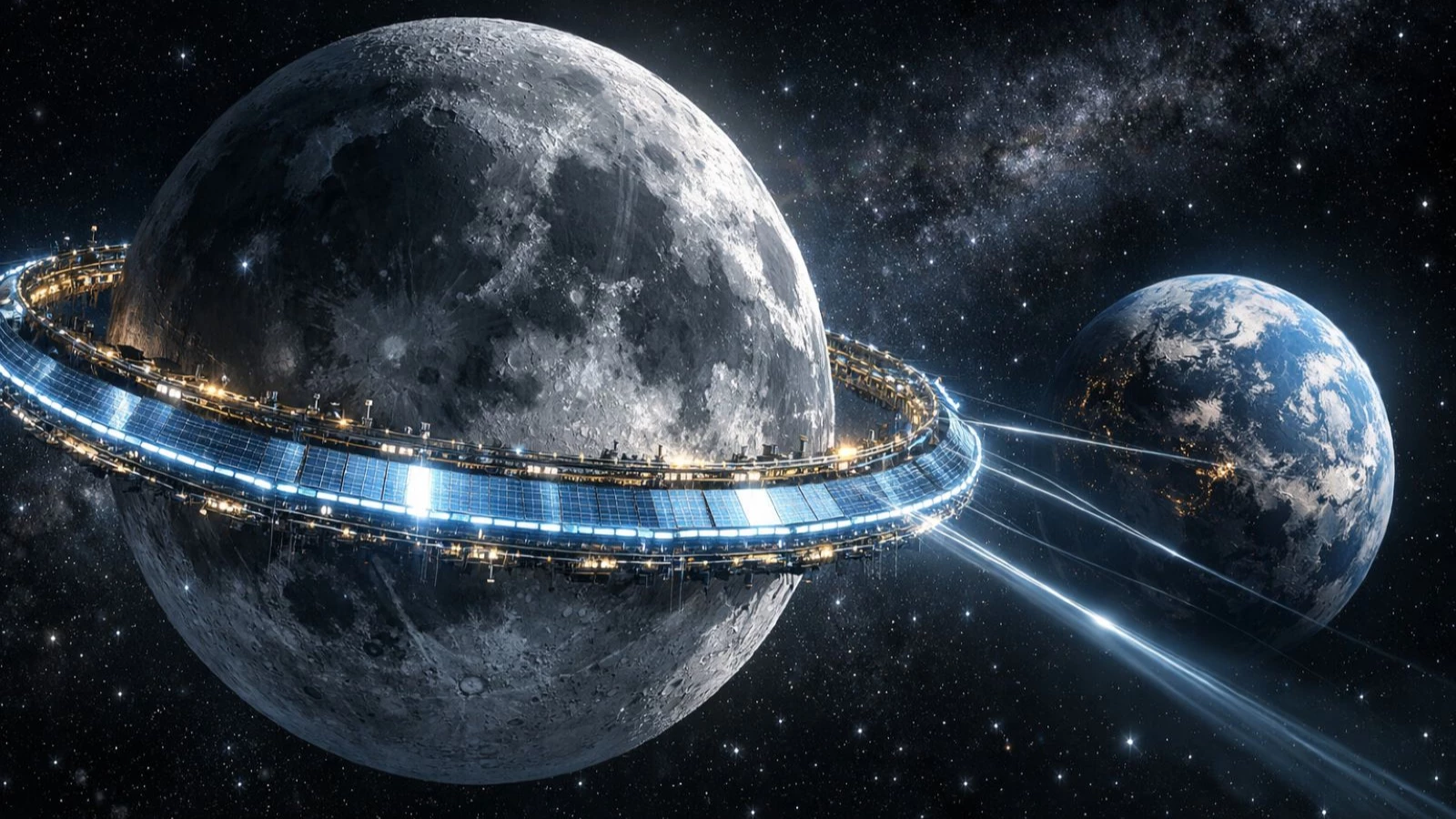
About a decade ago, a Japanese construction company came up with an idea that might seem crazy to many: building a giant solar panel belt around the Moon’s equator.
This project, called the “Luna Ring,” would extend for 6,800 miles and make it possible to produce uninterrupted solar energy without dependence on weather conditions or the day-night cycle.
The project did not attract much attention when it was first presented, but following the Fukushima Daiichi nuclear disaster in March 2011, Japan began to turn more to alternative energy sources.
The company responsible for the project is Shimizu Corporation. The company argues that solar panels on Earth produce only one-twentieth the energy of an equivalent system in space. Since there is no atmosphere, clouds and night at the Moon’s equator, it is possible to benefit from sunlight constantly.
Company president Tetsuji Yoshida stated that if this energy could be completely transferred to the Earth, there would be no need to burn coal, oil and biomass.
This project can solve the intermittency problem, which is one of the biggest problems of solar energy on Earth. On Earth, solar power plants do not operate at night or their efficiency decreases in cloudy weather; This situation does not occur on the Moon.
The idea is to collect solar energy with panels placed at the Moon’s equator, convert it into electricity, and transport it to the Earth-facing side of the Moon. From here, the energy is converted into laser beams that reach the Earth and are converted back into electricity on Earth.
Hydrogen as fuel
According to Shimizu Corporation, this system can also provide hydrogen production to reduce dependence on fossil fuels.
The construction of the project will be carried out by robots controlled 24 hours a day from Earth and occasionally with the help of a small team of astronauts.
However, the biggest obstacle is the high cost. Economist Masanori Komori from the Japan Institute of Energy Economics stated that the idea is interesting in theory but is very expensive.
