
Businessman Ali Koç’s statements regarding Türkiye’s potential in agriculture brought the production figures of recent years back to the agenda. Evaluating the 2027 cover of The Economist magazine as a warning about water wars, Koç stated that Türkiye’s most strategic sector is agriculture and said, “We have the sun, we have water and we have incredibly fertile lands. But we missed this train because we cannot do industrialized agriculture.”
CHANGE IS HAPPENING
Long-term statistics on Türkiye’s agricultural areas are among the basic data showing the change in land. According to the records of the Ministry of Agriculture and Forestry and TÜİK, In 2002, the total of fields, vegetable, fruit fields and fallow lands was approximately 26 million 579 thousand hectares. This size decreased to 23 million 978 thousand hectares in 2025. Grain and other field products are grown in 16.5 million hectares of agricultural areas. While vegetable gardens are recorded as 754 thousand hectares, fruit, vineyard and olive grove areas are recorded as 3.82 million hectares, approximately 2 million 868 thousand hectares of land are left fallow.
IT IS GETTING Narrower
The change in land size is accompanied by fluctuations in production. According to the 2027 Presidential Annual Program of the Presidency of Strategy and Budget, the Turkish economy grew by 3.7 percent in 2025, while the added value of the agriculture, forestry and fisheries sector decreased by 8.5 percent. The share of agriculture in national income decreased from 5.8 percent in 2024 to 5.2 percent in 2025. Production losses due to drought and agricultural frost were effective in this contraction. Türkiye’s wheat production, which was 20.8 million tons in 2024, decreased to 17.95 million tons in 2025, and barley production decreased from 8.1 million tons to 6 million tons.
79 PERCENT IS IN IRRIGATION
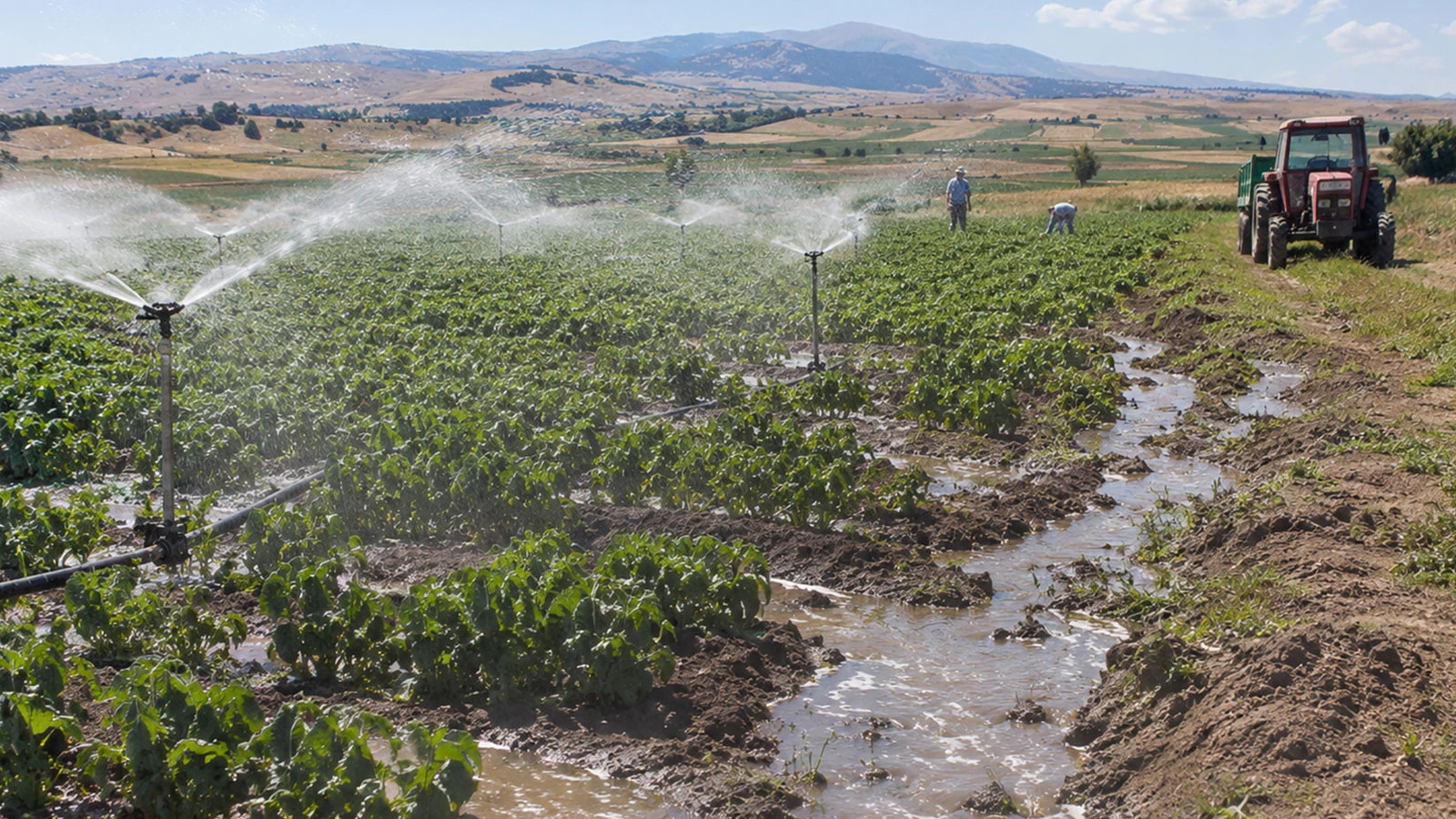
The water resources highlighted by Ali Koç are of great importance for Türkiye’s agricultural production. According to State Hydraulic Works data, 48.7 billion cubic meters of the 61.7 billion cubic meters of water used in a year, that is, 79 percent, is allocated for agricultural irrigation. Large changes in the amount of precipitation in Türkiye also affect agricultural production. According to meteorological data, the amount of precipitation between October 2024 and September 2025 decreased to 422.5 millimeters, the lowest level in the last 52 years. The next year, it rose to 741.6 millimeters, breaking the record of the last 66 years. The annual amount of usable water per capita in Türkiye is approximately 1,300 cubic meters.
PIECED FIELDS
One of the problems that Türkiye faces in its transition to industrialized agriculture is the land structure of agricultural enterprises. The Presidency’s Strategy and Budget Directorate states in its 2027 Annual Program that small-scale, fragmented and distant agricultural lands increase production costs. According to the report, this structure makes it difficult to use agricultural machinery and modern production techniques effectively, while also limiting the benefits from irrigation investments. Within the scope of land consolidation studies, the area whose consolidation has been completed is expected to reach 9.9 million hectares and the area whose title deed registration has been completed is expected to reach 8.2 million hectares by the end of 2026..
LOSS OF EMPLOYMENT
Türkiye’s transformation in agriculture is also reflected in employment figures. While 4 million 827 thousand people worked in the agricultural sector in 2024, this number decreased to 4 million 560 thousand in 2025. Thus, agricultural employment decreased by 267 thousand people in one year. The sector’s share in total employment dropped to 14 percent. In the third quarter of 2026, the share of agriculture in employment was recorded as 13.6 percent.
“MUST BE BASED ON TECHNOLOGY”
Dursun Yıldız, former director of DSI and President of the Water Policy Association, comments on the emerging picture as follows: “We cannot evaluate Türkiye’s problems in agriculture only with the amount of production. Agricultural employment decreased by 267 thousand people in the last year. While production costs increased by over 32 percent, agricultural and food imports exceeded 27 billion dollars. Our exports continue, but our foreign trade surplus is declining.” Increasing agricultural supports is important, but resources also need to be used efficiently. “We cannot use water effectively.”
