
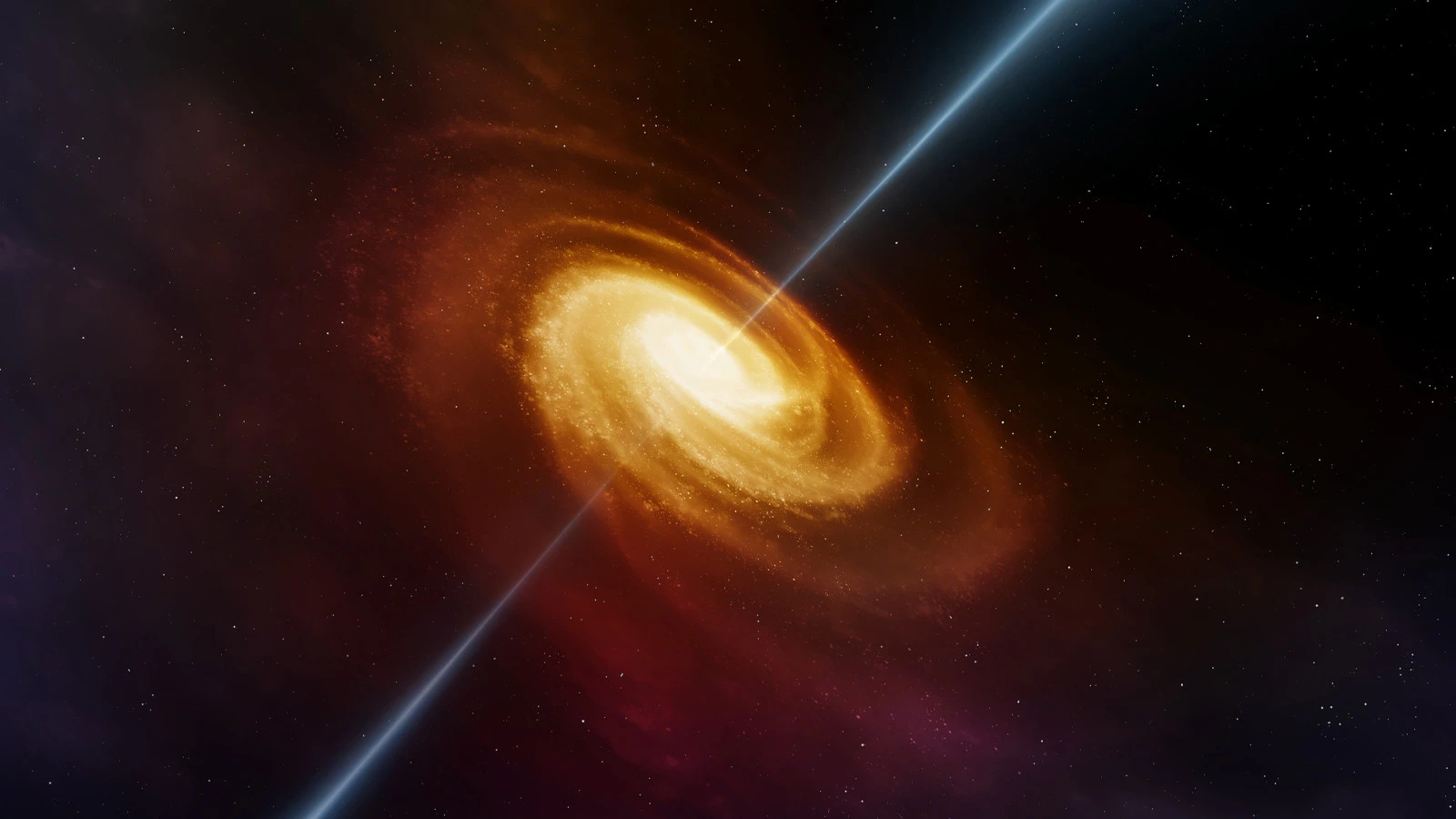
The European Space Agency’s (ESA) Euclid Space Telescope has discovered the most distant quasar ever detected, existing approximately 630 million years after the Big Bang. While the state of this celestial body, called “J1504+6252” and also known as “Dun Aonghasa”, was observed approximately 13.1 billion years ago, the discovery moved the record for the most distant quasar, which Euclid announced a few months ago, back 40 million years.
OBSERVATIONS AND DETAILS OF THE DISCOVERY
The existence of the quasar, which was revealed by scanning Euclid’s approximately 18-month observation data among millions of celestial objects, was confirmed by follow-up observations made with both ground-based and space-based telescopes. Examinations of the James Webb Space Telescope showed that the mass of the black hole at the center of the quasar is approximately 360 million times that of the Sun. Remarkably, this black hole was found to consume the surrounding matter more slowly than black holes in other distant quasars.
QUESTION THAT CHALLENGES SCIENTIFIC MODELS
How such a gigantic black hole formed in this early period, when the universe was only 630 million years old, and how it reached this mass in a short time brought new questions for scientists. It is stated that the findings challenge existing models explaining the formation and growth processes of black holes.
Quasars are defined as galaxy nuclei that release large amounts of energy as a result of the supermassive black holes at their centers pulling in the gases around them. The Euclid Space Telescope, launched into space in 2023, generally investigates the building blocks of the universe that have not yet been fully elucidated, such as dark matter and dark energy.
