
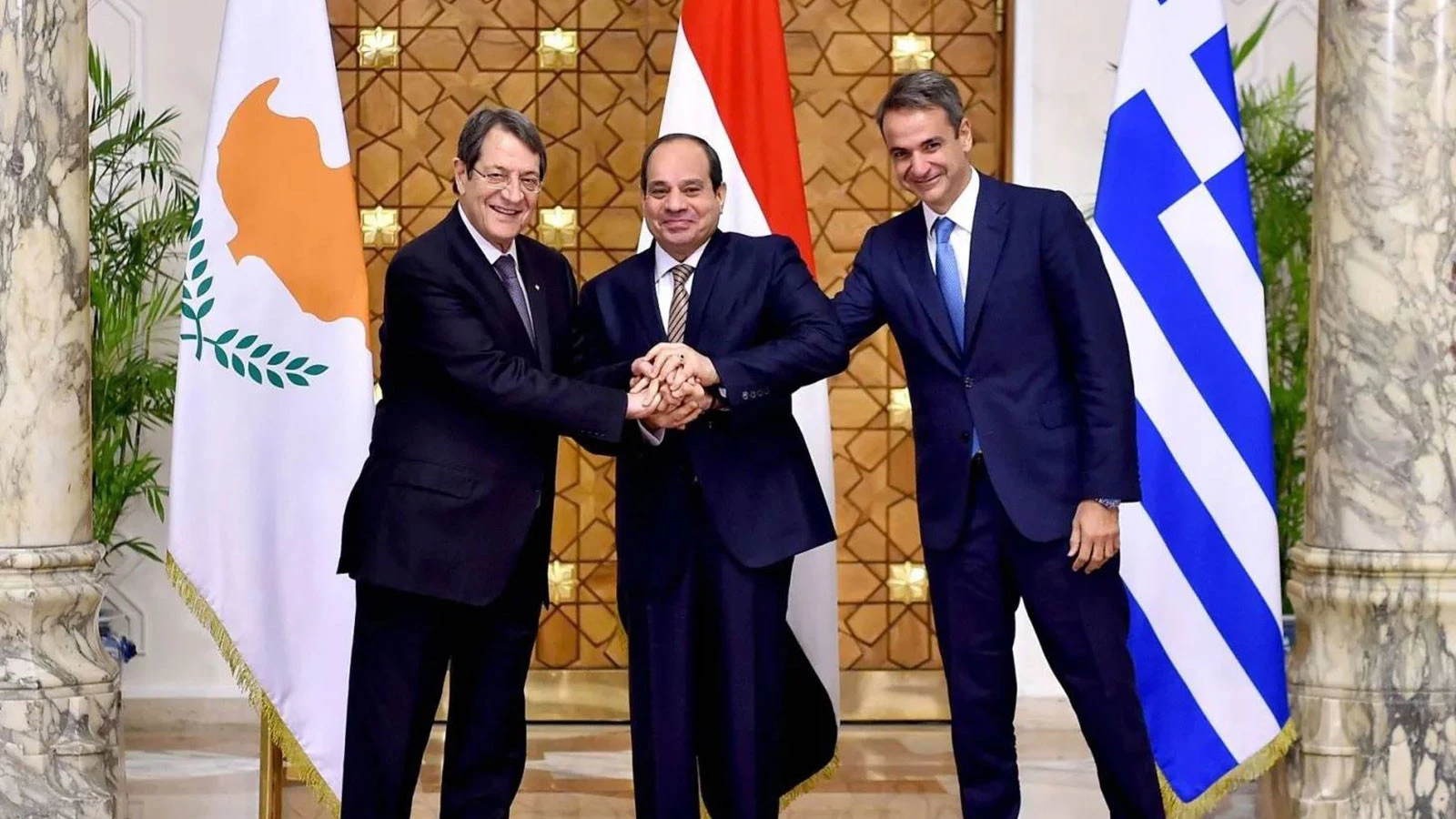
While the crisis line extending from Iraq to Syria, from Lebanon to Israel converges in the Eastern Mediterranean, the policy followed by Egypt attracts attention. While Cairo conducts military exercises with Türkiye and signs new agreements in the defense industry, on the other hand, it continues its military and energy cooperation with Greece and the Greek Cypriot Administration of Southern Cyprus. The last symbolic image of this policy appeared at the military parade held in the Greek Cypriot Administration of Southern Cyprus on October 1. In addition to Greece, military representatives from Egypt, France, the USA and the UK also attended the ceremony. Egypt, which is said to be pursuing an ambivalent strategy in the region, also wants to get closer to the new security structure on the Türkiye-Saudi Arabia-Pakistan axis.
ENERGY BASE TARGET
But Cairo’s involvement on the Athens-Nicosia line is not just ceremonial. In September, the defense ministers of Egypt, Greece and Greek Cypriot Administration of Southern Cyprus met in Cairo. Joint exercises, military training, new technologies and protection of the energy infrastructure in the Eastern Mediterranean were discussed. The real strategic bond in the Egypt-Greece-GCASC line is established through energy. It is planned that the natural gas off the Greek Cypriot side will be transported to Egypt, processed there and sent to Europe as LNG. While production in the Cronos field is aimed to start in 2028, the gas is expected to be connected to the Egyptian infrastructure. Thus, Egypt becomes one of the gateways for Eastern Mediterranean gas to Europe. This situation is being closely monitored in terms of Türkiye’s goal of becoming the energy center in the region.
IN EXERCISE WITH Türkiye
On the other side of the table, there is a rapid Türkiye-Egypt rapprochement. While the chiefs of general staff of the two countries signed a military cooperation protocol; Egyptian warplanes participated in the Anatolian Eagle 2026 exercise in Türkiye. Then, Turkish special forces conducted joint training with Egyptian troops at Golden Eagle 2026, held in Egypt. The development that further complicates regional calculations is The new defense structure established between Türkiye, Saudi Arabia and Pakistan. Egypt is not a direct member of this structure, but maintains close contact with Ankara and Riyadh.
THREE CRITICAL RISKS
The first risk for Türkiye is maritime jurisdictions. If Egypt maintains its current maritime border order with Greece and Greek Cypriot Administration, the structural disagreement with Ankara will continue. The second risk is energy. If the transportation of Greek gas to Europe via Egypt becomes permanent, the bargaining power of alternative energy routes passing through Türkiye may decrease. The third risk is military balance. Cairo’s military cooperation with both Türkiye and Greece-GCASC leaves open the question of which direction Egypt will take in a possible Eastern Mediterranean crisis.
What does the expert say?
“THE OLD FRONTATION IS NOT OVER”
International Relations Expert Prof. Dr. Hasan Köni brings the following findings to the agenda:
“Although the policy followed by Egypt may seem like a double game at first glance, it is actually a multiple balance strategy. While getting closer to Turkey, Cairo does not give up on the alliances it has established with Greece and Southern Cyprus. While maintaining its military ties with Washington, it also wants to take part in the new regional structure on the Ankara-Riyadh line. The real danger for Turkey is to think that rapprochement with Egypt ends the old confrontation in the Eastern Mediterranean. Because Cairo is playing against three different power centers at the same time. Developments in Iraq, Syria and Lebanon may change the direction of regional alliances. New diplomatic rapprochements centered in Mecca are also an important part of this equation. Egypt is trying to increase its regional influence without closing any doors. “Ankara needs to look at its concrete steps in the Eastern Mediterranean rather than Cairo’s rhetoric.”
