
Transatlantic relations
Canada as an associated EU member? This is the situation now
Updated on September 17, 2026 – 6:27 p.mReading time: 4 minutes

US President Donald Trump would like to make Canada the 51st state of the United States. The Canadians are not very enthusiastic – and are now accepting an explosive offer from Brussels.
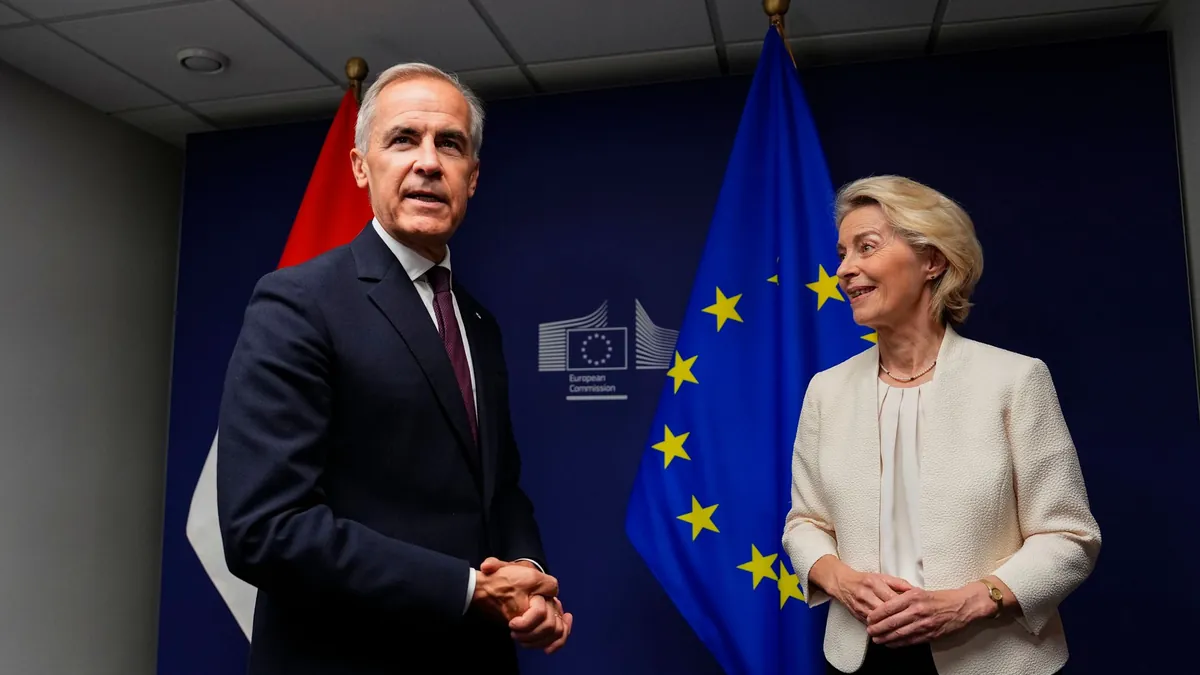
Becomes Canada the first “associated member” of the EU? Canadian Prime Minister Mark Carney has the surprising move from the President of the EU Commission Ursula von der Leyen welcomed and made it clear how he could imagine a new transatlantic alliance. But does the project really have a chance of being realized? Questions and answers at a glance:
What did Ursula von der Leyen suggest?
The President of the EU Commission wants to make Canada the first “associated member” of the European Union and thus bring relations to “the highest possible level”. She names technology issues, defense equipment production, artificial intelligence and Arctic policy as concrete areas for possible closer cooperation.
What does Carney say?
He welcomes the move. Polls showed that an overwhelming majority of Canadians supported significantly closer ties, he said in his speech to the European Parliament in Strasbourg. Europe and Canada are each strong in their own right. But together we are even stronger.
Carney wants to turn the classic trade and values partnership into a strategic alliance in which Canada and Europe pool their economic, technological and security policy strengths in order to become more independent, more crisis-proof and less susceptible to blackmail. He named critical raw materials, energy, space travel, payment systems and research as further areas for even closer cooperation with the EU.
Is this also about the USA and its President Donald Trump?
Yes. Since Trump took office, Canada and the EU have had the bitter experience that the most powerful country in the world is no longer the partner it once was. Escalated customs conflicts and demands for control Denmark belonging Arctic island Greenland are just two examples.
Is there a reaction from Trump yet?
When asked about von der Leyen’s suggestion of “associated membership” for Canada, Trump said on Wednesday evening (local time): “I think that’s ridiculous.” If he were to perceive the action as a “hostile act,” he would impose “very high tariffs” or stop trade with Europe in many areas. However, the president also said that the procedure was okay if the intention behind it was good – without explaining in more detail how he would base this on it. In the past, he had repeatedly spoken about Canada becoming the 51st US state.
Where does the idea of “associate membership” come from?
In the current European debate, the term has recently been used primarily by the Federal Chancellor Friedrich Merz prominent. In June, the CDU politician voted for the Ukraine “Associated membership” was proposed as an intermediate step on the way to regular EU accession. According to his ideas, Ukraine could regularly take part in summit meetings or specialist councils of ministers before accession. Also conceivable are a Ukrainian commissioner without a portfolio and voting rights, as well as Ukrainian MPs who take part in the deliberations of the European Parliament without voting rights.
