
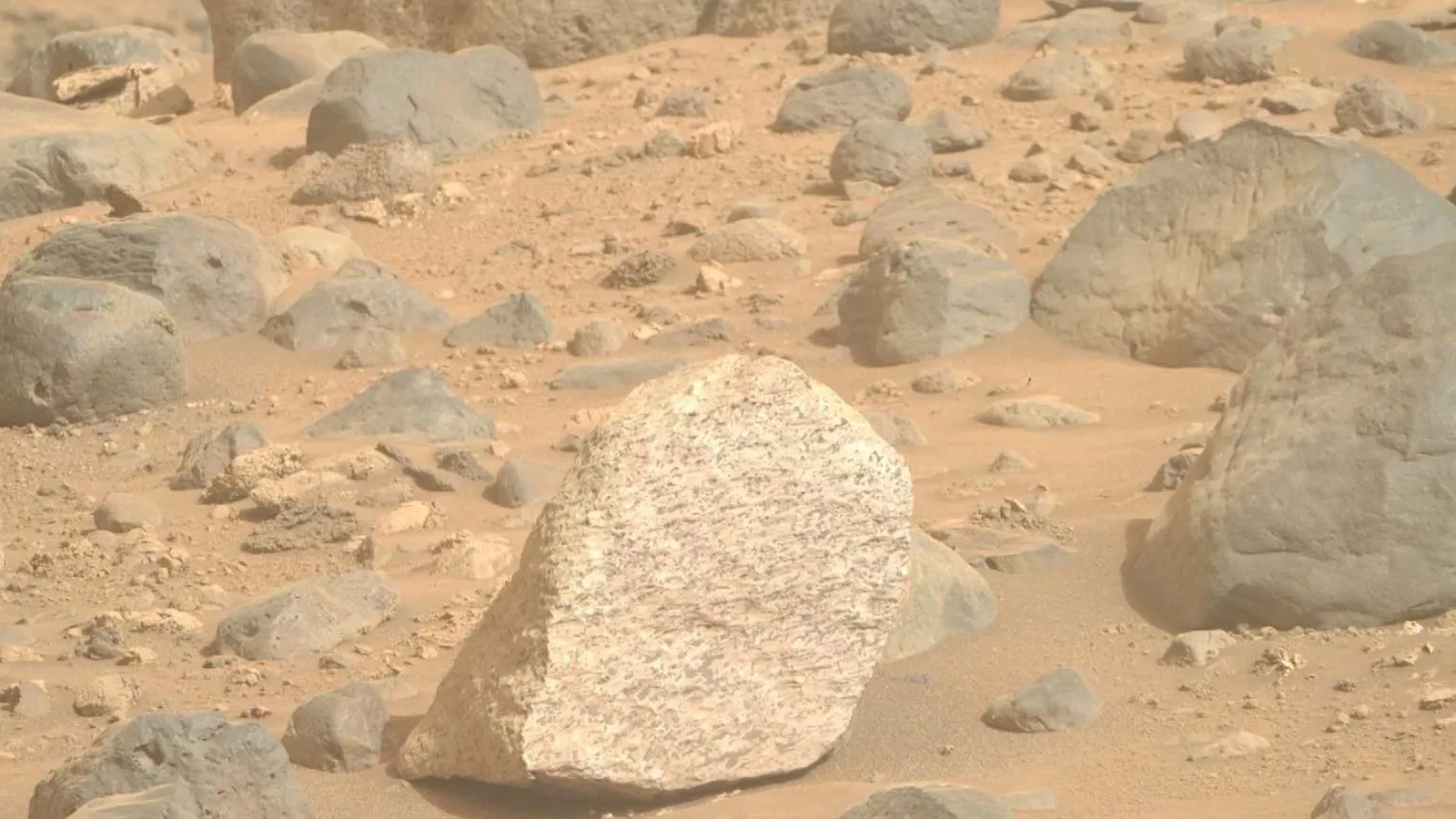
NASA’s Mars exploration vehicle Perseverance has made an extraordinary discovery that will shed light on the planet’s past. Complex organic molecules called “macromolecular carbon” (MMC) were identified in the “Bright Angel” rock formation along the Neretva Vallis, an ancient riverbed. This detection, made thanks to the rover’s high-tech SHERLOC instrument, reignited the possibility that the red planet was once home to microbial life.
FIRST EXPLORATION WITHOUT DISTURBING THE ROCK INTEGRITY
The most striking element that distinguishes this important research from previous studies is that this is the first time that such complex organic carbon has been identified on the surface of Mars, in a natural and intact rock surface that has not been drilled. The macromolecular carbon in question was detected in two different rocks in the river channel feeding the delta region of the crater. The most striking of these rocks was the “Cheyava Falls” mudstone, which contains leopard-like spots that can be associated with microbial activities and has caused controversy in the scientific world for a long time. Discovered complex compounds; It offers a structure that supports elements that form the basic building blocks of life, such as carbonate, sulfate and phosphate.
ANCIENT LIFE CONDITIONS MAY BE COMMON ACROSS THE PLANET
Astrobiologist Kyle Uckert from NASA’s Jet Propulsion Laboratory emphasizes that the macromolecular carbon detected on the cleaned but untreated surface of the Cheyava Falls rock is the shallowest finding of organic matter ever recorded on the surface of Mars. This suggests that organic materials were either exposed at the surface relatively recently or were successfully protected from lethal radiation by minerals with photoprotective properties.
The fact that these organic-containing mudstones found in Jezero Crater are approximately 3,500 kilometers away from the organic structures previously detected by the Curiosity rover in Gale Crater also excites scientists. This enormous distance indicates that billions of years ago, the conditions necessary for life on Mars and organic materials may have been widely available throughout the planet.
BIOLOGICAL ORIGIN OR GEOLOGICAL PROCESS?
According to Sciencealert; The research team meticulously compared the spectral properties of the obtained samples with meteorite and terrestrial samples on Earth. Geologist Dr. from the Planetary Science Institute in the USA. Ashley Murphy confirmed that the macromolecular carbon examined had an “amorphous carbon” structure. However, Murphy reminds that this type of carbon can originate from biological sources such as microbial mats and coal, as well as non-biological (abiotic) processes such as meteorites and hydrothermal rocks. It does not seem possible yet to make a precise source distinction with the available data.
The current equipment on the Perseverance rover does not have the sensitivity to distinguish whether organic compounds originate from a fully biological process or abiotic effects such as volcanic, electrochemical and hydrothermal reactions. For this reason, experts underline that these findings cannot be presented as definitive evidence of ancient life on Mars.
THE EXACT ANSWER WILL BE GIVEN IN THE LABORATORY
Determining the exact origin of organic compounds will only be possible by bringing these samples to Earth and analyzing them in advanced laboratory environments. Perseverance continues to safely store a total of 30 valuable samples, including the rock core called “Sapphire Canyon” taken from the region examined for this great purpose, in its cache for future missions planned to be delivered to Earth.
