

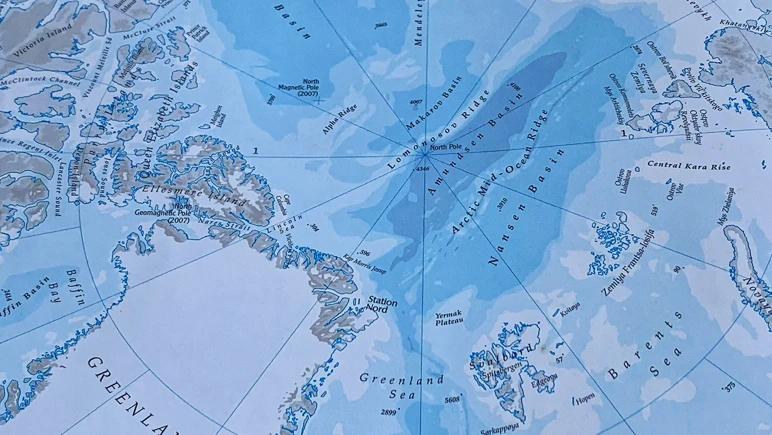
China is launching a new sea route to Europe at a time when global trade routes are increasingly fragile due to geopolitical crises. The route, called the “Ice Silk Road”, starts from Ningbo in the east of China, goes to the Arctic Ocean, follows the Northern Sea Route along the northern coast of Russia, and reaches England’s Port of Felixstowe via the North Sea. The new route is one of the most striking examples of China’s search for alternatives, especially at a time when the Suez Canal and the Red Sea line are seriously disrupted due to wars and attacks in the Middle East.
DISTANCE AND TIME
The most important advantage of the route is distance and time. During the trial voyage carried out by the Chinese company Sea Legend last year, transportation from Ningbo to Europe took approximately 20 days. This period provides a serious advantage compared to the alternatives that take approximately 40 days via the Suez Canal and approximately 50 days via the Cape of Good Hope.. The company states that the Arctic route can be advantageous, especially in the transportation of time and temperature sensitive products such as lithium-ion batteries and solar panels.
REGULAR TRAVEL FOR THE FIRST TIME
The critical development here is that China no longer only conducts test flights. According to the report dated August 7, Rosatom, the state company responsible for operating Russia’s Northern Sea Route, gave passage permission to seven Chinese ships bound for Europe. It has been reported that Sea Legend will launch regular container service on the route in 2026, with voyages planned to operate weekly throughout the Arctic shipping season.. The report noted that this represents a regular commercial service, unlike previous one-off or experimental transports.
EUROPEAN EXPEDITIONS
Shipping specialist publication Seatrade Maritime also reported in August that Chinese and South Korean companies began increasing their European voyages via the Arctic. It was stated that in addition to Sea Legend, New New Shipping, OVP Shipping and South Korean PanStar are also preparing to use the Northern Sea Route.. PanStar’s voyage, which is expected to reach Felixstowe from Busan in approximately 18 days, shows that the route is starting to become a commercial alternative not only for China but for the whole of East Asia.
ALTERNATIVE TO SUWEYSH
One of the most important reasons behind China’s Arctic move is the security crisis in the Middle East. According to Al Jazeera, the Bab al-Mandab Strait at the southern entrance of the Red Sea has become a highly risky route for ships in recent weeks. Due to Houthi attacks, most of the ships are forced to navigate through southern Africa instead of the Red Sea and Suez Canal.. The crisis in the Strait of Hormuz also increases global risks in terms of energy transportation. During peace periods, approximately 20 percent of world oil and LNG exports are transported through Hormuz.
CHINA’S ADVANTAGE
China’s trade with Europe and the Middle East is dependent on geopolitically sensitive chokepoints such as the Strait of Malacca, the Red Sea, Bab el Mandeb, Suez and Hormuz. The Arctic route gives China the opportunity to disable a significant part of this chain. However, according to experts, this does not mean that the Suez Canal is coming to an end. Speaking to Al Jazeera, Dylan Loh from Nanyang Technological University in Singapore states that the Arctic route is, for now, a seasonal option that complements traditional routes rather than replacing them.. Because the route depends on the ice conditions and is not available all year round.
(email protected)
