
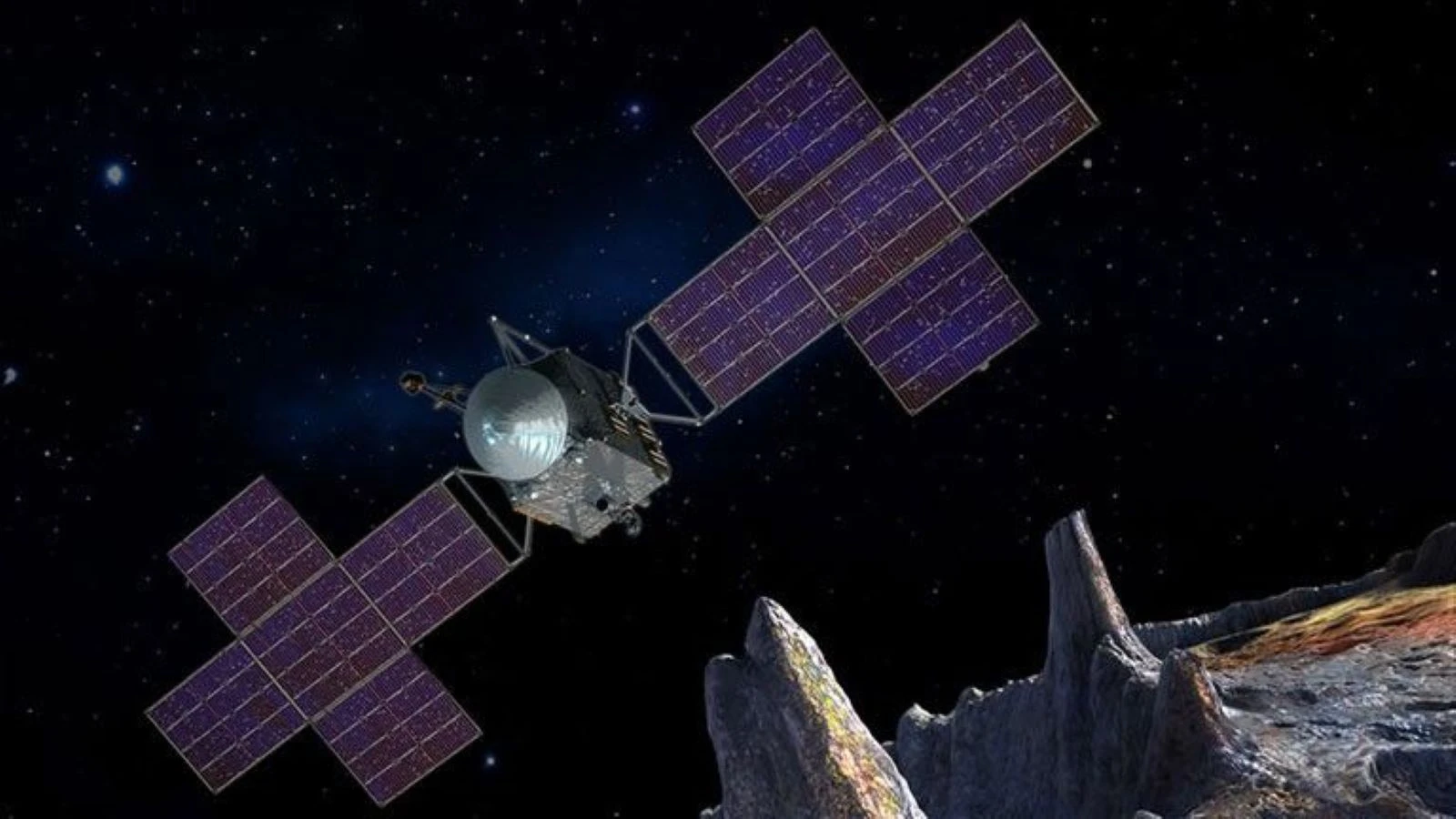
The spacecraft sent by NASA to asteroid 16 Psyche, one of the most interesting targets of the Solar System, has passed a critical threshold in its journey. The Psyche spacecraft, which passed near Mars on May 15, 2026, took advantage of the planet’s gravity to gain speed and change its course to the metal-rich asteroid. Before the maneuver, NASA announced that the spacecraft would pass from a distance of approximately 4,500 kilometers to the surface of Mars.
The Psyche spacecraft was launched on October 13, 2023. Instead of classical rocket fuel, the vehicle uses a solar-powered electric propulsion system and xenon gas for the long journey. The Mars flyby enabled the mission to save fuel; such maneuvers are known as “gravity slinging” in space missions.
Goal: Reaching Psyche in 2029
According to NASA’s plan, the spacecraft will reach asteroid 16 Psyche in the summer of 2029 if all goes well. According to Reuters, when the vehicle arrives at the asteroid, it will remain in orbit for approximately 26 months and examine the gravity, magnetic field and composition of the celestial body.
16 Psyche is located in the main asteroid belt between Mars and Jupiter. What makes it special is that it is extraordinarily rich in metal. According to NASA, the most recent analysis shows that Psyche is composed of a mixture of rock and metal; It shows that the metal fraction may be around 30 percent to 60 percent by volume.
“How realistic is the claim, ‘It is worth 300 times the world economy’?”
Psyche often comes up with the title “asteroid worth hundreds of times the world economy”. This is due to the huge estimates of the theoretical market value of the iron, nickel and other metals it may contain.
However, this statement does not fully describe the scientific goal. NASA’s mission is not to use this asteroid for mining. The agency’s main goal is to figure out whether Psyche is truly the core of an ancient planetoid. If this theory is confirmed, Psyche could offer a unique window into understanding the metal cores of rocky planets like Earth.
Why is it so important?
Scientists cannot directly examine the Earth’s core. That’s why metal-rich celestial bodies like Psyche are so valuable for understanding how planets form. If the asteroid is truly a structure left over from the core of a shattered primitive planet, this will be the first time NASA will have the opportunity to closely examine such a “remnant planetary core.”
The asteroid’s shape is irregular, similar to a potato. It is stated that its widest point is approximately 280 kilometers. The surface area is calculated as approximately 165 thousand 800 square kilometers.
Why was the Mars maneuver done?
Psyche’s reason for visiting Mars was not to study the Red Planet, but to get help from it. The spacecraft changed its speed and direction using Mars’ gravity. Thus, it consumed less fuel to reach the asteroid.
During this maneuver, NASA also had the opportunity to test the vehicle’s scientific equipment. Psyche’s cameras imaged Mars; The calibration and data collection capacity of the devices were checked for the next stages of the journey.
When the target is reached in 2029, NASA will not only have images of a metal-rich asteroid; At the same time, there will be much stronger clues about the early period of the Solar System and the internal structure of the planets.
