
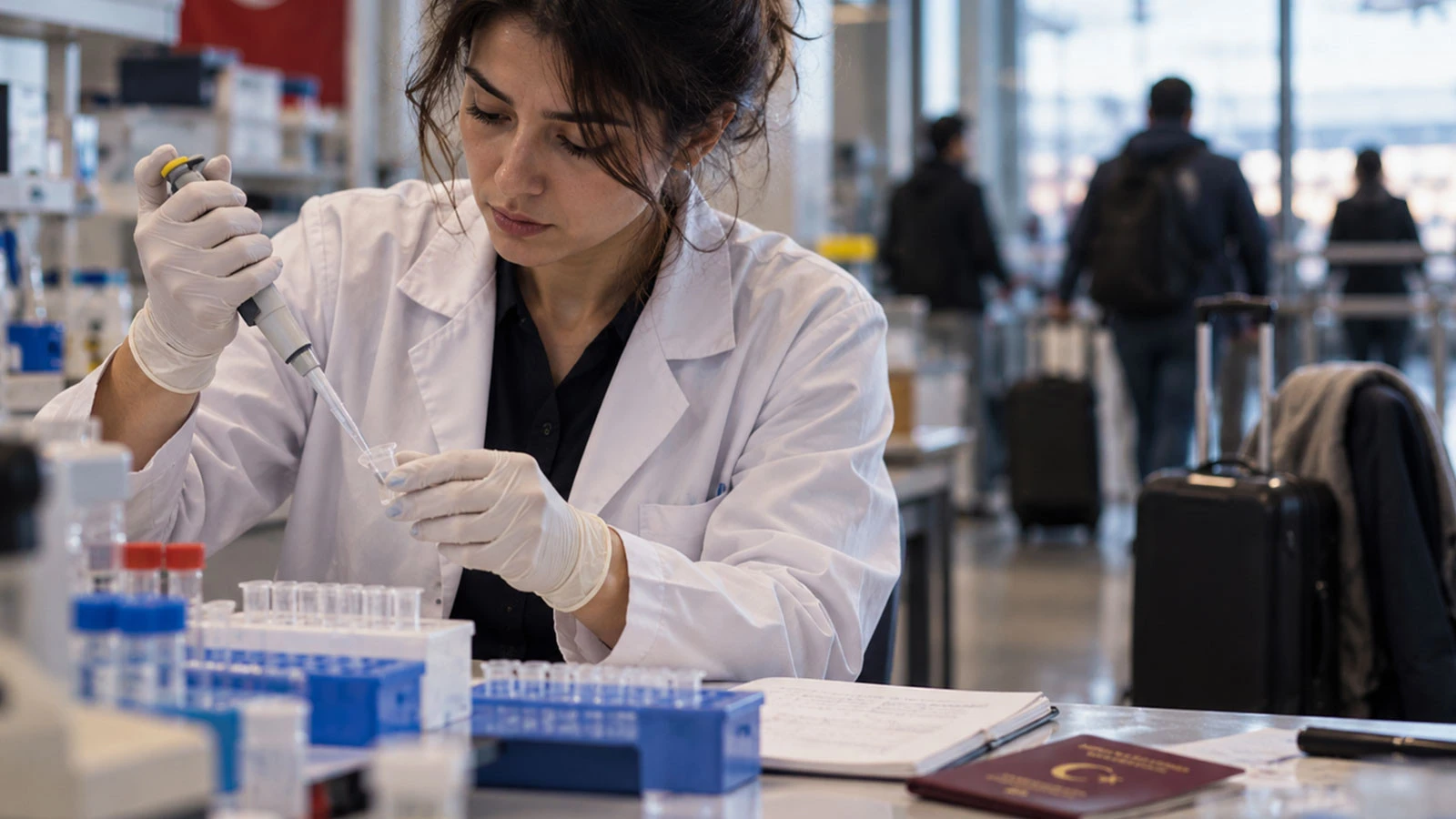
A new record was recorded in brain drain, which closely concerns Türkiye’s trained manpower. According to the latest data of the Turkish Statistical Institute, the brain drain rate of university graduates increased to 2.2 percent. This rate was 1.6 percent in 2015 and 2 percent in 2024. When comparing the last 11-year period, the highest level was reached. Figures showed that around 22 out of every 1,000 university graduates studied live abroad.
GENETICISTS ARE FIRST
Among the areas where brain drain is most intense are professions that are important for Türkiye’s technology and science production. While the rate of migration abroad for molecular biology and genetics graduates reaches 13.1 percent, this department is followed by business engineering with 13 percent, mathematical engineering with 11 percent, electronics engineering with 10.9 percent and physics engineering with 10.2 percent.
PRIORITIES GERMANY
The country where university graduates settled abroad most was Germany with 22 percent. Germany is followed by the USA with 16.9 percent, the UK with 10.5 percent, the Netherlands with 8.3 percent and Canada with 5.2 percent.. In other words, approximately 6 out of every 10 graduates who settled abroad live in these five countries. While computer engineering graduates come to the fore among those who go to Germany, England and the Netherlands, electrical-electronics engineering graduates come first among those who settle in the USA, and business administration graduates come first in Canada.
WHY ARE THEY GOING?
Economic conditions, employment expectations and career advancement opportunities are behind migration decisions. According to the 2025 Youth Well-Being Survey prepared by Habitat Association and Infakto RW 68.8 percent of young people considering settling in another country cited better job opportunities and 35.3 percent cited better education opportunities. Research opportunities and international experience are also important for scientists. In the qualitative research published in 2025 in the Abant Journal of Social Sciences, the inadequacy of scientific study opportunities and the desire to gain experience in different countries came to the fore in heading abroad.
ISTANBUL IS IN THE FIRST PLACE
Among the provinces, the city with the highest brain drain rate was Istanbul with 4 percent. Istanbul was followed by Izmir, Ankara, Eskişehir and Yalova. The lowest rate was seen in Siirt with 0.2 percent. While the nationwide brain drain rate for female university graduates was 1.8 percent, it reached 2.7 percent for men. This rate was calculated as 4.4 percent for foundation university graduates and 1.9 percent for state university graduates.

SCHOLARSHIPS ARE GOING TOO
One of the striking results of the research was the data on young people who graduated from foundation universities with full scholarships. The brain drain rate in this group increased to 8.6 percent. The rate was recorded as 3.8 percent for graduates with partial scholarships and 3.7 percent for those studying for a fee. There are also significant differences between those studying in a foreign language. While the brain drain was 10.5 percent for graduates who studied in French, it was 7.5 percent for those who studied in German and 6.8 percent for those who studied in English.
Türkiye’S LOSS
Public Opinion Researcher Volkan Tebrizcik commented on the emerging picture with the words: “Turkey is losing its most qualified young people, whom it trained by spending great effort and resources, to other countries. This migration, especially in the fields of science and technology, means the loss of not only trained manpower but also the potential for future production and development.”
