
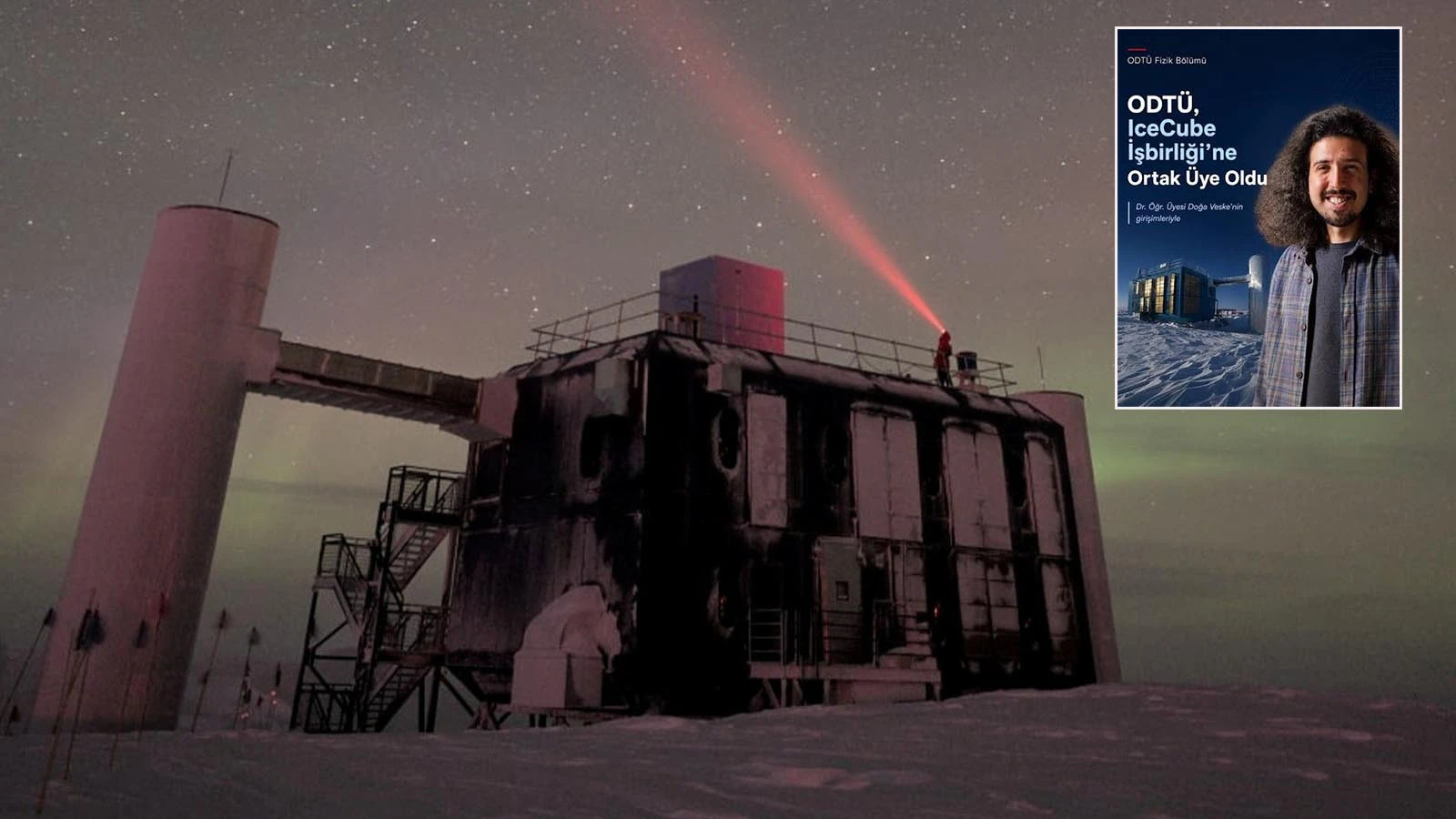
The Royal Swedish Academy of Sciences awarded the 2026 Nobel Prize in Physics to Francis Halzen for his decisive contributions to the IceCube Neutrino Observatory and the discovery of high-energy neutrinos of astrophysical origin. IceCube is an international research project that turns approximately one cubic kilometer of ice at the South Pole into a giant neutrino detector. The equivalent of this great scientific cooperation in Türkiye was the Middle East Technical University. METU Department of Physics, Dr. With the initiatives of Faculty Member Doğa Veske, the university participates in the IceCube Collaboration as an associate member. Today, the IceCube Collaboration brings together 58 institutions and more than 450 researchers from 14 countries.
TURKISH SCIENTIST INSIDE ICECUBE
One of METU Physics Department faculty member Doğa Veske’s areas of expertise is high-energy astrophysics and multi-messenger astronomy. Veske is involved in research examining the high-energy neutrinos detected by IceCube along with other cosmic signals.. In particular, it is being investigated whether neutrinos and gravitational waves come from the same cosmic event. In a study published by IceCube, Veske is named as one of the co-leads of the analysis that matched IceCube neutrinos with gravitational waves detected by LIGO and Virgo.
TWO DIFFERENT SIGNALS, SAME UNIVERSE
These studies are based on a new method in astronomy. According to publications on this subject, scientists no longer examine a cosmic event solely through the light coming from telescopes. Neutrinos, gravitational waves and electromagnetic signals that may come from the same event are evaluated together. For example, the merger of two black holes creates gravitational waves. If the same event also produces high-energy neutrinos, matching the two signals in time and direction can provide much more information about the physical structure of the event. Veske’s work is also considered as part of this new generation “multiple messenger astronomy” approach.. In a seminar given by Veske on September 25, METU stated that this method provides new information on different questions, from the expansion of the universe to the formation of heavy elements.
METU IS IN THE INTERNATIONAL NETWORK
A research group in Türkiye, with associate membership of METU, has become institutionally involved in the scientific work of one of the world’s leading neutrino observatories at the South Pole. Veske’s academic records also include many IceCube studies published in 2026. These include studies examining the energy distribution of cosmic neutrinos, as well as studies investigating the common sources of IceCube neutrinos and gravitational waves.
