
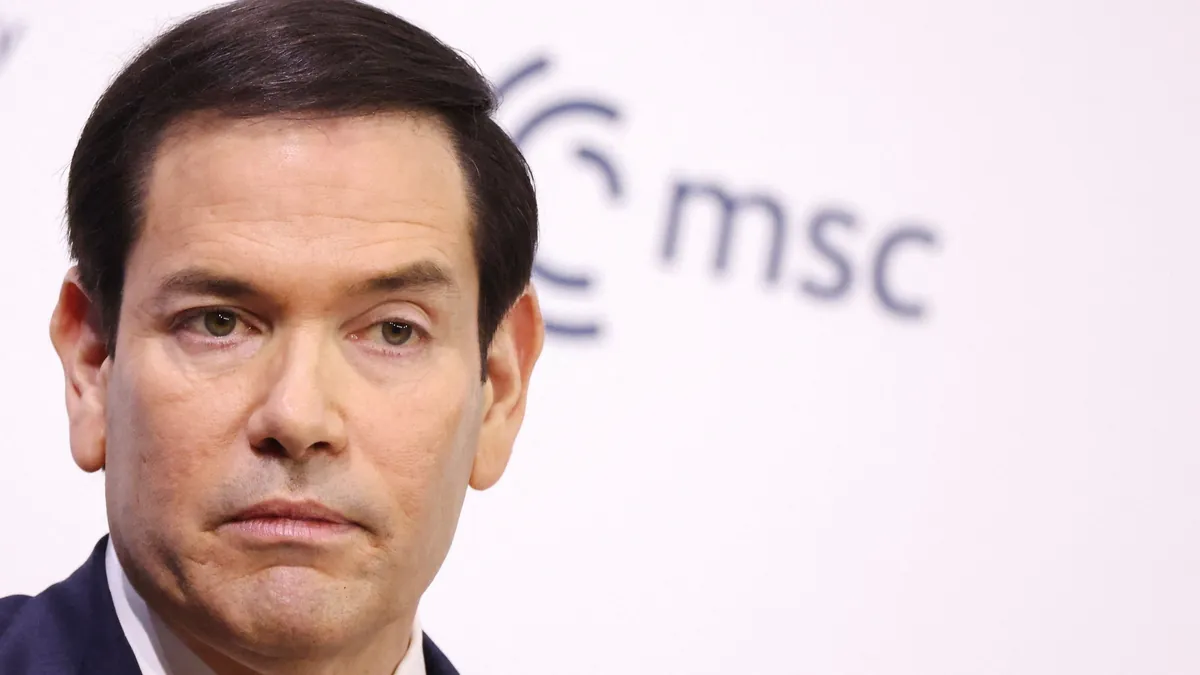
There was relieved applause for Marco Rubio in Munich. But if you listened closely, you would not recognize a reconciliation speech, but rather an elegantly packaged, ideological declaration of war.
Bastian Brauns reports from Washington
The initial reactions to Marco Rubio’s speech at the Munich Security Conference sounded as if Trump’s Secretary of State had given a major transatlantic reconciliation speech there. Unlike US Vice President JD Vance’s aggressive words last year, there was much applause and a standing ovation from the audience. Yes, there was even a hearty laugh.
There were politicians who called Rubio’s speech “excellent” and “encouraging.” Others heard a “sigh of relief” in the room. Bavaria’s Prime Minister Markus Söder even praised the “new sound from the USA” and was pleased about “a new appreciation and partnership for Europe.”
But anyone who listened more closely could see that Rubio’s supposedly friendly speech was not an alliance speech between equal partners. As with JD Vance 2025, it was an ideological declaration of war, only packaged more elegantly.
Especially in view of the US security strategy published a few months ago, the appearance in Munich did not seem like an offer of partnership renewal, but rather like an announcement of the transatlantic reorganization under the USA’s MAGA leadership.
Despite Rubio’s smooth words, one should not forget: he played a key role in this security strategy. It describes not Russia or China, but the European Union as the priority problem for the USA.
In his speech, Rubio spoke of the West as a “great and noble civilization.” He spoke of the “Christian faith”, of the common cultural “heritage”, of “shared descent” and of the “survival” of this very civilization.
Anyone who considers these terms to be well-sounding historical rhetoric underestimates the fact that they are politically charged. It is the vocabulary of a civilizational defensive struggle.
A narrative that right-wing nationalists in the USA and Europe have been using for years: Europe and the USA as a threatened culture, as a Christian-influenced community of destiny, as a historically grown identity that must be defended against migration and multilateralism.
As the child of immigrants, Rubio portrayed migration as an existential threat, a destabilizing force and a threat to cohesion and cultural continuity. There were right-wing nationalist and identity political codes that ran through the Foreign Minister’s entire speech.
What was also noticeable was what Rubio didn’t say. He didn’t mention the European Union as the central political actor in Europe. No appreciation of their peacekeeping integration achievements. No recognition of the EU as a democratically legitimate geopolitical actor. He spoke of nations, of peoples and of sovereignty.
These are words that fit the model of a “Europe of fatherlands” as propagated by the European far-right parties. These are actors whose elected representatives sit in the EU Parliament, which they want to abolish. The Trump administration is colluding with them.
The plan for Europe is very clear: away from shared sovereignty and towards renationalized power. It is no coincidence that Rubio traveled directly from Munich to Slovakia and Hungary. There, on Trump’s behalf, he supports Robert Fico and Viktor Orbán, beneficiaries of the EU who are also its strongest enemies.
