
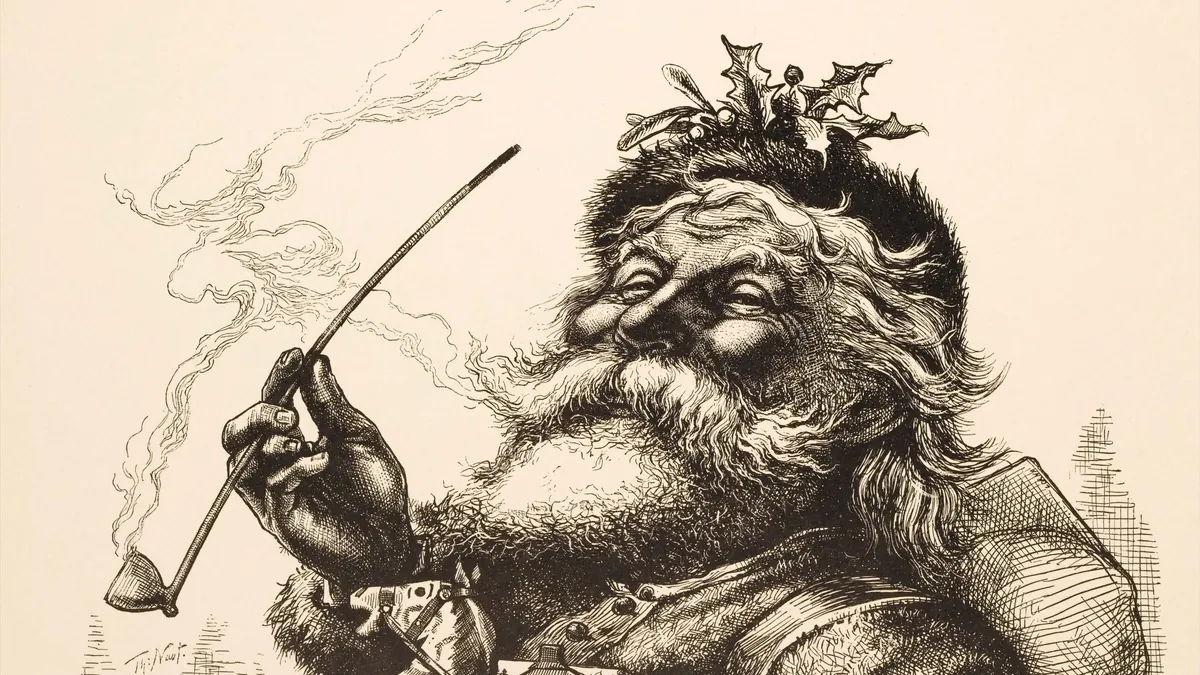
Nast gave the grumpy Pelznickel in the USA a positive image with Santa Claus. A prime example of brand transformation. “You can transplant the Palatinate, but you just can’t get the Palatinate out of it,” said the Rhineland-Palatinate deputy head of government and integration minister Karin Binz (Bündnis90/Die Grünen). The free spirit Nast would certainly have liked that.
The exhibition shows that Nast’s drawings always have something subtle about them. “In a democracy, everyone is king,” says a cartoon in which everyone in a New York street scene simply walks around wearing a crown. But there is nothing majestic about his people as sovereign. Some people are reminded of Johannes Grützke’s “Procession of People’s Representatives” in the Paulskirche Parliament in Frankfurt. There is something consistently unruly about Nast’s work.
No wonder, the man comes from the Palatinate. In 1832, tens of thousands of people demonstrated for freedom of the press and democracy at Hambach Castle in Neustadt an der Weinstrasse. The leaders Johann Georg August Wirth and Philipp Jakob Siebenpfeiffer were brought to trial a year later in Nast’s hometown of Landau.
The proceedings in front of around 600 spectators were moved to the “Engel” inn, just around the corner from Nast’s birthplace, the Red Barracks. Nast’s father was stationed there as a military musician. The trial ended unexpectedly in the first case. The Palatinate jury voted for acquittal. Nast’s love for democracy, freedom and justice was born in the Palatinate.
By the end of his life, Nast had reconciled himself with official politics in the USA. US President Theodore Roosevelt sent him as US representative to Ecuador. Nast died there of yellow fever in 1902.
