
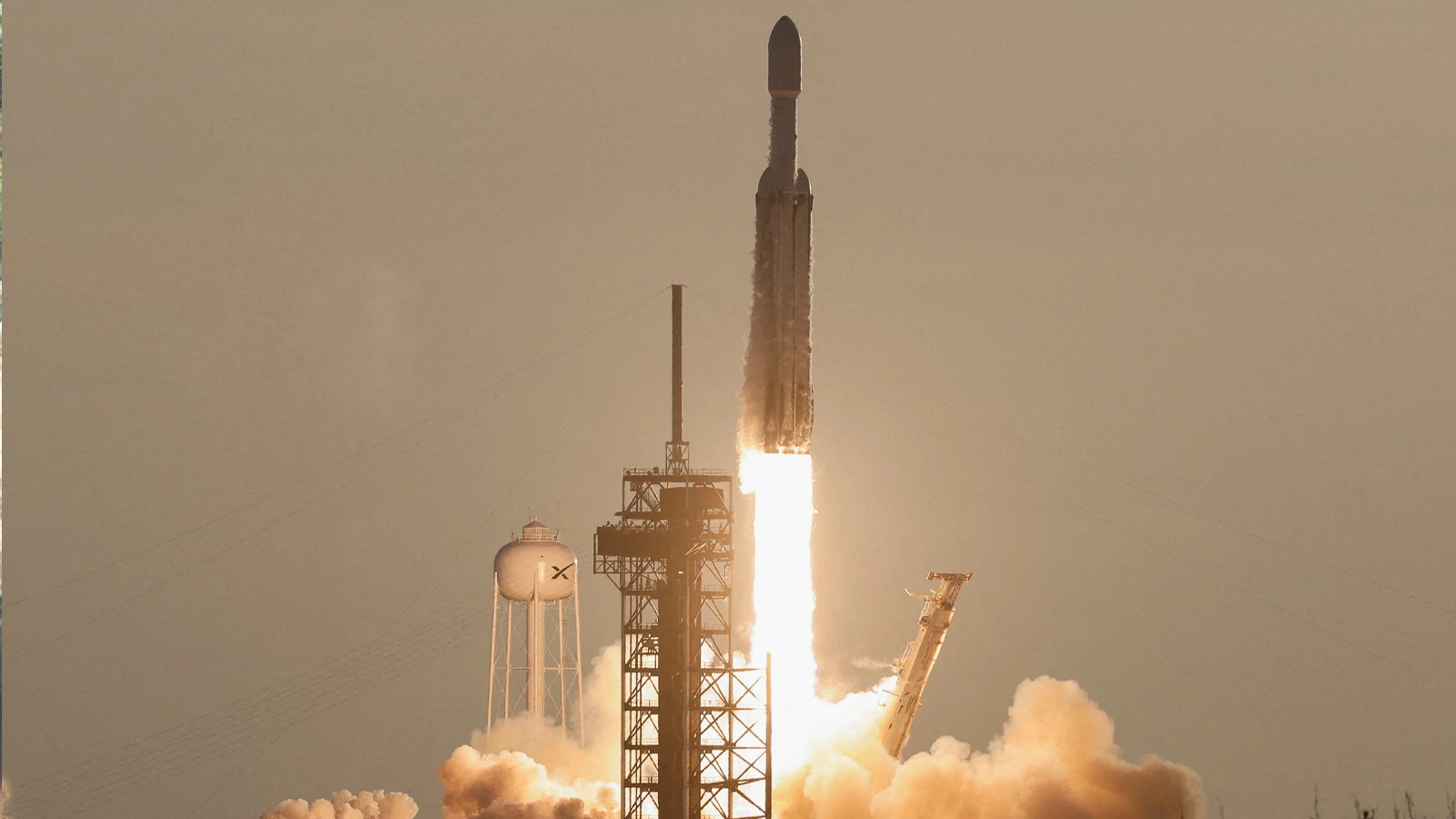
The American Aeronautics and Space Administration (NASA) sent the Nancy Grace Roman Space Telescope, the newest and most advanced observation tool, into space, which will shed light on the unknowns of the universe. The launch moment was broadcast live all over the world via the official account on the X social media platform owned by Elon Musk.
The giant telescope worth 4.3 billion dollars, which took off from NASA Kennedy Space Center in Florida at around 07.30 local time, was carried into orbit by the Falcon rocket of the space and aviation company SpaceX. The telescope is expected to take more than 3 months to reach the targeted observation point (L2 Lagrange Point), located approximately 1.5 million kilometers from Earth.
100 TIMES WIDE FIELD OF VIEW THAN HUBBLE
Named after Nancy Grace Roman, NASA’s “first chief astronomer” and known as the “Mother of Hubble”, the telescope takes its observation capacity to a whole new level with its technical features. Although it has similar resolution to the Hubble Space Telescope, the telescope has a field of view more than 100 times wider and will be able to scan large areas in space in a much shorter time.
In his statement after the launch, NASA Science Mission Directorate Administrator Nicky Fox emphasized the importance of the mission with the following words: “The Nancy Grace Roman Space Telescope will allow us to see depths we have never witnessed before, with its incredibly wide field of view. Within the scope of this mission, we aim to detect thousands of supernovae, tens of thousands of exoplanets, and billions of galaxies and stars.”
DARK MATTER AND EXPLANETS UNDER THE SPOTLIGHT
During its mission, the Nancy Grace Roman Space Telescope will focus mainly on “dark energy”, which causes the accelerated expansion of the universe, and the mysterious “dark matter” that holds galaxies together. At the same time, it will make critical contributions to the search for traces of life in the universe by discovering thousands of new exoplanets outside the Solar System using the gravitational microlensing method.
