
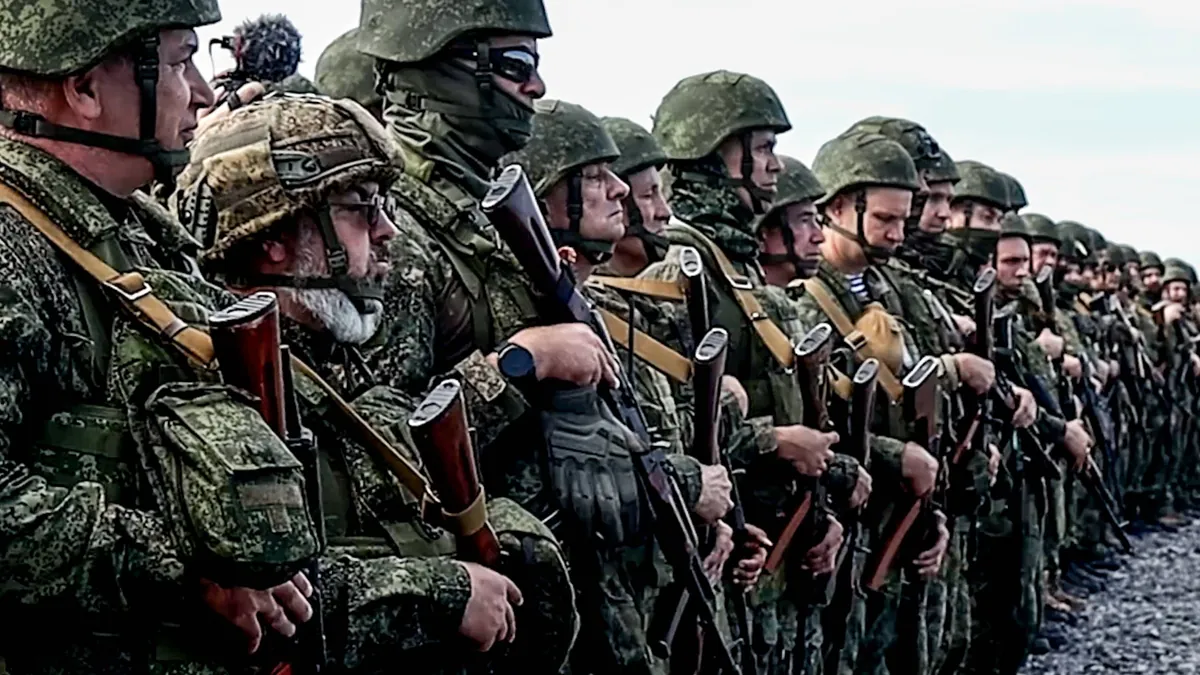
“Brought here to die”
More and more soldiers are probably leaving Putin’s army
Updated on 01/16/2026 – 05:03 amReading time: 2 minutes

New figures indicate an increase in desertions in Russia’s army. Deserters report, among other things, forced recruitment.
The number of deserters in the Russian army is likely to continue to rise significantly. According to an analysis by the Ukrainian project “Frontelligence Insight”, the number of documented desertions doubled in 2025 compared to the previous year.
According to the analysts, the analysis is based on tens of thousands of personnel files of Russian soldiers as well as internal documents from various units, including the 30th Motorized Rifle Brigade, the 1st Tank Army and parts of the 58th Army. By July 2025, 3,400 cases of desertion had already been registered – more than in the entire previous year. If the trend continues, around 70,000 soldiers could leave their service every year – around a tenth of the troops deployed in Ukraine.
A particularly drastic increase can be seen in the 30th Motorized Rifle Brigade, where the monthly number of deserters has increased sixfold since the beginning of 2024. In total, this unit alone recorded over 2,000 cases within two years. According to the analysis, the majority of deserters here are middle-aged contract soldiers.
video | Russia recruits African mercenaries to the front

Player is loading
Despite the tightening of disciplinary measures – including extrajudicial punishments and torture, as “Frontelligence Insight” reports – the number of escape attempts continues to increase. In individual units such as the 144th Separate Motorized Rifle Brigade, it was possible to bring back up to 80 percent of the deserters, but even there a significant proportion remain permanently missing.
The motives of the deserters are diverse. In addition to fear of death and poor care, many cite political rejection of the war. In several cases reported by the medium “Sever Realii”, former soldiers describe experiences of violence in training camps, mistreatment by superiors and chaotic conditions at the front. In one case, a former engineer who was forcibly recruited reported: “We were brought here to die.” Another soldier described how wounded people at the front had been deliberately shot.
