
Trend-setting vote
Knesset election: Head-to-head race expected in Israel
Updated 10/27/2026 – 6:22 p.mReading time: 3 minutes

A high voter turnout suggests that for many Israelis this is a fateful election for the country’s future. In view of a close race, the outcome seems completely open.
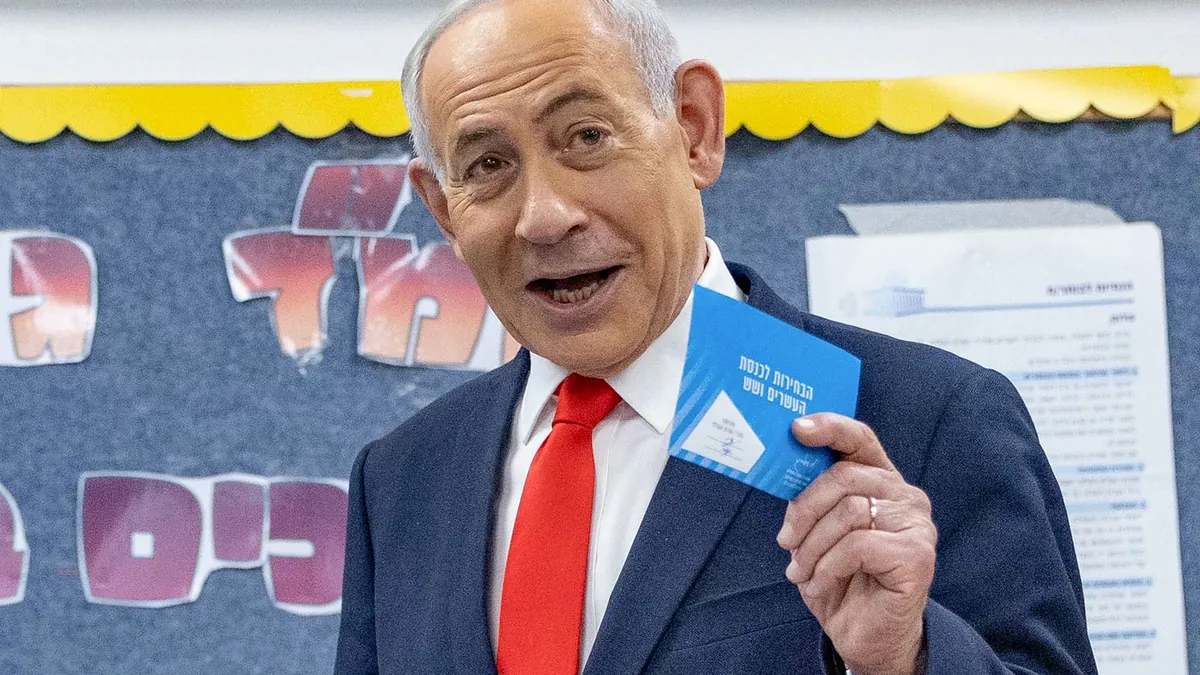
In the parliamentary election in Israel There is a high voter turnout and a close race between the Prime Minister’s camp Benjamin Netanyahu and his political opponents. The vote was seen as a fateful choice, especially for the country’s domestic political direction. According to leading politicians, a change of course in Palestinian policy seems unlikely.
Around 7.3 million eligible voters were called upon to choose the 120 members of the Knesset. Polling stations should close at 9 p.m. CET. Afterwards, the first forecasts based on post-election surveys were expected.
High voter turnout expected
According to the Central Election Commission, voter turnout was the highest since records began in 1973. At 5 p.m. CET it was 66.7 percent. In the last election in 2022 it was 55.7 percent at this time. In front of polling stations Tel Avivbut according to eyewitnesses, long queues also formed in Arab-influenced cities in Israel. According to media reports, more than 70,000 Israelis traveled from abroad to cast their votes.
Netanyahu called on his supporters on Platform X to vote and, as in previous elections, justified this with an allegedly above-average turnout among Arab citizens. According to Netanyahu, it is an “emergency call” because the participation in the right-wing camp is comparatively lower.
Tension during the counting up to and including Wednesday
The votes of hundreds of thousands of Israeli soldiers and reservists will only be counted one day later, starting on Wednesday. This group of voters is said to have strong support for right-wing parties.
Preliminary final results are expected on Thursday. The official results are due to be published eight days after the election. President Izchak Herzog then commissions the candidate who is given the best chance to form a government. He initially has four weeks to forge a coalition.
Difficult government formation expected
According to the latest polls on Friday, there is a neck-and-neck race between Prime Minister Netanyahu and his political opponents. The main challenger is former military chief Gadi Eisenkot at the head of the centrist Jashar party.
No bloc is expected to reach the 61 votes required to form a government. Therefore, long and difficult coalition negotiations could follow.
A stalemate cannot be ruled out either. In this case, Netanyahu could remain in office at the head of a transitional government until new elections are held.
The right-wing extremist police minister Itamar Ben-Gvir On election day, he shared a report from the daily newspaper “Israel Hajom” on platform
US President Donald Trump had made two election recommendations for Netanyahu.
Security and democracy dominated the election campaign
It is the first election since the Hamas massacre on October 7, 2023 and the subsequent Gaza war. After the last parliamentary election in November 2022, Netanyahu formed the most right-wing government in Israel’s history with religious and right-wing extremist forces.
A government-driven – and extremely controversial – restructuring of the judiciary as well as the dispute over the Conscription for the ultra-Orthodox deeply divided Israeli society and there were ongoing mass protests.
