
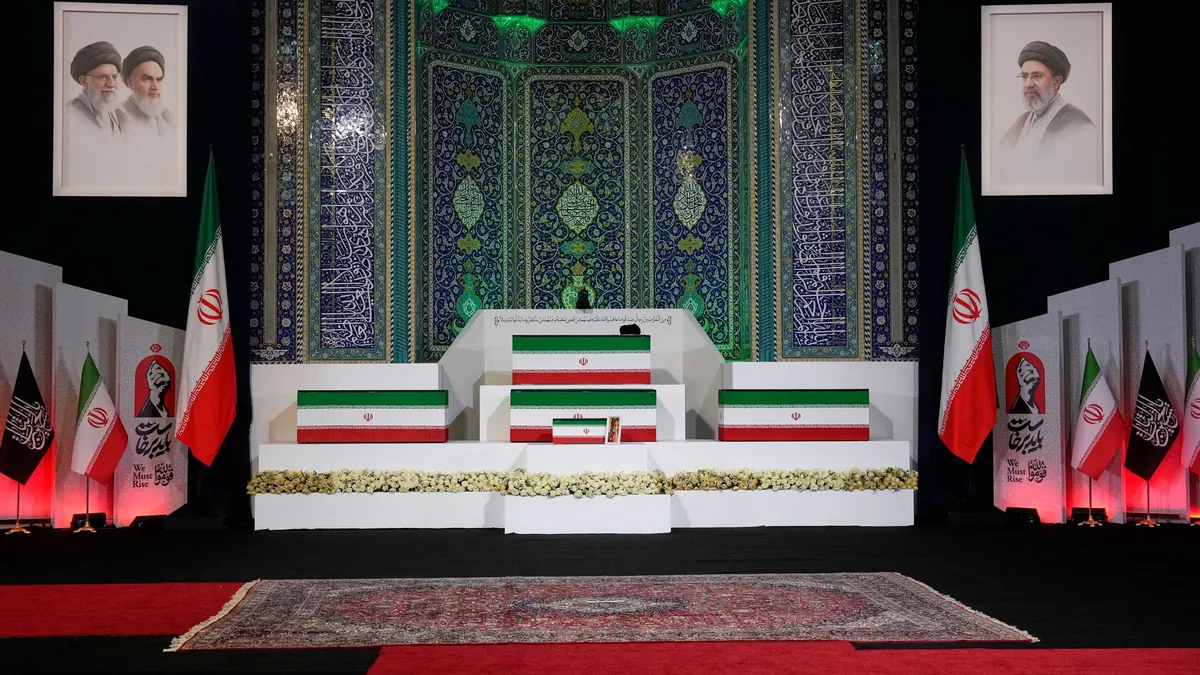
Killed head of state
Iran begins public funeral ceremonies for Khamenei
Updated July 4, 2026 – 4:00 a.mReading time: 3 minutes

Around four months after his killing, Iran’s head of state Ayatollah Ali Khamenei is finally to be buried. Now the public funeral ceremonies begin.
More than four months after his killing begins in Iran the public funeral ceremonies for the funeral of Supreme Leader Ayatollah Ali Khamenei. The body of the former head of state will remain in the capital Tehran for three days before being transported to the pilgrimage city of Qom and then to the capital for further ceremonies Iraq is brought.
The former religious leader is to be buried next Thursday in the religious center of his hometown of Mashhad. For Khamenei’s supporters and Iran’s government, the national mourning is both a farewell and a sign of a show of power.
Khamenei was killed on February 28 at the age of 86 in an Israeli airstrike on his official residence in Iran’s capital. They led for more than five weeks USA and Israel then war against Iran until representatives from Washington and Tehran agreed to a ceasefire at the beginning of April. Dozens of Iranian generals and politicians were also killed. The future of a possible agreement between the USA and Iran that is intended to permanently resolve the conflict remains uncertain.
Tightened security precautions at funeral ceremonies
Meanwhile, the authorities were preparing for a mass crowd of several million supporters. Government critics and many people in Iran who, at the beginning of the year, were against the authoritarian course of the leadership and the massive economic crisis However, those who took to the streets view the celebrations with indifference and rejection. Thousands of demonstrators were killed in protests in mid-January.
For security reasons, Iran plans to close its airspace for several days from Monday. More than 65,000 security forces will be deployed in the metropolises, the state news agency Irna reported, citing the commander of the law enforcement forces. Another 200,000 troops are expected to ensure security in the provinces.
With a view to the war between the USA and Israel, Iran’s armed forces warned of a new military escalation around national mourning. “Any miscalculation will be met with a decisive and even harsher response than ever before. A response that will forever be recorded in its history of shame,” said a statement from the Revolutionary Guard carried by Iranian media.
Khamenei ruled with absolute severity until his death
As Iran’s supreme leader, Khamenei had the final say on all important issues; the government and president were subordinate to him. The Shiite Ayatollah was also the supreme religious authority of the Islamic Republic. Under his leadership, the Revolutionary Guards became the country’s leading military force and expanded their influence in the region.
Khamenei was considered untouchable. Under his leadership, the country with its strong security apparatus rose to become an influential regional power, although it has been massively weakened in recent years. He also ruled internally with absolute severity. As head of state, the cleric had authoritarian traits. Criticism of his person was not tolerated. “Death to the dictator,” demonstrators chanted during recent waves of protests.
Uncertainty about Khamenei junior
Khamenei’s son Moschtaba was appointed as the new leader a week after his father’s death in early March, but has not made any public appearances since then. This had sparked speculation about his health and there was talk of serious injuries. State television described him as a “disabled war veteran” but gave no further details. It is also unclear whether he will appear at the funeral in Mashhad.
