
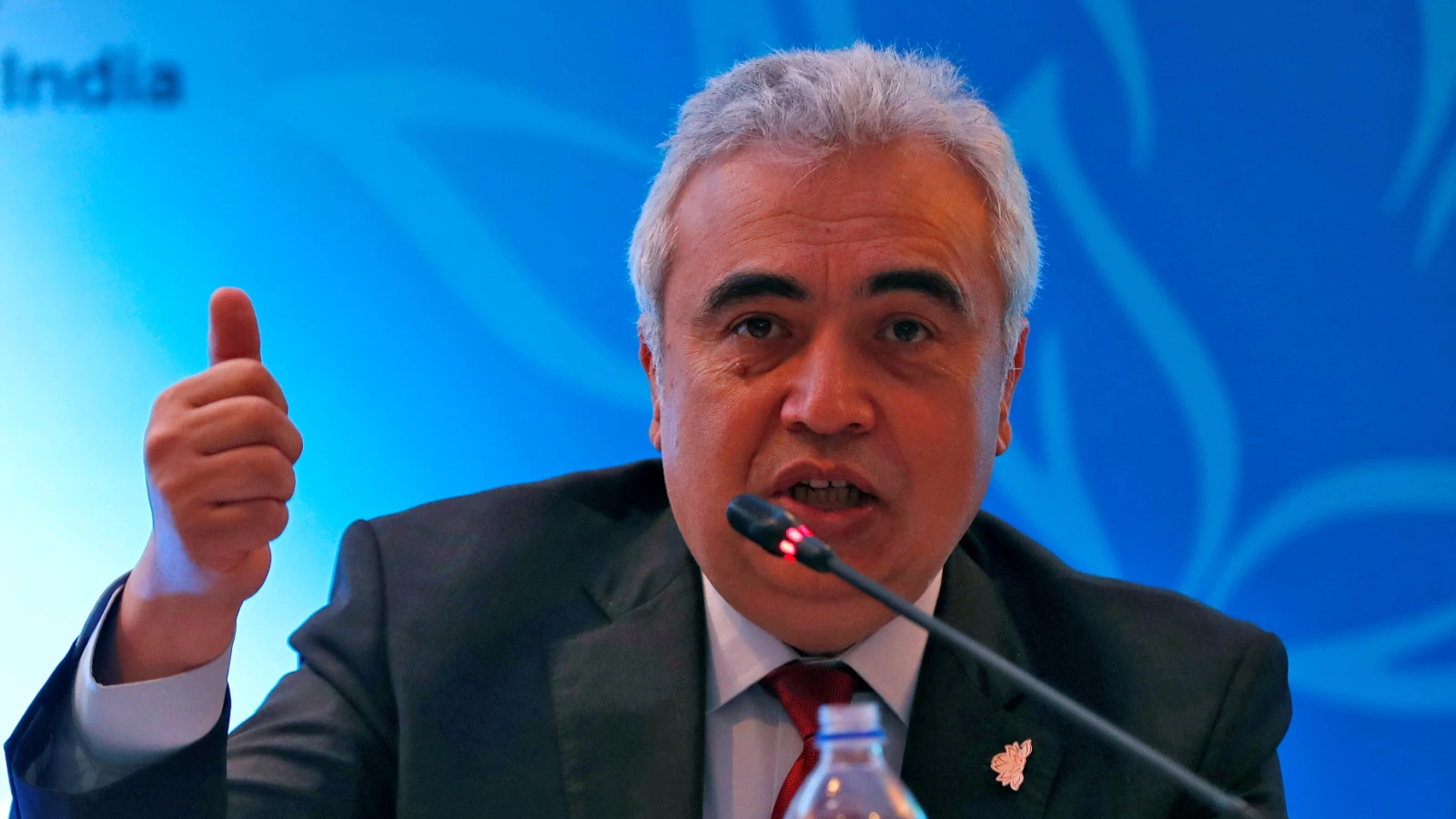
Fatih Birol, President of the International Energy Agency (IEA), stated that 84 energy facilities were damaged in the attacks in the Middle East and 34 of them were “serious and very seriously damaged” and said, “Even if the Strait of Hormuz is opened safely and immediately to convince everyone, it would be optimistic to expect the oil and natural gas supply to return to pre-war levels. It may take at least 2 years for the production in these facilities to return to normal levels, and for some, this process may exceed 2 years.” he said.
Birol answered the questions of the AA correspondent regarding the effects of the war in the Middle East on the energy markets and his predictions on this issue.
Birol said that they have been pointing out that it is “unwise” for the world economy to be dependent on such a narrow strait for many years, and that they have warned that the economy may be paralyzed if the Strait of Hormuz is closed.
Birol stated that the closure of the Bosphorus poses a great energy security risk for the global economy, whose size exceeds 110 trillion dollars, and that all countries have started to think about plans for what can be done in the short and medium term.
Giving information that there is a daily loss of 13 million barrels of crude oil in the oil supply in the short term, Birol continued as follows:
“When we consider that the world’s daily oil demand is at the level of 100 million barrels, 13 million barrels is a huge loss. There is also a loss of around 100 billion cubic meters in natural gas supply. When we look at all two of them, we are faced with a crisis greater than the sum of the energy crises so far. This is not only an oil and gas crisis, but also a difficult situation for some commodities that are extremely vital for the world economy. Such as fertilizer, sulfur, helium and petrochemical products. “There is also a huge problem in terms of commodities that are critical to supply chains.”
200 OIL AND 10 LNG TANKERS ARE FULL, WAITING FOR THE OPENING OF THE BOSPHORUS
Birol stated that more than 200 crude oil and petroleum product tankers and 10 liquefied natural gas (LNG) tankers are currently waiting full in the Gulf region.
Stating that with the opening of the Strait of Hormuz, this supply will come to the market and some relief may be seen, Birol said, “However, even if the Strait of Hormuz is opened safely and immediately in a way that convinces everyone, it would be optimistic to expect the oil and natural gas supply to return to pre-war levels. The most current data we have shows that 84 energy facilities, including oil and gas fields, refineries and LNG terminals, are currently damaged. 34 of them are seriously and very seriously damaged. Production in these facilities is not.” “It may take at least 2 years to return to normal levels, and for some, this process may exceed 2 years.” he said.
“WE NEED TO BE PREPARED FOR A VOLATILE OIL MARKET IN THE COMING MONTHS”
Birol also shared his predictions for the oil markets and said that the most important factor that will determine the prices is the opening of the Strait of Hormuz and the assurance by all actors that it will remain open from now on.
Stating that only in this way will insurance companies insure the ships and the trade flow can continue, Birol said, “We should all be ready for a volatile oil market in the coming months. High oil prices are a big risk, especially for developing countries. High oil prices will both cause an acceleration of inflation and a widening of the foreign trade deficit in many developing countries. My biggest fear is the risk of this situation creating a foreign debt vortex for many countries.” he said.
Birol reminded that they formed a joint emergency crisis coordination group with the presidents of the International Monetary Fund (IMF) and the World Bank last week, and said that this group will work on providing direct financial and guidance support, especially to developing countries.
“THERE ARE A FEW ALTERNATIVES FOR Türkiye”
Stating that all countries’ search for alternatives accelerated with the war and that alternative oil and gas routes, technologies, fuels and energy partners will come to the agenda, Birol said, “In this context, there are several alternatives in front of Türkiye. One of the alternative projects that Türkiye should look at is a pipeline between Basra and Ceyhan and the further development of the existing pipeline. The other could be the further expansion of the Baku-Ceyhan pipeline.” he said.
Birol underlined that the projects that may come to the agenda during this period should be created on a solid political, financial and legal basis and said, “Many projects will be in competition with each other. But the advantage of our country is the possibility of the oil and gas coming to Türkiye to be transported to both the Mediterranean and Europe. This is a very important advantage.” made his assessment.
SITUATION IN ENERGY FACILITIES IN THE REGION
The energy infrastructure in the Middle East was significantly damaged in the attacks carried out after the US/Israel-Iran War started on February 28.
These include LNG production facilities in Ras Laffan and Mesaieed industrial cities owned by QatarEnergy in Qatar, one of the world’s largest LNG producers.
Additionally, significant infrastructure problems occurred at many facilities in countries in the region, including Bahrain, Saudi Arabia, the United Arab Emirates and Iraq.
