
Crisis meeting at the G20 summit
Fateful days for Ukraine: How can Europe help?
Updated 11/23/2025 – 5:18 amReading time: 4 minutes

US President Trump shocked Ukraine and the Europeans with his new peace plan. Can this still become an opportunity for a just end to the war?
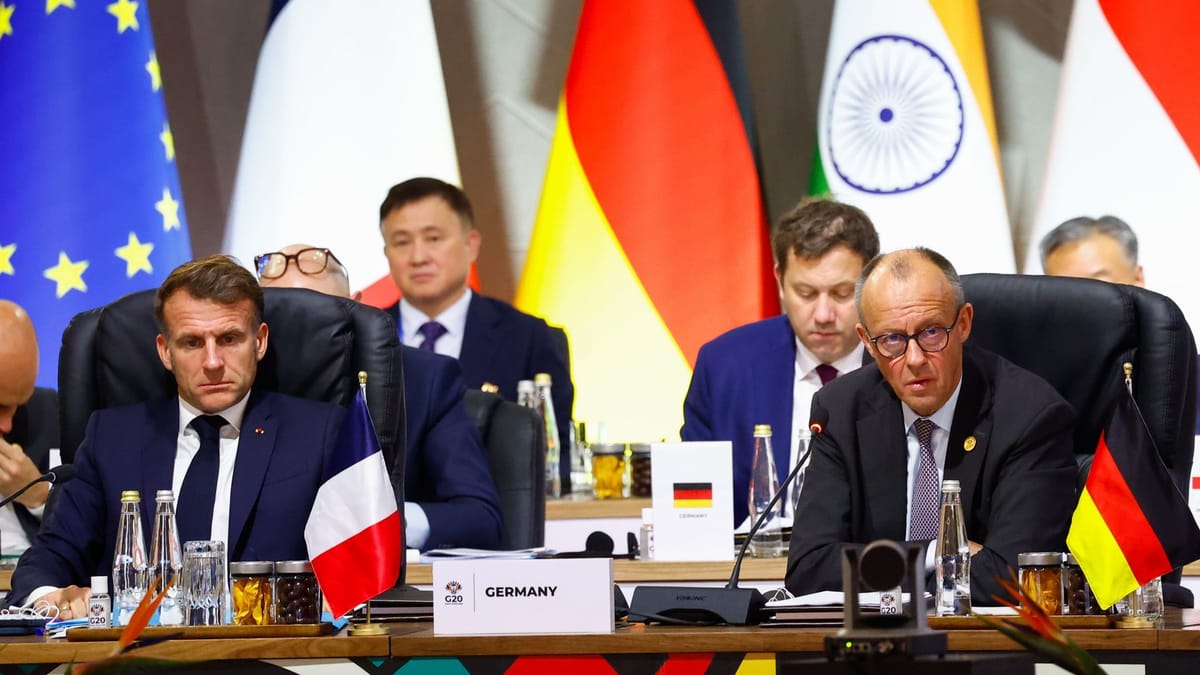
The seriousness of the situation can be heard when Chancellor Friedrich Merz (CDU) appears in front of the cameras at the G20 summit in Johannesburg. Shortly beforehand, he discussed US President Donald Trump’s peace initiative with European heads of state and government. About the plan that shocked not only Ukrainian President Volodymyr Zelensky, but also his European allies. Japan and Canada join in. Basically everyone who doesn’t want to let Ukraine down in the crucial phase of the defensive battle against Russia has come together.
It’s about perhaps getting the peace plan, which is simply unacceptable for Ukraine, on the right track. And all this under massive time pressure. Trump wants a result by Thursday. His proposal, for example, stipulates that Ukraine cede previously defended areas to Russia, limit its military capabilities and that NATO declare a renunciation of any expansion. That would be tantamount to surrender.
For the Europeans, dealing with the American plan is a high-risk balancing act. They see the great risk that the security situation could become even worse for them if far-reaching concessions are made to the aggressor Russia.
At the same time, many heads of state and government are confronted with war-weary voters at home who are increasingly questioning the costly support for Ukraine. The European Union and the member states have now mobilized almost 190 billion euros.
It is also viewed critically that since travel restrictions were relaxed, numerous young Ukrainian men have left their homeland for the EU in order to avoid being drafted into military service. The question is why should we continue to support the country if not even young Ukrainians want to fight for the future of their country?
The problem for the Europeans is that they have little leverage against US President Trump. A number of top politicians have openly admitted in the past that attempting to support Ukraine without the United States would probably be futile. Quite simply because the necessary military capabilities were lacking. For example, American Patriot air defense systems are considered indispensable for the foreseeable future in defending Ukrainian airspace against Ukrainian drones and missile attacks. The same applies to US intelligence information and long-range rocket launchers.
In addition, the costly and risky nature of attempting it would probably be very difficult to convey to the population in many countries. Within the EU, far-reaching plans for more support for Ukraine can no longer be implemented because they require unanimous approval and block countries like Hungary and Slovakia.
