
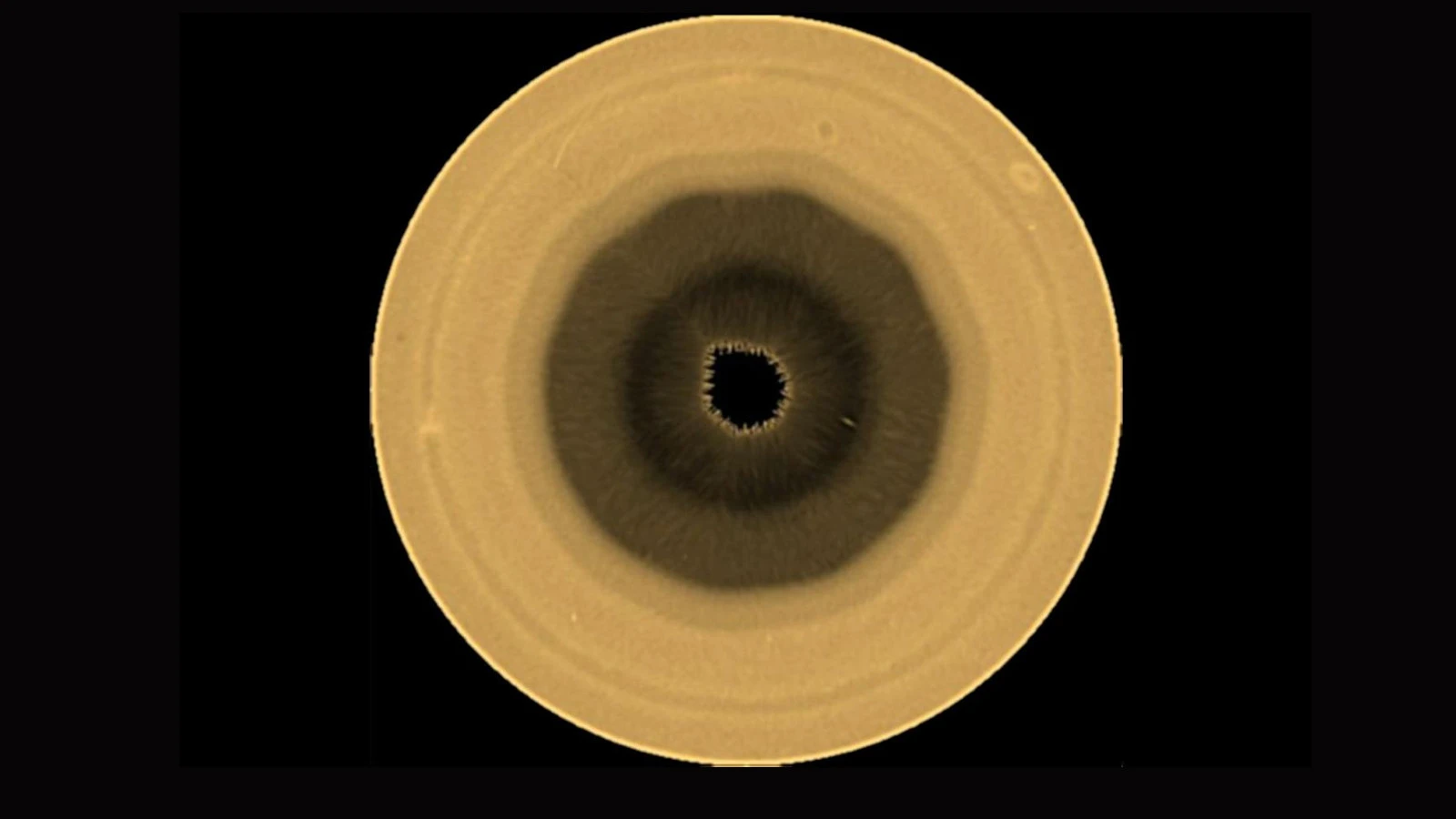
The ringed planet Saturn continues to surprise the scientific world with extraordinary formations in its atmosphere. Astronomers have detected a huge decagonal cloud structure, approximately 168 thousand kilometers wide, at the south pole of the planet. It was noteworthy that the structure was much larger than the famous hexagon that has been observed for years at Saturn’s north pole.
The research was published in the journal Science Advances. According to scientists’ calculations, the discovered decagonal structure has a width of approximately 167 thousand 820 kilometers. It was determined that the length of each side of the structure is approximately 16 thousand 780 kilometers.
Compared to the hexagon located at Saturn’s north pole, which is approximately 32 thousand kilometers wide, the scale of the new discovery reaches remarkable dimensions.
IT REVEALED YEARS LATER
The mysterious formation was revealed by re-examination of images obtained by NASA’s Hubble Space Telescope.
Due to Saturn’s axis tilt, the planet’s southern hemisphere could not be observed from Earth at a suitable angle between 2012 and 2023. Images obtained after visibility conditions became favorable again revealed a previously unnoticed symmetrical cloud pattern at the south pole.
Researchers stated that since the discovery of the hexagonal structure in the north pole, they have been looking for a similar geometric formation in the south pole, but have not found any signs so far.
Therefore, the new discovery was an unexpected surprise for scientists.
HOW WAS THIS GIANT STRUCTURE CREATED?
Computer simulations and experiments on atmospheric currents indicate that the decagonal structure may have formed as a result of ripples trapped in a powerful winding atmospheric jet stream.
However, the formation at the south pole differs from the hexagon in the north at an important point.
While the hexagonal structure at Saturn’s north pole has largely preserved its shape and color for decades, changes in brightness and darkness were observed at the edges of the decagon at the south pole.
Scientists state that this variability suggests that the structure is still going through an active and dynamic evolution process.
WILL BE CLOSELY MONITORED UNTIL 2032
Researchers have now turned their eyes to the future of the massive structure at Saturn’s south pole.
Solar radiation in the region is expected to peak in 2032. With the observations to be made until this date, scientists will try to understand whether the decagonal structure will become increasingly stable or whether it will deteriorate and disappear over time.
The new discovery is considered to be important not only for understanding Saturn’s atmosphere, but also for obtaining more information about the atmospheric movements of gas giants and planetary meteorology.
The gigantic decagon that emerged at the south pole after the mysterious hexagon at Saturn’s north pole once again showed that the planet’s atmosphere has many secrets still waiting to be discovered.
