
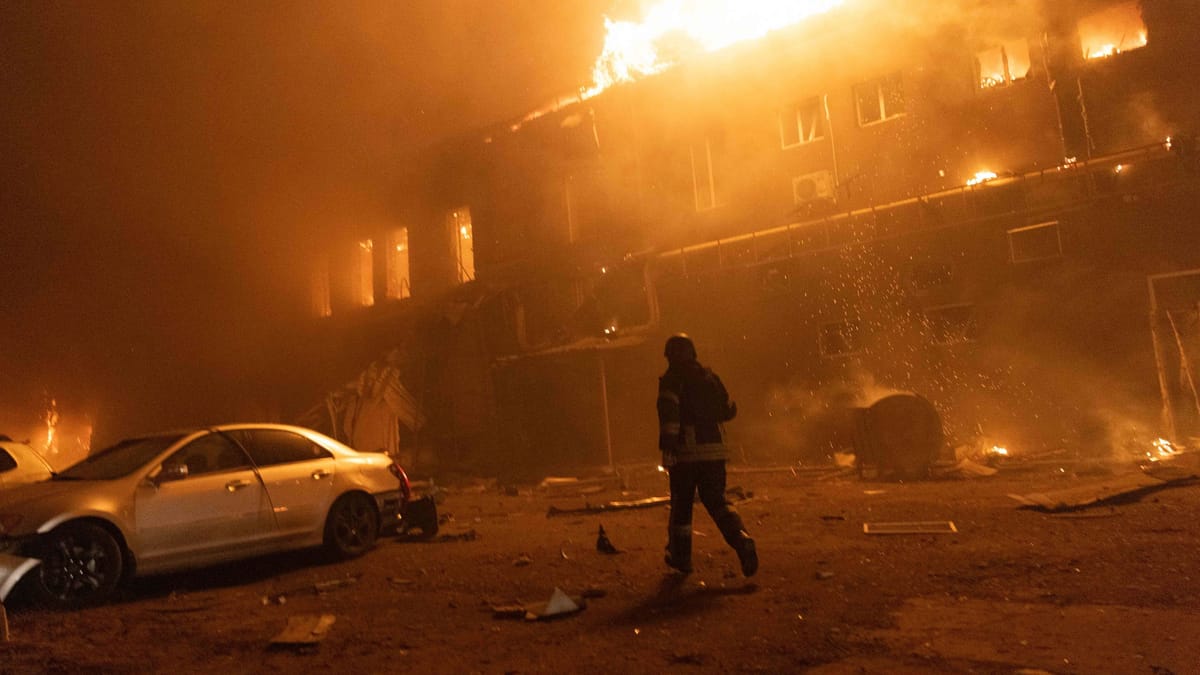
Three and a half years after the attack on Ukraine, Russia mostly attacks drones with drones. The attacks could become even more violent, warns a German general.
Anyone who has heard the sound of a Shahehed drone approaching their goal will not forget that so quickly. The gun with which Russia currently attacks Ukraine sounds like an old motorcycle. This is due to the two -stroke engine, with which the Shaheds are driven and which accelerates the drones to a march speed of up to 240 kilometers per hour until the whir is stopped and replaced by an explosion when the weapon finds its goal.
For Russia, the attacks with Shahed drones have several advantages: Since they only cost around 50,000 euros each in production, the armaments industry can produce them in large quantities. In addition, the attacks with drone swarms regularly manage to overwhelm the Ukrainian air defense, so that many explosives find their destination and thus intimidate the civilian population.
Due to the mass production of the drones, Russia could soon attack Ukraine with even larger drone swarms, warns Major General Christian Freding, head of the Bundeswehr Ukraine situation. “Russia is planning attacks with up to 2,000 drones,” he says in a video published on Saturday on the Bundeswehr YouTube channel.
Russia’s goal is to “over -saturate” Ukrainian air defense, Freding continues. According to its own statements, Ukraine succeeds in shooting around 80 percent of the drones. “But if 20 percent get through with 700 drones, considerable damage is created,” explains the Major General.
A central problem is the costs resulting from the defense against Shahed attacks. Although the anti-aircraft systems delivered by the West, such as the US Patriot would work well, a defense rocket for the system costs around five million euros, while the costs for a Shahed drone amounted to around 50,000 euros, according to Freding.
“The conventional defense systems are effective, but are not economically unacceptable,” emphasizes Freuding. “We need countermeasures in the range of 2,000 to 4,000 euros per unit in order to be able to react economically efficiently.” In addition, the Ukraine must be supplied with weapons from the West, which to attack it, military infrastructure in the Russian hinterland.
Freding sees China’s role in the Russian attacks particularly critically. Beijing has now completely stopped the export of drone parts to Ukraine and instead deliver only to Russia. “Ukraine was displaced from this market,” said Freuding. This development tightens the already tense situation on the front.
At the beginning of the war, Russia mainly used marching missiles and ballistic rockets to attack destinations in Ukraine. But that apparently did not expect Putin. Because these attacks are expensive: the most extensive attack of this kind so far in August 2024 cost the Kremlin around 1.3 billion euros, as the “Ukrajinska Prawda” calculated.
Shahed attacks are cheaper for Russia
In contrast, the attacks with Shahed drones are much cheaper. When 539 Shaheds attacked Ukraine on July 4 of this year, this was associated with costs of only around 27 million euros for Putin. This should be an important factor in the conversion of the Russian attack tactics.
According to the US Institute for the Study of War, Russia has massively raised its drone production. Up to 2,700 Shahed drones and 2,500 dummies are currently to be produced every month. Although these sham destinations do not have an explosive, but can hardly be distinguished from real attack drones and thus present the Ukrainian air defense before a dilemma: either they arouse the real drones laboriously or they shoot expensive rockets on dummies. Both provide the real attack drones.
