
The fact that European countries have allowed the sale of pesticides to other countries, which they banned to protect their own citizens, has opened the door to a new debate on food safety. Recent studies prepared by Switzerland-based Public Eye and Greenpeace’s research unit Unearthed have revealed the extent of Europe’s trade in banned pesticides. According to the research based on documents obtained from the European Chemicals Agency and national institutions, while the planned export of banned pesticides from European countries was 81 thousand 600 tons in 2018, this rate has increased to approximately 122 thousand tons in recent years.
GERMANY IS IN THE FIRST PLACE
The growth of trade drew attention despite the European Commission’s commitment to end the export of banned chemicals in 2020. While Germany alone accounted for more than 40 percent of banned pesticide exports, this country was followed by Belgium, Spain, the Netherlands and Bulgaria.
PUBLISHED ON THE PRODUCTS
It is noteworthy that some chemicals mentioned in export documents from Europe to Türkiye are also detected in food products sent from Türkiye to Europe. In the 2026 records of the European Union’s Rapid Alert System for Food and Feed (RASFF), Imidacloprid and Cyfluthrin residues were found in grape leaves sent from Türkiye. Both substances are on Türkiye’s list of banned active substances.
Türkiye IS IN SECOND PLACE
According to the data compiled by Greenpeace Türkiye from RASFF records, Türkiye became the second country that received the most notifications due to pesticide residues in 2025.. While India ranked first with 124 notifications, 105 notifications were made about Türkiye, 88 notifications about Egypt, 48 notifications about China and 34 notifications about Brazil. 51 of the 105 notifications about Türkiye resulted in the products being turned away from the border. Of the notifications regarding products not allowed to enter Europe, 27 were about peppers, 9 about tomatoes, 5 about pomegranates and 4 about lemons.
DID IT REMAIN ON PAPER?
The problem continued in 2026. Nine different chemicals on the banned substances list of the Ministry of Agriculture and Forestry were found in the records of food products sent from Türkiye until the beginning of July. Some of these were in the process of being banned in Türkiye in 2020 and 2021. However, years later, traces of banned substances were detected in peppers, tangerines, pomegranates, vine leaves and even organic dried figs. In the same period, 254 notifications were made about foods originating from Türkiye, and 197 of them were about vegetables and fruits. While 183 of the notifications were classified as serious risk, 188 resulted in the products being turned away from the border.
15 YEARS BANNED DRUG
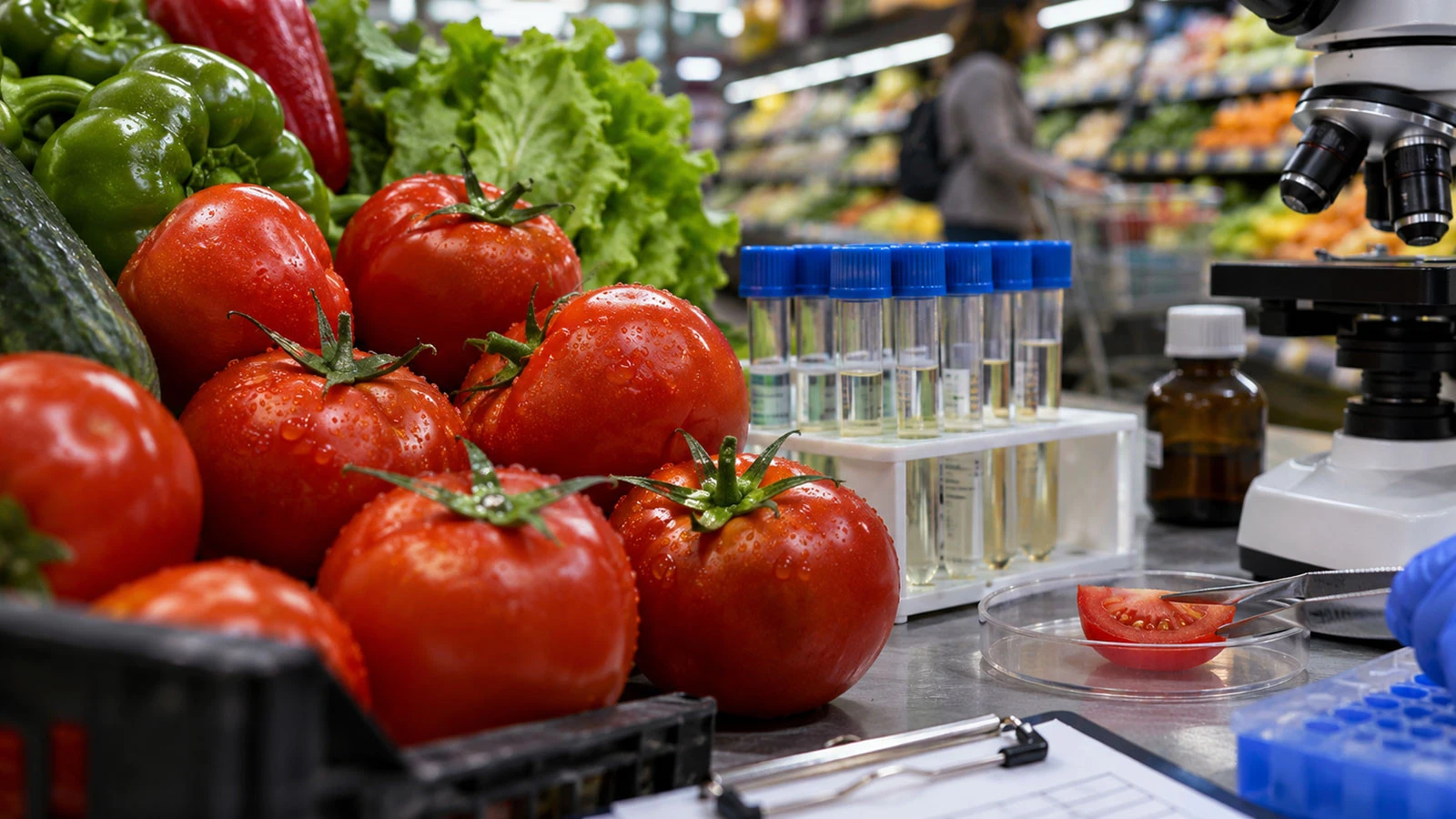
One of the most remarkable studies regarding the products offered to the domestic market in Türkiye was announced to the public on September 1, 2026. Greenpeace Turkey examined 20 tomato samples taken from five large market chains operating in Kadıköy, Ataşehir, Sancaktepe and Sultanbeyli districts of Istanbul. While non-compliance with the legislation was detected in three of the samples, more than three pesticide residues were found in seven of them. A chemical called Chlorfenapyr, whose use has been completely banned in Türkiye since December 31, 2010, was found in a tomato. No pesticide residue was found in only one of the 20 tomatoes examined.
WHAT DOES THE DATA SAY?
As a result of the legal struggle waged by Greenpeace Türkiye for the disclosure of pesticide analyses, some inspection results of the Ministry of Agriculture and Forestry for the past years have come to light. According to the information shared by the Ministry, violations of the legislation were detected in 6 thousand 369 of 246 thousand 946 samples taken from 55 different products between 2021-2023. While the non-conformity rate in the inspected samples was calculated as 2.58 percent, details about which chemicals were contained in which products and to what extent legal limits were exceeded were not shared.
PRESCRIPTION PERIOD
The Ministry of Agriculture and Forestry has implemented the B-Prescription system in 81 provinces as of July 1, 2026, in order to prevent erroneous and uncontrolled use of pesticides. The application, which was first launched in Ankara, Mersin, Samsun and Kırklareli, aims to electronically record which pesticide the farmer uses, for which product, in how much and on which land.
