
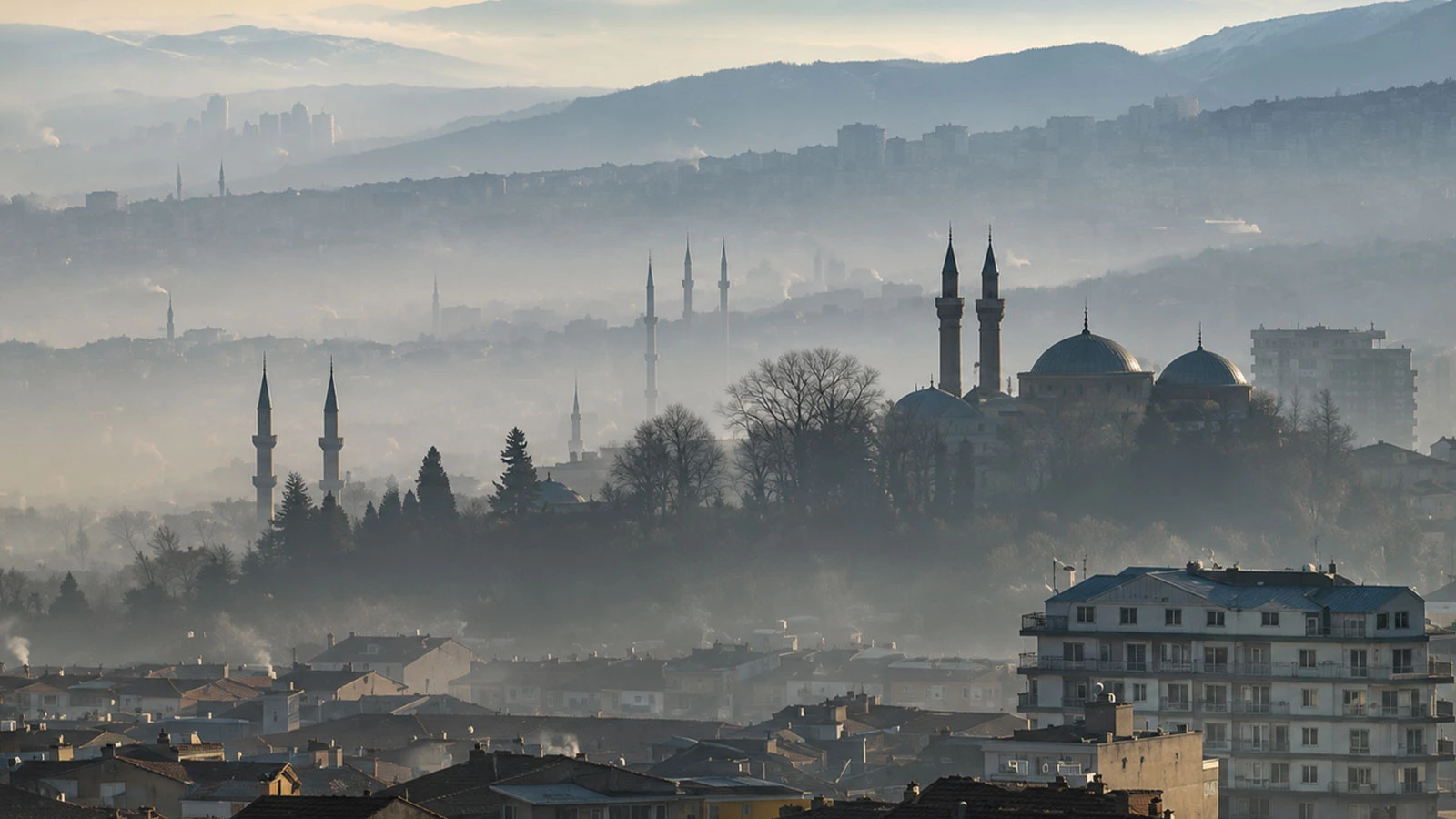
Bursa, one of Türkiye’s leading cities in terms of industry and population density, faces the problem of gradually warming weather and ongoing pollution. The research prepared by Özkan Çapraz from Istanbul Technical University Eurasia Earth Sciences Institute revealed the dimensions of environmental change in the city. While the study examined temperature measurements between 1996-2025 and air pollution data obtained from five different stations in the period 2013-2025, the results showed that although there was a general decrease in the density of harmful dust particles in the air, pollution continued to be a problem for human health.
INCREASE OF 1.74 DEGREES
One of the remarkable results of the research was the change in the temperature values of Bursa. While the annual average temperature in the city for the period 1996-2025 was calculated as 15.4 degrees, an average increase in temperatures of 0.06 degrees was determined every year. The lowest annual average temperature of the examined period was measured as 13.8 degrees in 1997, while the highest value reached 16.9 degrees in 2024. Thus, there was a difference of 3.1 degrees between the averages of the coldest and hottest years. Warming was not limited to the summer months only. It was observed that the temperature increase became especially evident in autumn. An annual increase of 0.09 degrees in September and November and 0.07 degrees in August was calculated. It was determined that temperatures increased in all months except May.
HARMFUL PARTICLES
The second important problem in Bursa is air pollution. In the research, the density of dust particles that can enter the body through breathing and have a diameter of less than 10 micrometers was examined. The average pollution value between 2013 and 2025 at the measurement station in the center of Bursa was calculated as 72.6 micrograms per cubic meter of air. While the annual average limit value for particles smaller than 10 micrometers in diameter in Türkiye is 40 micrograms, the average values reached approximately 1.8 times the legal limit.
A RECORD WAS BROKEN IN 2015
The year with the highest pollution was recorded as 2015. During this period, the annual average value increased to 104.7 micrograms. In the following years, there was a significant decrease, especially from 2018, and the average decreased to 40 micrograms in 2024. However, the research revealed that pollution will rise again in 2025. A similar increase was also seen in measurements on Beyazıt Street.
5 TIMES HIGH
In the study, measurements in Kestel also showed that the improvement in air quality was not reflected equally in all parts of the city. Moreover, it was determined that pollution increased in May, June and July. Although these increasing trends were not statistically strong, Kestel differed among the stations examined with this feature. According to the research, the highest annual average density of dust particles smaller than 10 micrometers in diameter was measured in Kestel in 2025. In measurements around Uludağ University, the 13-year average of fine particles, which are smaller and can reach the deep parts of the lungs, was determined to be 25 micrograms per cubic meter of air. While the annual average limit recommended by the World Health Organization for these particles is 5 micrograms, the long-term average measured around the university reached five times this value.
DIFFERENCE OF UP TO 10 DEGREES
Scientific studies evaluated in Özkan Çapraz’s research also revealed that dense construction in Bursa caused a temperature difference of 1.5 to 2 degrees between the city center and the surrounding regions. According to satellite data, it was determined that the surface temperature difference between the city center and green areas was 5 to 6 degrees on average and reached 10 degrees at some points. High temperatures stood out in industrial areas during the day and in Osmangazi and Yıldırım districts at night. While increasing temperatures increase the risk of drought and pressure on water resources, the study emphasized that despite the improvement in air quality, pollution caused by industry, heating and traffic should be reduced and green areas should be protected.
