
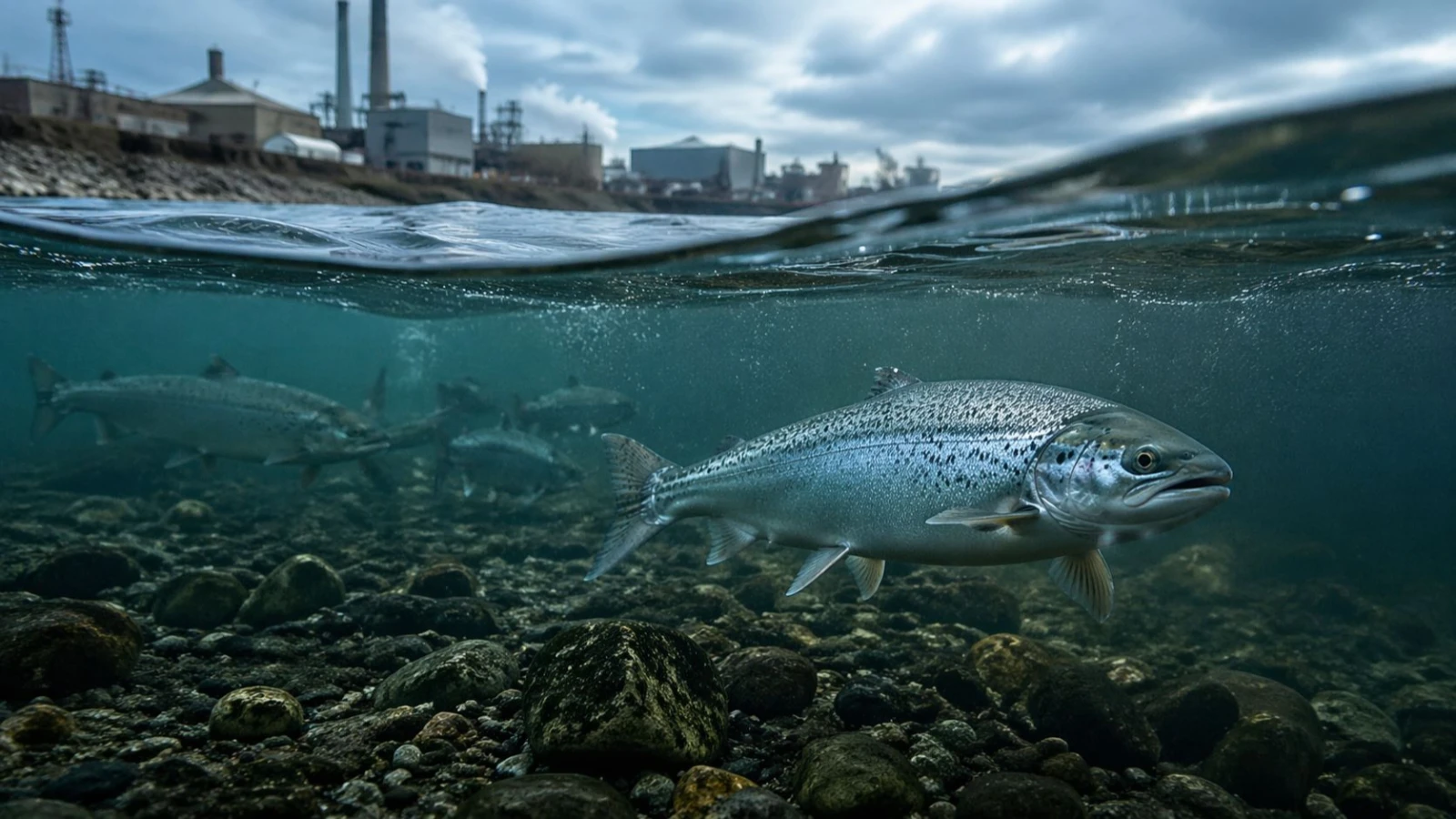
Researchers observed that Atlantic salmon exposed to cocaine and its major metabolite, benzoylecgonine, showed significant changes in their behavior, which could have profound consequences on ecosystem balances.
Essentially, these fish travel much longer distances and disperse over a much wider area than salmon that have not been exposed to drugs; The effects of this are completely unpredictable. This was demonstrated in the first and controversial experiment carried out in the wild by scientists by drugging fish via a slow-release mechanism. Previously, behavioral changes had only been detected in vitro; However, laboratory analyzes naturally have significant shortcomings due to the numerous limitations imposed by captivity conditions.
controversial experiment
Exposing salmon to cocaine to monitor their behavior may seem strange and cruel, but in reality it’s an everyday occurrence for many fish that live in lakes and rivers.
Especially in urban areas, high amounts of cocaine are found in the wastewater of cities due to the intense consumption of this drug. Despite modern filtration systems, drugs and their metabolites still find their way into waterways and natural watersheds, poisoning the animals that live there.
In 2018, Italian researchers from the Department of Biology of the University of Naples Federico II and the Department of Chemistry and Biology of the University of Salerno showed that the rivers of major cities were polluted with cocaine at such high levels that this substance seriously damaged the muscles of endangered eels and disrupted their ability to migrate and reproduce.
Other studies have also shown that various drugs, such as anxiolytics, entering rivers and seas can disrupt the behavior of fish and harm their health. In the new study, researchers wanted to examine what consequences actually occur in animals exposed to cocaine.
The experiment was carried out by a large international research team led by scientists from the Umeå campus of the Swedish University of Agricultural Sciences. The team collaborated closely with colleagues from many institutions. Participating institutions include the Zoological Institute of the Zoological Society of London (UK), České Budějovice University of South Bohemia (Czechia), Max Planck Institute for Animal Behavior (Germany), Stockholm University Department of Zoology (Sweden) and Griffith University Australian Rivers Institute (Australia). Researchers coordinated by Jack A. Brand and Michael G. Bertram reached their conclusions after releasing young Atlantic salmon (smolt) into Sweden’s large natural Lake Vättern, where cocaine contamination is low.
Tested on 105 salmon
A total of 105 farm-raised salmon, approximately 2 years old, were used in the study. These fish were implanted with a device that slowly released cocaine, the metabolite benzoylecgonine, or nothing for the control group. Three groups were followed with an acoustic telemetry system for eight weeks; In this way, researchers analyzed weekly movements, distances traveled, spatial distribution and apparent survival rate. Finally, the concentrations of the substances in the brain were also examined in the fish that could be brought back.
When all the data was put together, it was revealed that fish exposed to benzoylecgonine, the main substance the human body produces after taking cocaine, swam up to 1.9 times farther than control fish.
This was especially evident in the final weeks of the study. Some fish traveled 13-14 kilometers further. Their spatial distribution became 12.3 kilometers wider than where they were released, and they tended to congregate in more northern areas of the lake.
Cocaine also showed significant effects, but the effects of the metabolite were much more pronounced. Interestingly, the drugged fish had a slightly higher survival rate; Although there was serious statistical uncertainty here. Possibly traveling longer distances may have brought them to safer areas from predators. The accumulation of the substance in the brain was approximately 43 ng/g for cocaine and 34 ng/g for the metabolite; these are concentrations similar to levels observed in polluted waterways and watersheds.
These movement changes may seem insignificant at first glance, but in reality they have serious effects on ecosystem balances. “Where fish are found determines what they eat, who eats them, and how populations are structured,” study co-author Marcus Michelangeli said in a press release. He added: “If pollution is changing these patterns, it has the potential to affect ecosystems in ways that we are only now beginning to understand.” Due to the type of study, the increase in aggression seen in cocaine-exposed fish in laboratory tests could not be analyzed; However, it is possible that salmon also exhibited such behavior.
“The idea that cocaine could have an effect on fish may seem surprising, but the reality is that wildlife is already exposed to a wide range of human-derived drugs every day,” said the study’s lead author. He also emphasized that what’s interesting is not the experiment itself, but “what’s already happening in our waterways.” This is yet another proof of how profoundly human activities and behaviors—in this case illegal ones—can affect the lives of other animals, and with it the balance of entire ecosystems.
Details of the research were published in the journal Current Biology with the title “Cocaine pollution alters the movement and space use of Atlantic salmon (Salmo salar) in a large natural lake.”
