
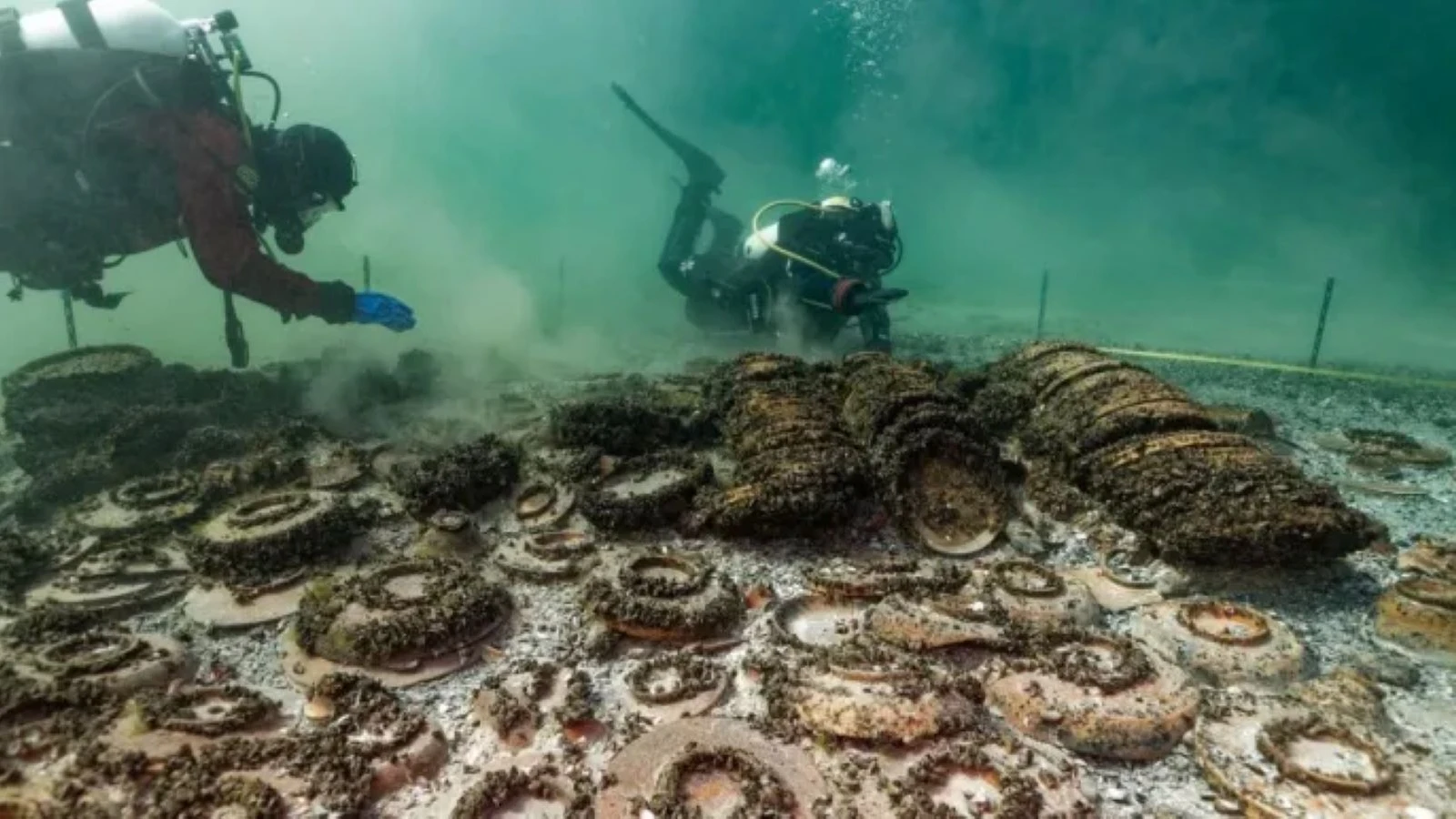
An anomaly spotted by Fabien Droz in the water led archaeologist Fabien Langenegger and the president of the Octopus Foundation, a nonprofit that aims to preserve marine heritage, to conduct inspection dives. As a result of these dives, a large accumulation of artifacts was unearthed. It soon became clear that this was the cargo of a Roman ship that had remained hidden under layers of sediment for centuries.
Scientific analysis has enabled the shipwreck to be dated fairly precisely. A wooden sample examined using the carbon-14 method showed that the load dates back to between 50 BC and 50 AD.
Additionally, thanks to the dendrochronological analysis of a fibula (military brooch) and a wooden piece found in the region, the dating became clearer and pointed to after 17 AD.
The excavations, which were carried out in two stages in 2025 and 2026, were carried out in a specific area at a depth of approximately 8 meters. Archaeologists worked systematically by dividing the site into sections and gradually removed the artifacts. The total number of artifacts found at the end of the studies exceeded 1000, revealing how extraordinary the discovery was.
The importance of the discovery: what does the underwater treasure tell?
This cargo recovered from Lake Neuchâtel is extremely remarkable in terms of its diversity and state of preservation. Among the most notable finds are hundreds of almost completely intact ceramics: plates, bowls, mugs and trays. These are thought to have been produced most likely in central Switzerland.
In addition, olive oil containers imported from Spain were also found. This provides concrete evidence of the existence of long-distance trade routes in the Roman period.
Finds related to daily life and transportation are also very interesting: kitchen utensils, metal parts, a wicker basket and even perfectly preserved cart wheels. These finds indicate the existence of an advanced logistics system combining land and water transportation.
Particularly striking is the presence of military equipment: swords and various tools used by the legionnaires. This strengthens the possibility that the cargo may have been sent to Roman soldiers serving on the Rhine border.
The artifacts found today are undergoing a sensitive conservation and restoration process. When the work is completed, this unique collection will be exhibited at the Laténium Archaeological Museum in Hauterive in the Lake Neuchâtel region. Additionally, the Octopus Foundation plans to publish a book and documentary about this discovery in 2027.
