
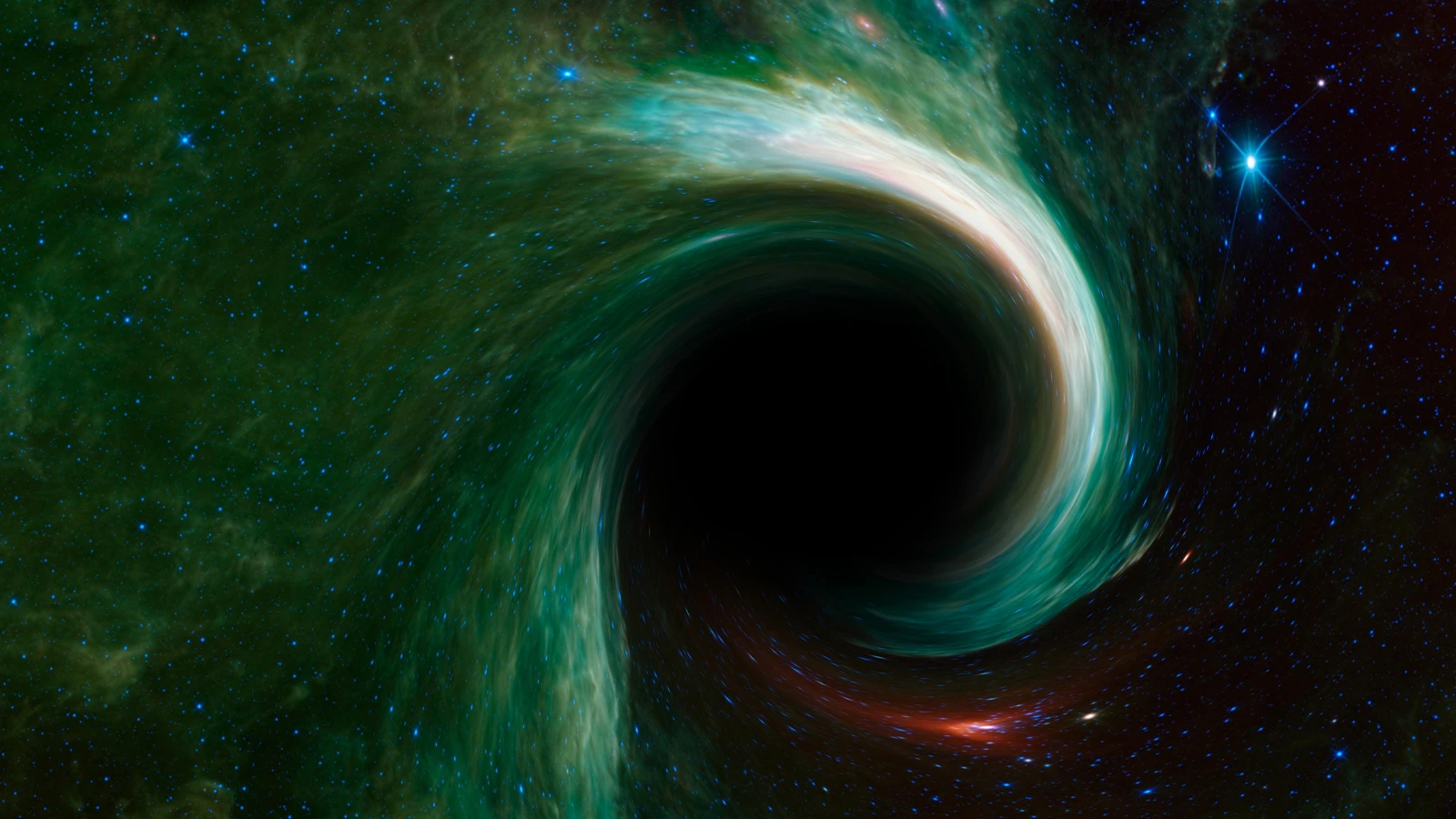
The astronomy world is abuzz with a discovery from the depths of space-time that defies all known laws of astrophysics. An international research team examining an ancient structure that existed when the universe was only 5 percent of its current age with the James Webb Space Telescope (JWST) has detected a massive black hole that is older than its host galaxy and much more dominant in mass.
This extraordinary celestial body, classified as the “Little Red Dot” and called Abell2744-QSO1, may throw away all we know about the early universe, according to scientists.
SPACE-TIME WAS TWISTED, GIANT MAGNIFICANT WAS IN ACTION
It was impossible to examine this microstructure, which is only 1,300 light-years wide under normal conditions, in detail from billions of light-years away. But nature has provided astronomers with a cosmic laboratory. The gravitational lensing effect created by the giant galaxy cluster Abell 2744, also known as “Pandora’s Cluster”, came into play.
The mass of the massive cluster warped space-time, magnifying this distant structure behind it like a giant magnifying glass and displaying it in three separate copies in the sky. Thanks to this natural telescope effect, JWST was able to analyze the object directly and clearly.
CLASSICAL FORMATION SCENARIOS ARE INVALID
The team, led by Ignas Juodžbalis and Roberto Maiolino from the Kavli Institute of Cosmology at the University of Cambridge, mapped the gravitational effect on the gas around the black hole using the telescope’s NIRSpec (Near Infrared Spectrograph) instrument. Direct measurements revealed that the black hole was exactly 50 million solar masses in size.
The real shocking data was hidden in the mass ratios: This huge structure alone constituted at least two-thirds (approximately 66 percent) of the total mass of the galaxy it was in. While central black holes in galaxies in today’s universe constitute only a tiny fraction of the mass of the host galaxy, the fact that this ancient object surpasses the galaxy itself in mass has turned all galaxy formation theories upside down.
WE ARE FACED WITH A “NAKED BLACK HOLE”
According to the classical theory accepted in the world of astrophysics; First, galaxies and stars were formed, giant stars that completed their lives collapsed and gave birth to small black holes, and over time, these black holes would swallow the materials around them and become supermassive. So the galaxy was the “mother” and food source of the black hole.
But in Abell2744-QSO1 the situation is completely different. Spectral analyzes showed that the gas composition in the region consists almost entirely of pure hydrogen and helium; It was determined that the ratio of star residue heavy elements such as oxygen was 0.5 percent less than that of the Sun. Researchers describe this structure as “an almost completely naked black hole” that has not yet gone through any stellar process, and was formed by collapsing into itself directly after the Big Bang.
A NEW ERA IS BEGINNING IN ASTROPHYSICS
This discovery, announced in two separate articles published in the respected science journals Nature and Monthly Notices of the Royal Astronomical Society, shows that the first large structures of the universe may not be galaxies, as expected, but directly giant black holes.
Experts state that this finding is a paradigm shift (axis shift) that requires a complete rewriting of the formation and growth scenarios of black holes. The possibility that matter may have formed these gigantic “primordial” structures by collapsing into itself with direct density differences after the Big Bang, without going through the stellar collapse phase, is a candidate to be the biggest cosmic research topic of the next decade.
