
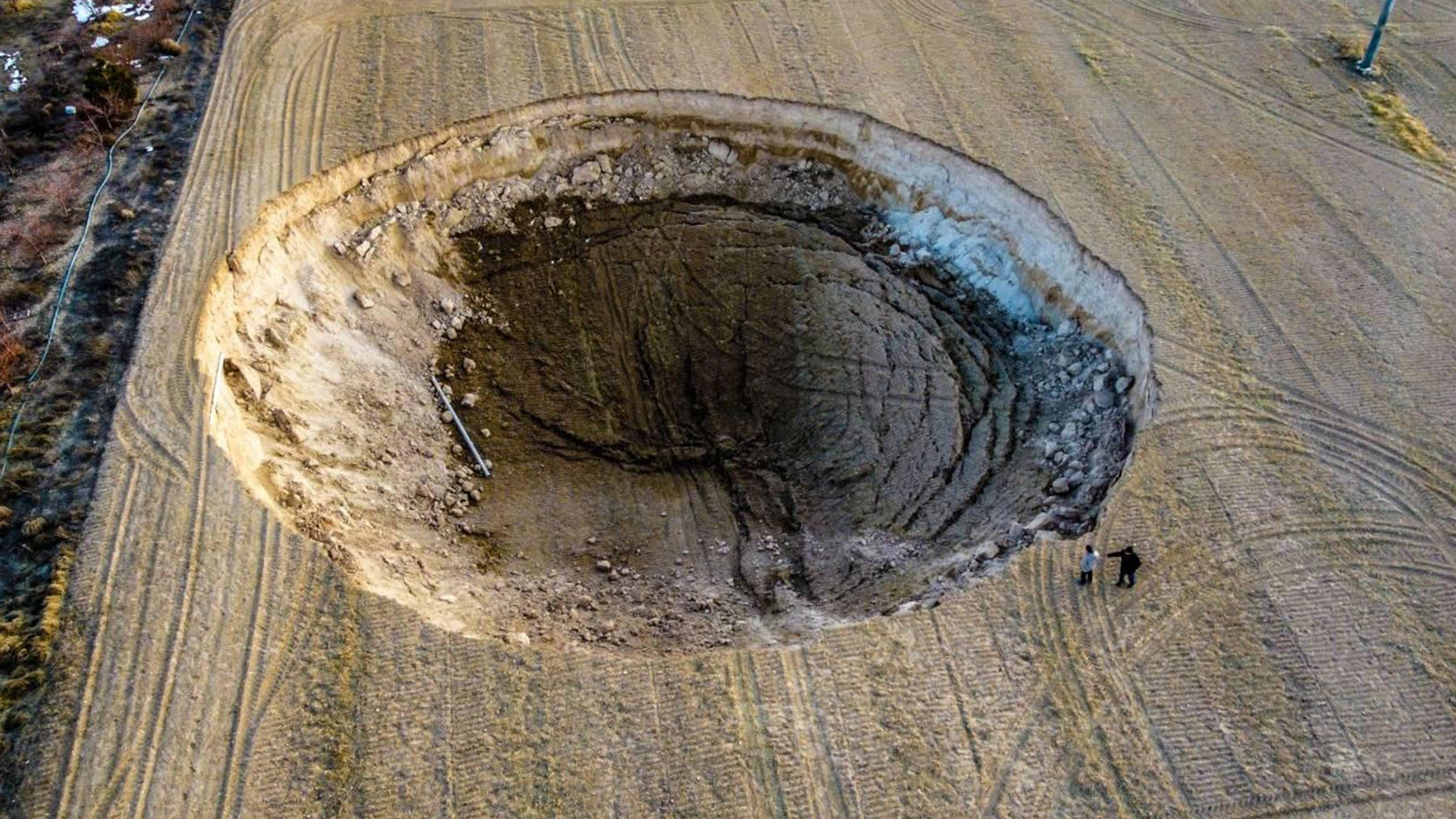
Water loss and drought, which has been going on for years in the Konya Plain, make the underground danger more visible every year. While the underground water level is decreasing as a result of the recent decrease in rainfall, rising temperatures, intensive agricultural irrigation and water extraction through unlicensed wells, new sinkholes continue to form. So much so that, according to AFAD’s Sinkhole Sensitivity Map study, the number of sinkholes recorded in the Konya Closed Basin has reached 739. 702 of the sinkholes are located within the borders of Konya, 29 of them are within the borders of Karaman, and 8 of them are within the borders of Aksaray. It is noted that 126 new sinkholes have been added to the 576 previously recorded sinkholes in Konya since 2020. Scientific field studies indicate that the number increases to much higher levels when not only large and deep sinkholes but also smaller collapses, surface deformations and settlement structures are taken into account. Experts are closely monitoring the developments especially around Karapınar, Ereğli, Halkapınar, Emirgazi, Çumra, Cihanbeyli, Kulu, Yunak, Çeltik and Altınekin.
GROUNDWATER IS FALLING RAPIDLY
While only approximately 2 percent of Türkiye’s usable surface water resources are located in the region, approximately 17 percent of groundwater resources are located in the Konya Closed Basin. On the other hand, it is calculated that approximately 40 percent of the groundwater used throughout Türkiye is drawn from this basin. Approximately 60 percent of the water used in irrigated agricultural areas in the region is met by underground resources. It is stated that due to intensive use, the groundwater level decreases by 2 to 3 meters per year in some parts. In some regions, one has to go down to a depth of 250 to 300 meters in order to reach water for agricultural irrigation.
400 MILLION CUBIC METERS LOST
Boğaziçi University Dr. Faculty Member İrem Daloğlu Çetinkaya states that the sinkholes in the Konya Closed Basin are one of the most concrete indicators on the surface of excessive groundwater use that has been going on for years. Çetinkaya emphasizes that a significant part of the agricultural irrigation need is met from groundwater through unlicensed wells, while decreasing rainfall due to climate change weakens the natural recharge of the aquifers.. Çetinkaya points out that the expansion of the planting areas of products with high water demand, such as corn, in recent years has also increased the pressure, and states that on the one hand, excessive extraction and wrong product pattern, and on the other hand, climate-related water loss is experienced simultaneously.
UNSUSTAINABLE
Ege Tok, from the 350 Türkiye team, states that while Türkiye is preparing to host COP31 in Antalya, the picture in the Konya Plain reveals that the climate crisis is not a scenario for the future. Tok states that drought, decreasing rainfall, increasing temperatures and pressure on water resources directly affect the lives and livelihoods of millions of people. Tok also “The picture emerging in the Konya Plain reveals not only the increase in the number of sinkholes, but also the growing water deficit in one of Türkiye’s most important agricultural centers. “While excessive groundwater withdrawal, wrong cropping patterns, irrigation losses and decreasing rainfall converge at the same point, sinkholes are becoming one of the most visible signs of the crisis that has been growing under the ground for years,” he says.
