
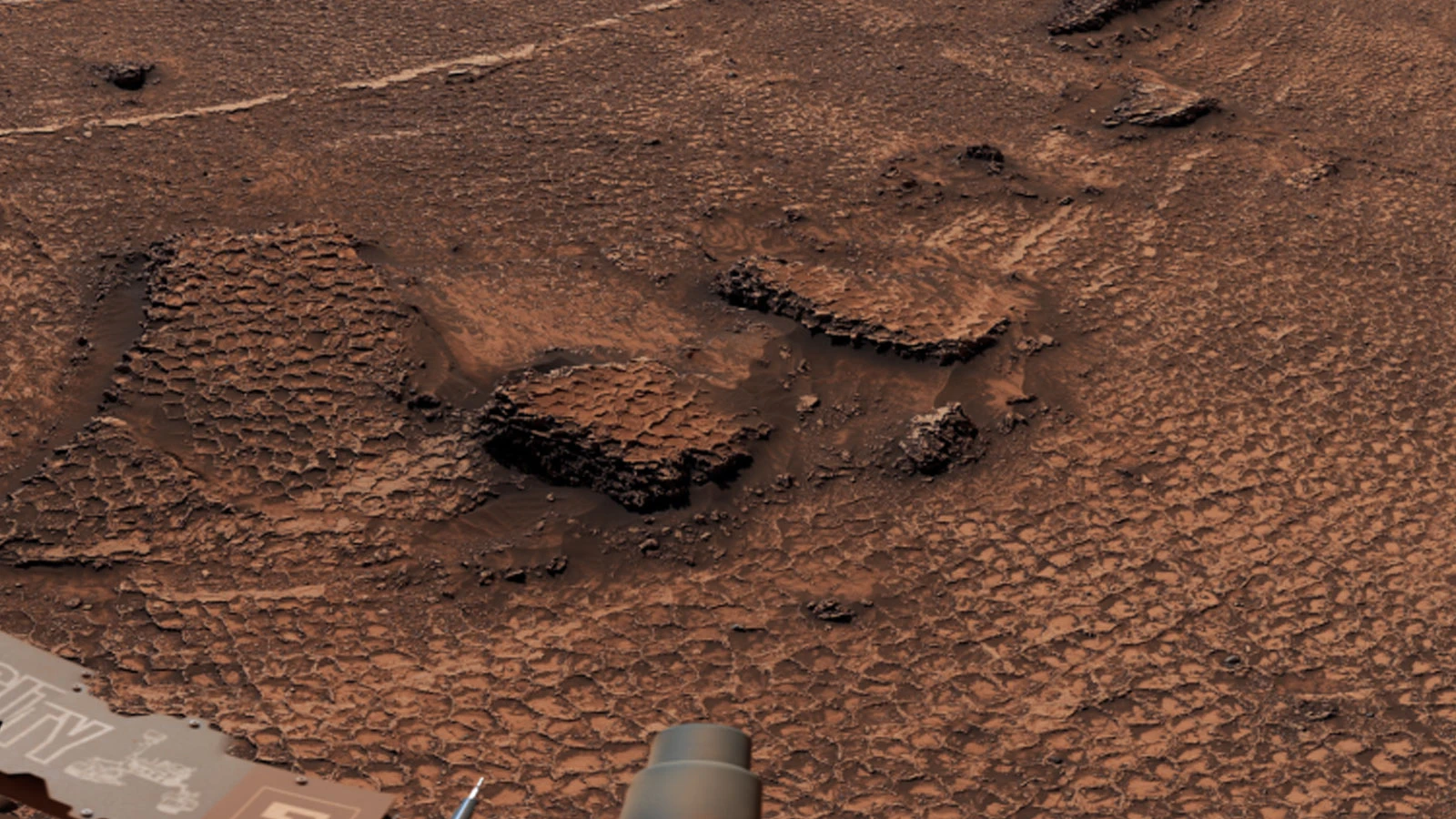
The discovery was made while Curiosity was moving through the valley called “Valle Grande” on Mars. In the 360-degree panorama taken by the vehicle on June 19 and 20, 2026, it was seen that the surface was covered with many small geometric structures.
Called “polygonal cracks,” the honeycomb-like shapes are each about 4 to 8 centimeters wide, according to NASA. However, what is remarkable is not the size of the individual buildings, but the width of the area they form. The patterns spread in almost every direction Curiosity can see.
Moreover, the formations are not only found on flat ground. Honeycomb patterns were seen extending up to the slopes of a hill called “Miraflores”, approximately 6 meters high.
IT’S NOT YET CERTAIN HOW THEY FORMED
Scientists are now trying to understand how these extraordinary structures form. NASA states that similar geometric cracks have been detected in small areas on Mars before, but no example has been found that spread over an area as wide as the one in Valle Grande.
Researchers consider the possibility that processes such as drying, temperature changes, compaction or water escaping from sediments may have played a role in the formations. However, the exact formation mechanism has not yet been determined.
NEW CLUDE TO MARS’ WATERFILLED PAST
It is known that the foothills of Mount Sharp, where Curiosity researched, hosted lakes and streams billions of years ago. The vehicle had previously detected chemical traces of Mars’ watery past in the region, as well as carbon-based molecules that may be precursors of RNA and DNA.
NASA particularly underlines that it is not known whether these organic molecules are formed through biological processes or geological means. But the findings strengthen evidence that ancient Mars had chemical conditions that could support life.
Curiosity’s investigations on the newly discovered giant “honeycomb field” are expected to provide new clues about how Mars lost its water in the past and how long habitable conditions lasted.
