
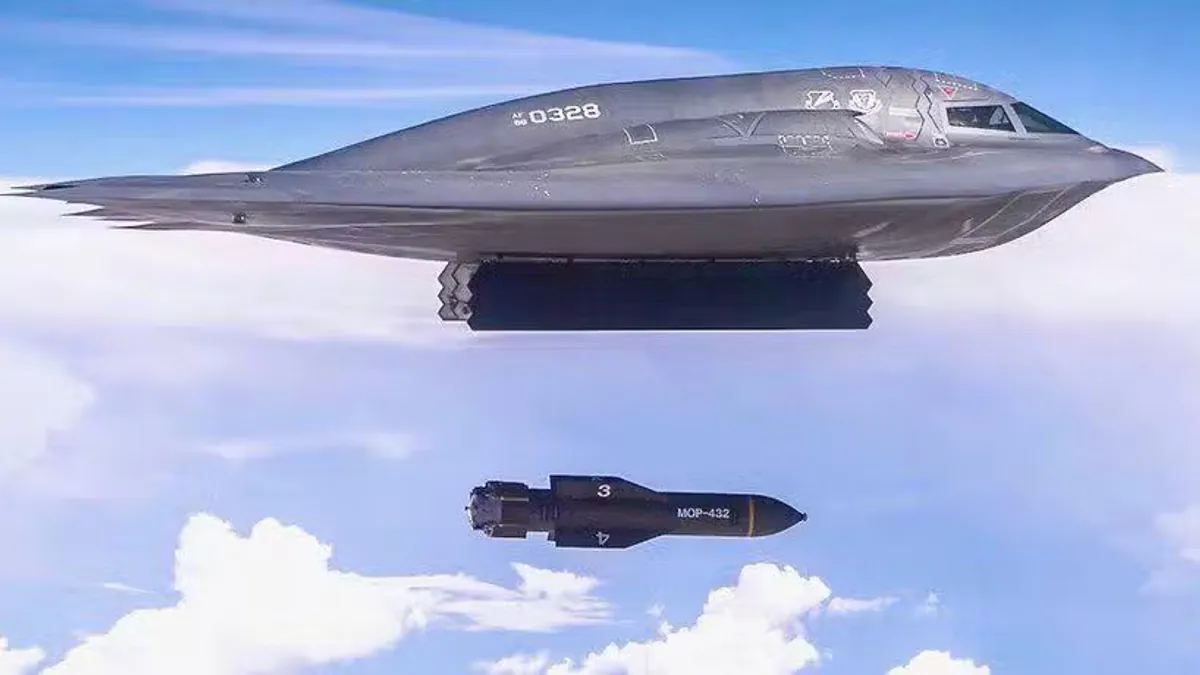
“twz” also warned: “Even a combined strike against the entrances and flat tunnels on Pickaxe Mountain could pose certain challenges. Reliable information about the exact route of the tunnels inside the mountain could be limited, which would make it difficult to choose the optimal meeting points.”
According to “twz”, the US military is working on special detonators that detect a cavity and only then explode deep underground. But this is also about development. The online platform “twz” assesses the limited options from the air: “By attacking equipment or personnel trying to get to the collapsed tunnels, the problem could theoretically be managed indefinitely.”
Trump’s unthinkable alternative: ground troops

The US Institute for Science and International Security (ISIS) comes to a different conclusion in its analysis of Pickaxe Mountain: “The terrain in its current state would be more suitable for an attack or act of sabotage by ground forces.”
Former US military officer Joseph Votel told “twz”: “We have the options to do that.” But he also warned: the operation would be “large” and “complex.”
In addition to the military calculation, there are political implications. There are midterm elections in the USA in November. Trump’s MAGA base is critical of foreign missions, especially the use of ground troops.
Balance sheet
US President Donald Trump is back in war mode with Iran. But one big question remains unanswered: that of the US president’s war aims.
First, Trump spoke of “regime change.” According to the New York Times and the Israeli newspaper Haaretz, there were even considerations to install former Iranian President Mahmoud Ahmadinejad as leader of Iran. But these plans failed. Ever since the leadership in Tehran began negotiating with the USA, they have felt internationally respected. The regime in Iran appears to be stabilized.
So Trump needs a negotiation success. A military strike on Pickaxe Mountain could not only block the nuclear facility – at least temporarily – but also persuade the leadership in Iran to make concessions. Paul Salem from the Center for Strategic and International Studies (CSIS) warned after the ceasefire agreement was concluded: “I doubt that the Iranians will make any significant concessions in the nuclear dispute. I don’t think the US has much leverage there. I think it will drag on.”
