
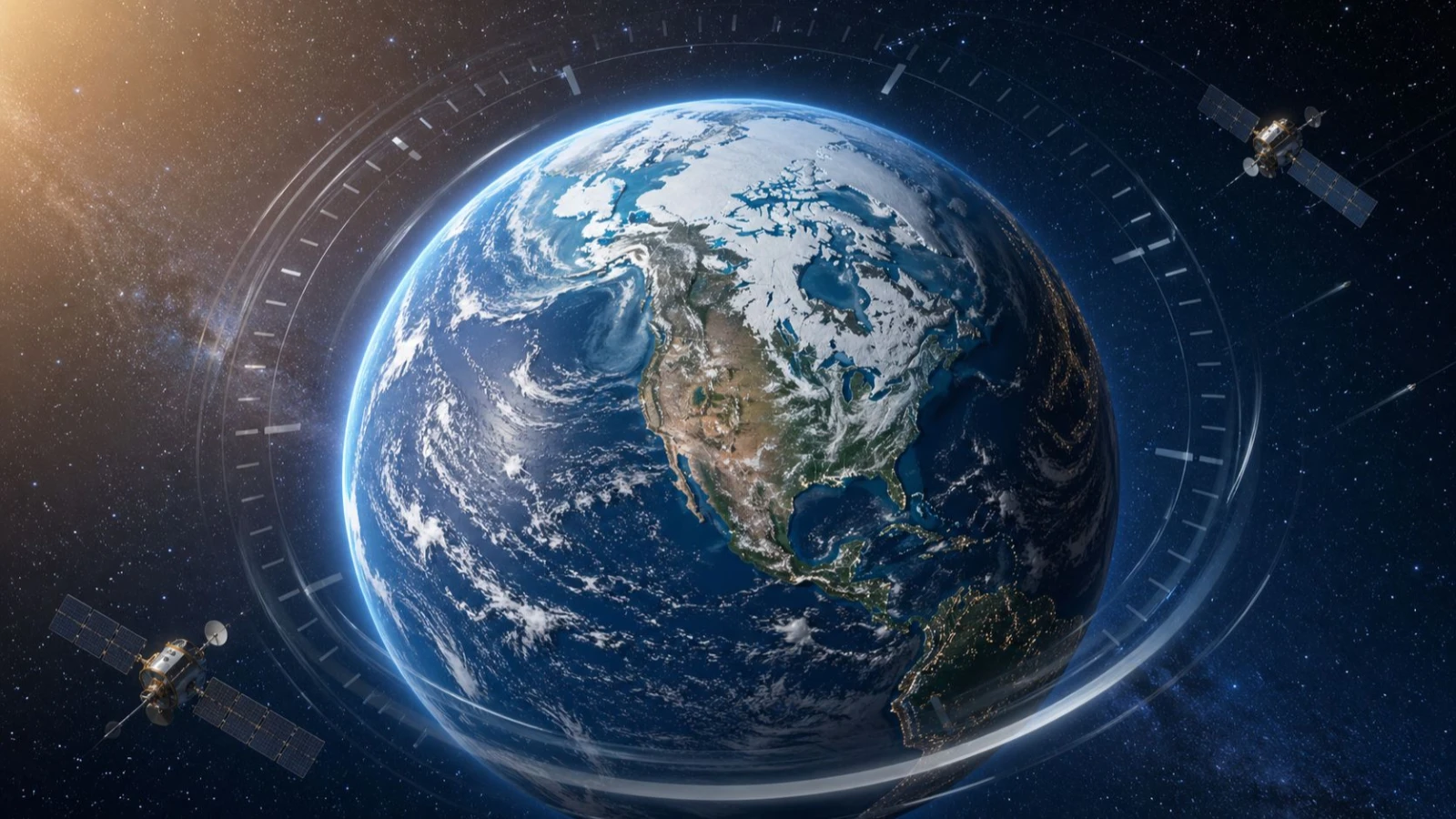
We think that a day on Earth lasts 24 hours. However, scientifically, this period is not always exactly the same. The world does not revolve like a perfectly working clock; Factors such as ocean movements, atmosphere, earth’s crust, the gravitational effect of the Moon and climate change cause very small changes in the planet’s rotation rate.
NASA-supported studies show that this change is no longer explained solely by natural processes. Melting glaciers, decrease in groundwater and rise in sea level are changing the mass distribution on Earth. This slows down the planet’s rotation by milliseconds.
According to scientists, this situation is not big enough to be felt in daily life. However, even these small differences are important for GPS, satellite systems, space missions, telecommunications and technologies that require precise time measurement.
Is a day on Earth really 24 hours?
In daily life, the expression “a day is 24 hours” is used. However, the Earth’s rotation around its axis is not constant. Sometimes very small accelerations and sometimes decelerations occur.
These changes are measured in milliseconds. A millisecond is one thousandth of a second. These changes, which are too small to be noticed in people’s daily lives, can be critical for technologies that operate with high precision.
Official time systems are based on atomic clocks. Atomic clocks are extremely stable. In contrast, the Earth’s rotation is irregular due to natural processes. For this reason, additions known as “leap seconds” are made from time to time. The aim is to prevent the difference between official time and astronomical time from becoming too wide.
The Moon slows down the Earth’s rotation
The most important natural reason why days on Earth have become longer throughout history is the Moon. The Moon’s gravity causes tides in the oceans. These tides create a braking effect on the Earth’s rotation.
According to data from NASA, tidal friction from the Moon increases the length of days on Earth by about 2.4 milliseconds per century, on average. Although this may seem like a very small value, when accumulated over billions of years it creates huge differences in the rotation period of the planet.
Scientists can examine changes in the Earth’s rotation speed going back thousands of years through past eclipse records and celestial events. According to the research published on the European Commission’s CORDIS platform, if the current slowdown trend continues, approximately 200 million years will be required for a day on Earth to reach 25 hours.
How does climate change affect Earth’s rotation?
The striking part of new research is the involvement of climate change in this process. According to NASA-supported studies, the melting of glaciers and polar ice sheets causes water to spread from the poles to the oceans and regions closer to the Equator.
This situation is explained physically as follows: Just as a skater spins more slowly when he spreads his arms, the spread of mass on Earth towards the Equator slows down the planet’s rotation slightly.
According to NASA, since 2000, days have been getting longer by about 1.33 milliseconds per century due to ice and water movements due to climate change. This rate is above the level in the previous century. It is stated that if emissions continue to increase, this effect may reach up to 2.62 milliseconds towards the end of the century.
The research published in PNAS also reveals that, in a high-emission scenario, climate-induced day length change could even exceed the tidal effect of the Moon by the end of the century.
When will days on Earth be 25 hours long?
The most curious question lately is: Will a day on Earth really have 25 hours?
Yes, it is possible in the very long term. However, this is not a change that will happen in the near future.
According to current calculations, it will take approximately 200 million years for a day on Earth to increase to 25 hours. So people won’t wake up one morning and see that the days are 25 hours long. This is a process that can be explained not by human lifespan but by geological time scale.
Does this change affect daily life?
The lengthening of days by milliseconds is not felt in daily life. People’s working hours, sleep patterns or calendars do not change for this reason.
However, the situation is different for systems that require precise timing. GPS, satellite navigation, spacecraft guidance, financial transactions, internet infrastructure and telecommunications systems are sensitive to even small time differences.
NASA emphasizes that these small changes in the Earth’s rotation must be taken into account in terms of modern technology. Because in space missions or precise positioning systems, even very small deviations can have significant consequences over large distances.
The Earth’s axis is also affected
Research doesn’t just focus on day length. NASA-supported studies show that there are also changes in the Earth’s rotation axis due to melting glaciers and redistribution of water.
According to NASA, a shift of approximately 10 meters in the Earth’s rotation axis has been observed over a period of approximately 120 years. Melting of ice masses, decrease in groundwater and rise in sea level play an important role in this change.
This means that climate change affects not only the atmosphere, oceans or weather events; It reveals that it also affects the physical movements of the planet.
Why do scientists care about this?
The fact that these changes are not noticeable to the human eye does not mean that they are unimportant. Millisecond differences in Earth’s rotation provide important information about the planet’s mass distribution and climate system.
In addition, this data may be decisive in how time systems are adjusted in the future. The International Earth Rotation and Reference Systems Service tracks measurements of the Earth’s rotation and issues announcements of time adjustments such as leap seconds.
According to the latest notification from the US Naval Observatory, a new leap second will not be added at the end of June 2026. This shows that the time adjustments are not random, but based on precise measurements of the Earth’s rotation.
