
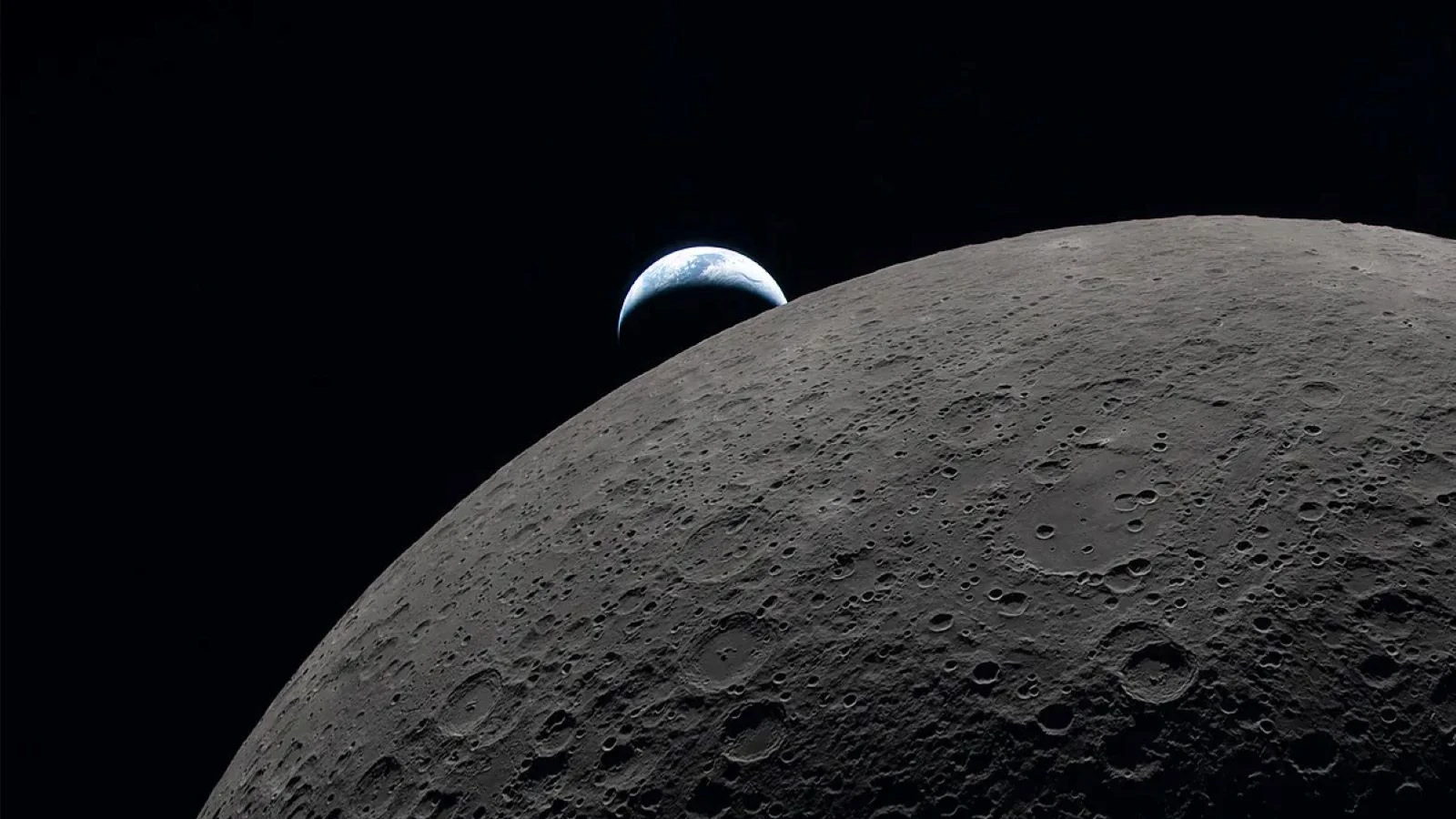
In December 1968, as Apolo 8 orbited the Moon, astronaut William Anders captured a photo that would prove more impressive than any speech: the Earth rising above the lunar horizon. More than half a century later, Artemis 2 inherits this legacy, and Earth once again appears to be rising from the dark side of the Moon.
Anders’ photograph had reached a turbulent world. USA, Martin Luther King Jr. and Robert F. Kennedy, a society torn apart by race riots and the Vietnam War. Artemis 2’s appearance came during a similarly turbulent time. The war waged by US President Donald Trump against Iran, which risks spreading to the Middle East, the conflict in Ukraine, and the divisions in Europe that strain the unity of NATO, constitute the background of this period.
Anders’ photo created a kind of moral pause. Now, 400,000 kilometers away from Earth, we remember again that no borders separate Donbas, ideologies or races. Just a blue ball floating in the dark… Maybe that’s why both that old photo and the current image seem both impressive and disturbing at the same time.
Apolo 8 orbited the Moon 10 times, and on one of those trips, Anders captured the bright blue of the Earth against the darkness of space. This contrast was even more evident with the gray and desolate lunar surface in the foreground. Anders said on his return: “We came here to explore the Moon, but we actually discovered the Earth.”
In the image from Artemis 2, a pale blue Earth is seen setting behind the crater-strewn lunar surface, with bright white clouds swirling over Australia and Oceania.
Dr. from NASA Science Missions Directorate. “Our astronauts brought back scientifically rich and extraordinary images that will inspire future generations,” said Nicky Fox.
Astronauts shared their observations around the Moon. They documented impact craters, ancient lava flows, and cracks in the surface. They also examined differences in color, gloss and texture. They observed the light of six meteors hitting the lunar surface. Images never seen before by the human eye were recorded for six hours.
Astronaut Christina Koch said that she observed fine dust particles rising from the Moon’s surface and floating in the air with electrostatic forces. Koch and pilot Victor Glover stated that after passing behind the Moon, the Earth’s brightness was reflected on the windows of the spacecraft. “It was so bright it looked like it didn’t belong there,” Glover said.
Koch stated that the Moon acts “like a sponge that absorbs light” and “illuminates” when the Earth comes into view.
Astronauts also stated that the Moon is not as gray as it seems, but also has brown tones. Glover described it as “like seeing the layers of the Grand Canyon.”
Among the images is an impressive solar eclipse. The Moon completely covered the Sun, creating a total eclipse that lasted 54 minutes. In this way, the outer atmosphere (corona), which normally cannot be seen due to the brightness of the Sun, could be examined.
The geological structures of the Moon were observed in detail in high-resolution images. It was also proposed to name two small craters in the Oriental basin “Integrity” and “Carroll”. One of these names was dedicated to the Orion spacecraft, and the other was dedicated to the wife of commander Reid Wiseman, who died in 2020.
The astronauts have now returned to Earth. Using the Moon’s gravity as a “slingshot”, they made their way back and are scheduled to land in the Pacific Ocean.
During the mission, astronauts on the International Space Station also established direct radio communication between a Moon mission and the space station for the first time. Glover stated that the biggest challenge in Orion was tight space.
Koch, on the other hand, said that he saw the “intense darkness” around the Earth more clearly and that this made the planet even more special.
