
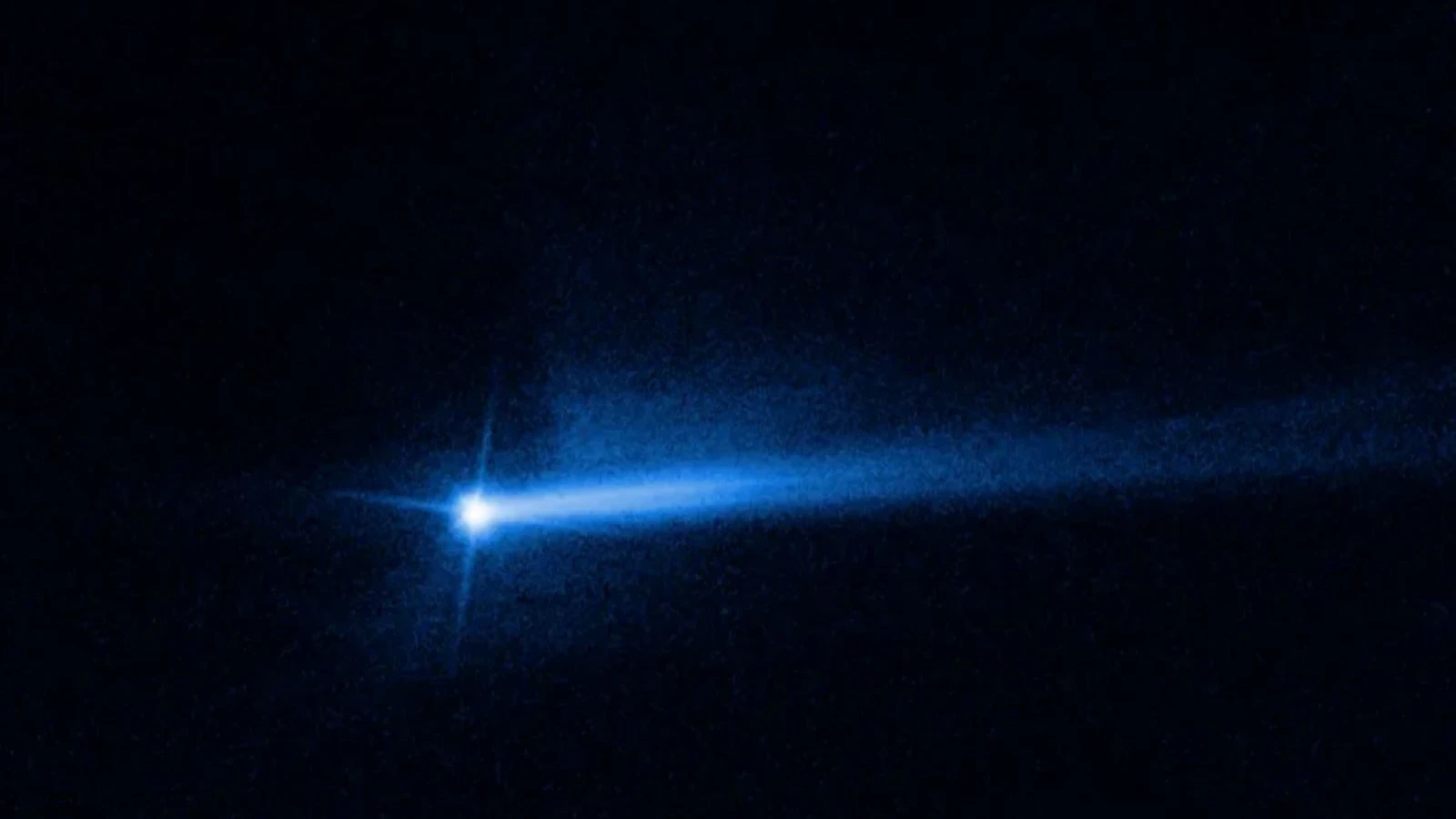
For the first time, humanity has managed to establish a “defense line” against a cosmic threat. The results of the intentional collision of NASA’s DART (Double Asteroid Redirection Test) spacecraft with the Dimorphos asteroid made a wide impact in the scientific world. New data published in the journal Science Advances reveal that the collision affects not only the target but the entire system.
Victory in Seconds: Trajectory Changed Permanently
The lead author of the study, Dr. According to Rahil Makadia, as a result of the collision, the 770-day orbital period of Dimorphos and its companion Didymos around the Sun was permanently shortened by less than a second.
Dr. Makadia explains the vital importance of this small change with the following words:
“The change in orbital speed was about 4 centimeters per hour. This may sound small, but on a space scale, a deviation of that much could make the difference between a giant asteroid hitting Earth or not.”
16 Million Kilogram Debris Cloud: More Effective Than a Collision!
New images and data prove that there was a massive ejection of matter into space at the time of impact. Approximately 16 million kilograms of rock and dust, 30 thousand times the mass of the spacecraft, were scattered into space.
Experts discovered that the main thrust was not provided by the spacecraft itself, but by the “reaction force” created by this scattered debris. Although the 170-meter-wide Dimorphos lost only 0.5% of its mass, this loss was enough to change its orbit.
Highlighted Findings
The speed of the binary system increased by 11.7 micrometers per second. Dimorphos’ orbit around its parent asteroid clocked in at 33 minutes. For the first time, a human-made object changed the course of a celestial body around the Sun.
Amateur Astronomers and Star Occultation
There is a silent army of heroes behind this precise measurement. Between October 2022 and March 2025, volunteer astronomers around the world collected data from 22 different observations. With the “star occultation” method, these millimeter calculations could be made by monitoring the millisecond light changes when the asteroid passed in front of the stars.
What’s Next? Hera Mission is on the Way
A new curtain is opening in planetary defense. The Hera spacecraft, launched by the European Space Agency (ESA) in 2024, will reach the asteroid system this autumn. Hera will take a close look at the crater formed after the collision and the final state of the system and send it to Earth.
