
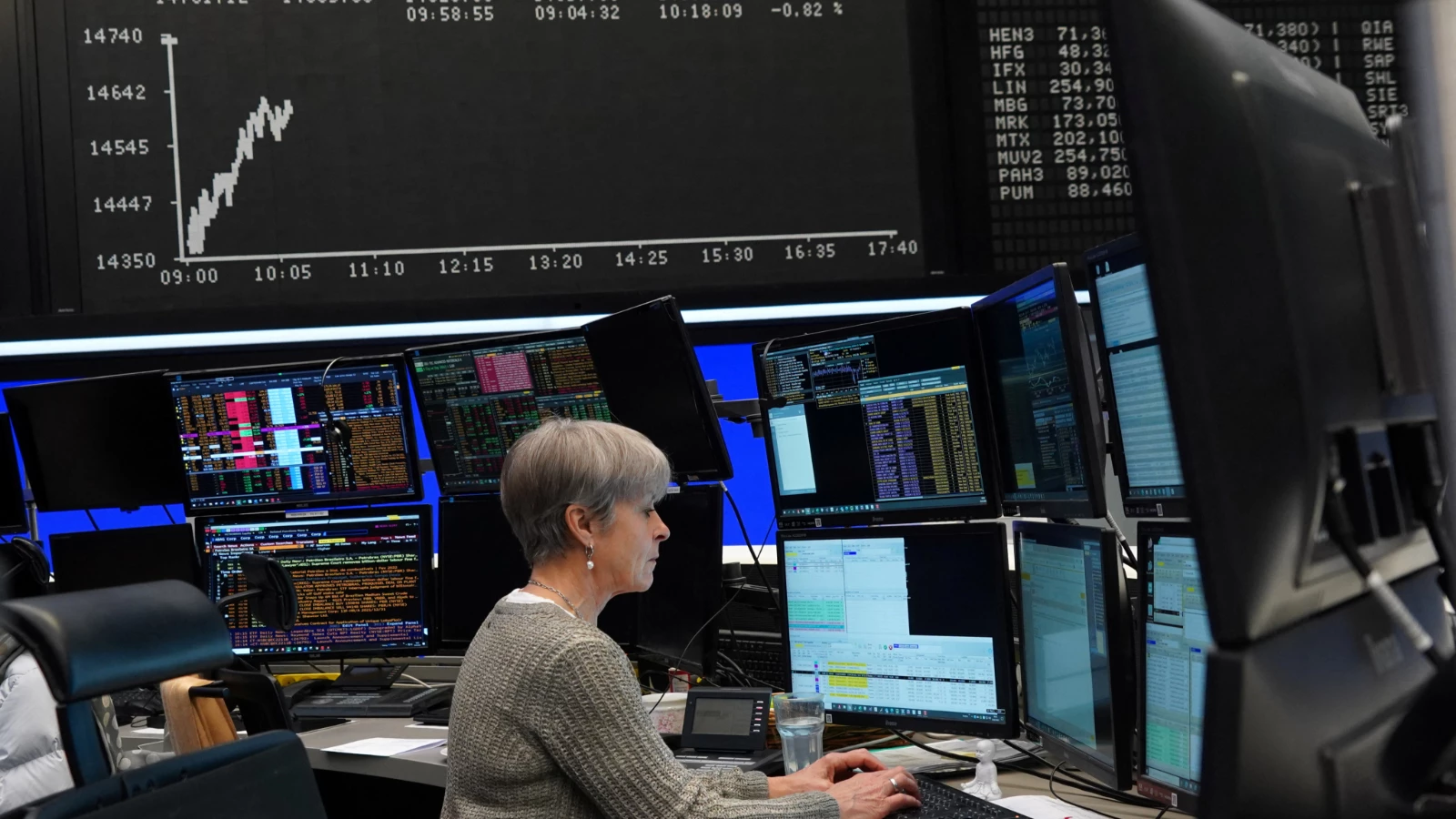
European stock markets remain positive on the last trading day of the week, following the flexibility messages of European Central Bank (ECB) President Christine Lagarde, despite the geopolitical tension in the Middle East.
As of 11.30 in the European markets, the Stoxx Europe 600 indicator index is traded at 607 points with a 0.4 percent increase, the DAX 40 index in Germany is traded at 23,945 points with a 0.7 percent increase, and the FTSE 100 index in the UK is traded at 10,454 points with a 0.4 percent premium.
In France, CAC 40 is at 8,081 points with a 0.4 percent increase, in Spain the IBEX 35 index is at 17,340 points with a 0.6 percent gain, while in Italy the FTSE MIB 30 index is traded at 44,865 points with a 0.6 percent increase.
While global markets follow a mixed course as the closure of the Strait of Hormuz increases risks and costs for energy supply, the non-agricultural employment data to be announced in the USA today is expected to have an impact on the direction of the markets.
While the ongoing geopolitical tension in the Middle East keeps the global risk perception high, concerns are increasing that conflicts may prolong and rising energy costs may strengthen global inflation again.
US President Donald Trump, in his statement yesterday, claimed that the Iranian government would give up and then Cuba would also fall. Noting that the USA is in contact with Cuba’s communist administration, Trump said, “They need help. We are in talks with Cuba.” he said.
Trump stated that he will have an influence on determining the new leader of Iran and said, “We will work with the people and the regime to ensure that someone who can build Iran well without nuclear weapons comes to power.” he said.
– Lagarde says ECB will remain flexible in age of uncertainty
Christine Lagarde stated that the bank will remain flexible in monetary policy after the conflicts in the Middle East and that the decisions will be evaluated with updated data from meeting to meeting, and emphasized that this approach puts the ECB in a strong position to monitor current shocks and understand their effects.
Emphasizing that the global economy has moved from a period of measurable risk to a period of real uncertainty, Lagarde said that macroeconomic models created based on stable conditions in the past are no longer sufficient.
Lagarde noted that the ECB based its strategy on scenario analysis and flexibility, and reminded that the optimism created by general-purpose technologies such as the internal combustion engine and electricity in the 1920s resulted in the Great Depression due to the fragmentation in the international system.
Pointing out that a similar situation is happening today, Lagarde said, “Markets price technological achievements as if the world was not falling apart. Policy makers, on the other hand, allow the division of the trading system as if this would not restrict growth. If we cannot manage the interaction of these two forces correctly, we face the risk of repeating the mistakes of the past.” he warned.
Emphasizing that extreme scenarios such as cutting off Russian gas or escalating conflicts in the Middle East are now an integral part of the policy-making process, Lagarde reminded the example of a negative scenario they published in March 2022, which gave results very close to actual inflation.
ECB President Lagarde pointed out that geopolitical fragmentation could reduce global output by 7 percent (as much as the combined economies of Germany and Japan) in 10 years and said, “The drive to retreat is natural, but this will cut off the gains our economies need most and make the situation worse for everyone.” he commented.
Analysts stated that geopolitical and political developments in the region will be monitored for the rest of the day, and that growth in the Eurozone and non-agricultural employment and unemployment rate data in the USA will be followed.
