
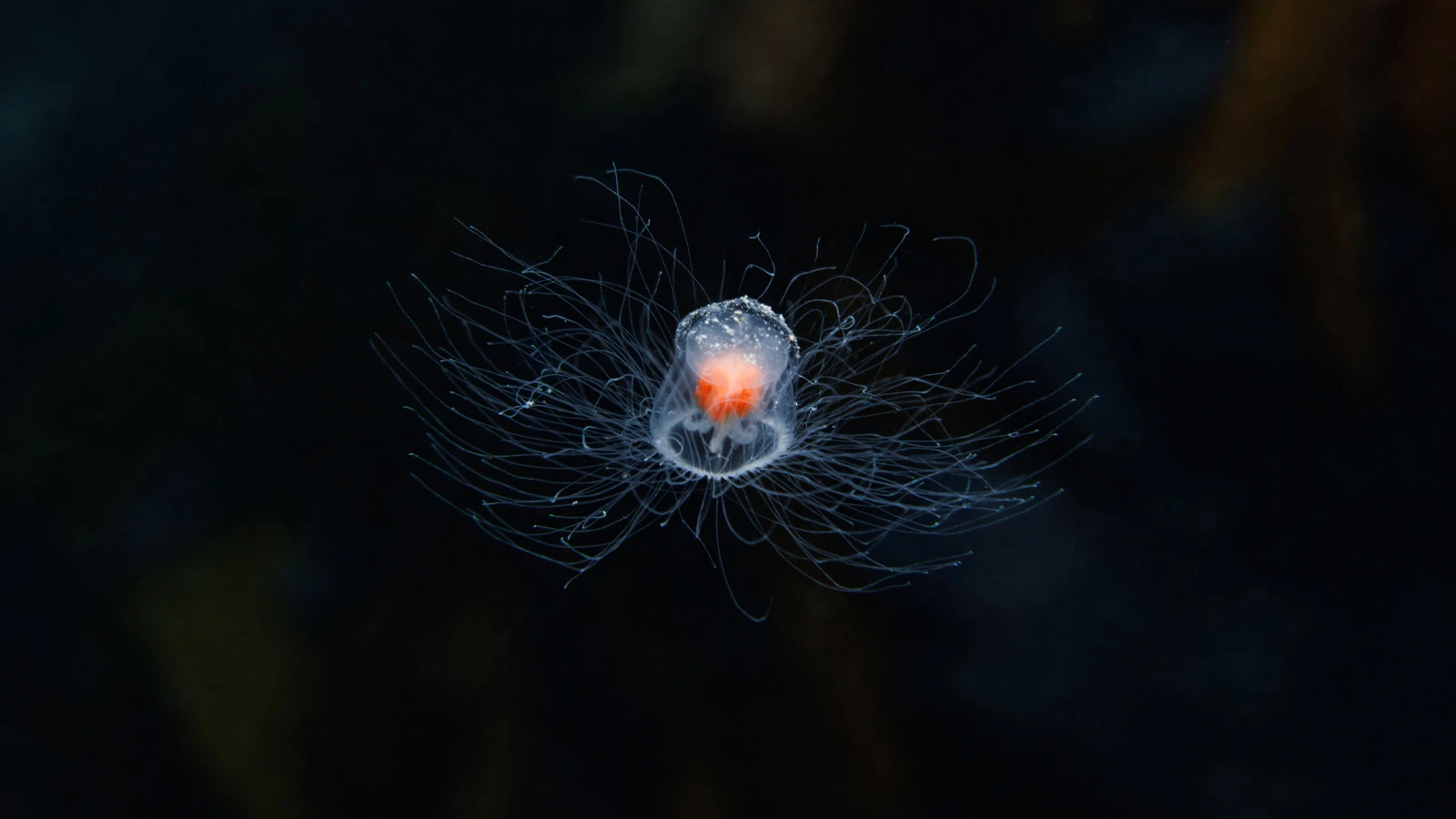
The small, transparent jellyfish called Turritopsis dohrnii is surprisingly difficult to kill.
Maria Miglietta, a marine biologist at Texas A&M University’s Galveston campus, slaughtered the creatures, boiled them, starved them, added excessive amounts of salt to their tanks, and released them into fresh water.
However, these interesting creatures seem to manage to escape death every time. When they are under heavy stress, they stop moving and sink to the bottom of the tank.
Then a surprising transformation occurs: The creatures transform into structures consisting of clusters of cells, completely different from the tentacled, umbrella-shaped appearance of adult jellyfish.
Within one to three days, this cluster of cells forms a polyp, one of the early stages of the jellyfish’s life cycle.
The polyp then grows and forms a colony from which new adult jellyfish emerge.
“From a single jellyfish that doesn’t die, you get a colony that can create hundreds of new jellyfish,” Miglietta said. he says.
Moreover, every new jellyfish that emerges can, in principle, experience the same rejuvenation process. Thus, these creatures appear to be able to rewind their biological clocks over and over again.
According to BBC news; Miglietta and other scientists are investigating the genetic and molecular processes that enable Turritopsis dohrnii to escape death. By solving these mysteries, it is aimed to understand whether similar processes can be triggered in humans.
The aim is not to turn old people into babies again, like in the Benjamin Button movie. Contrary to this idea, which remains in the realm of science fiction, researchers are looking for ways to return cells and tissues to a more youthful state to heal wounds and treat diseases associated with aging.
“THE BIGGEST GOAL IS RENEWAL BIOLOGY”
“I think the biggest goal in this field may be regenerative biology: trying to reverse the deterioration and wear and tear associated with aging,” says Michael Koldobskiy, a pediatric oncologist and physician-scientist at Johns Hopkins University. he says.
Koldobskiy states that using these mechanisms for human health is still a very distant goal.
However, he states that examining creatures that have developed these processes over millions of years may yield important results in the future.
The regenerative ability of the Turritopsis dohrnii species was first noticed in 1992 by an Italian scientist who examined these creatures in the laboratory. The researcher forgot to feed the jellyfish over a weekend. When he returned, he expected to encounter dead creatures.
“Instead, he found new polyps inside the container,” Miglietta said. he says.
Shortly thereafter, biologist Stefano Piraino of the University of Salento in Italy began investigating the mechanism behind this extraordinary ability to rejuvenate.
As embryos develop, stem cells multiply and turn into nerves, muscles and other cell types that make up the body.
Under normal conditions, after these cells transform into a certain cell type, they maintain that identity; over time, it grows old and dies.
However, Piraino discovered that during the rejuvenation process of the immortal jellyfish, some tissues in the adult stage go through a process called “transdifferentiation”.
During this process, cells return to a stem cell-like state and can then differentiate into different cell types.
This mechanism is considered to be one of the important biological processes underlying the jellyfish’s ability to rewind its life cycle.
