
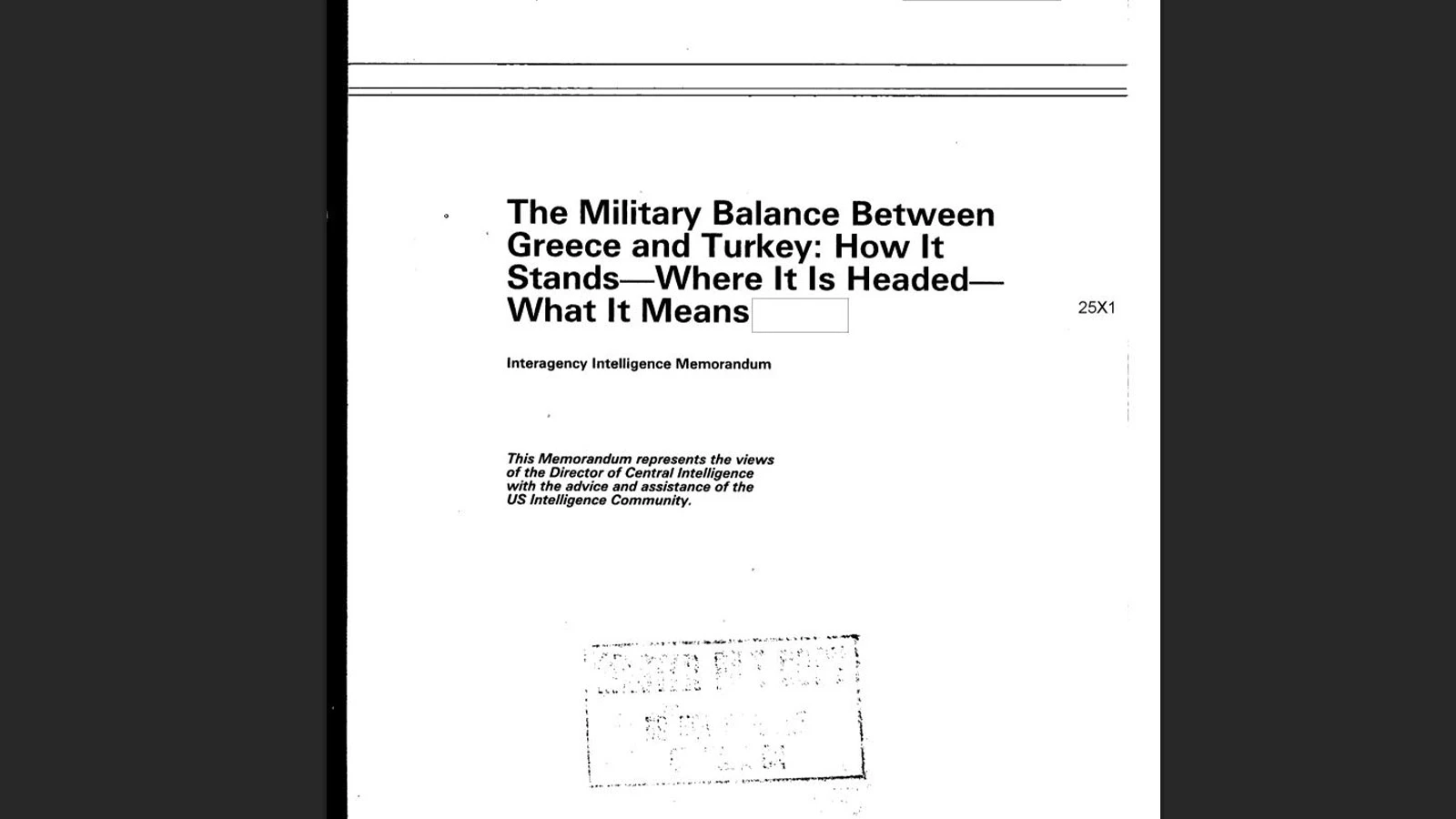
The reports prepared by US intelligence in the 1970s and 1980s reveal in detail at what stages tensions centered in the Aegean Sea and Cyprus could turn into a hot conflict, how Washington read these possibilities and what scenarios it was preparing for. The first thing that draws attention in the CIA documents is that the tension between Türkiye and Greece is treated not as a “sudden crisis” but as a layered and chronic security problem that spans many years. US intelligence reports emphasize that even in periods when the possibility of a direct war between two NATO allies is considered low, the smallest spark can lead to an uncontrolled escalation. It is clearly stated in the documents that sovereignty disputes and oil exploration activities, especially in the Aegean Sea, constantly threaten this fragile balance.
CIA’S CRISIS SCENARIO
Archive documents show that US intelligence acted with the understanding of “being prepared for surprises”. The CIA discusses not only possible scenarios but also low-probability but high-risk possibilities. The basis of this approach is the concern that a war between two allied countries could cause irreparable damage to the integrity of NATO. Reports indicate that tensions between Türkiye and Greece fluctuate periodically; However, it is noted that it never completely disappears.. According to US intelligence, the basis of the crises is not only diplomatic disagreements, but also historical competition, geopolitical location, maritime jurisdictions and the struggle for access to energy resources.
AEGEAN CENTER OF TENSION
In CIA reports, the Aegean Sea is defined as the “most sensitive fault line” in Türkiye-Greece relations. The documents emphasize that disputes regarding the status of territorial waters, continental shelf, airspace and islands in the Aegean keep the risk of military conflict constantly alive. The documents point out that oil exploration activities, which came to the fore in the Aegean Sea in the 1970s, brought the tension between the two countries to a new dimension. In CIA reports, it is seen that energy resources are not only an economic issue, but also evaluated under the heading of sovereignty and security. In the documents, it is stated that Türkiye’s deployment of oil exploration ships accompanied by military elements in the Aegean Sea was perceived as a “show of power” by Athens.
ISLANDS ARE DEFENSIVE
According to CIA analysis, Türkiye’s military capacity offers the opportunity to conduct a limited but effective operation. The report states that Ankara has the ability to put pressure on the Thrace line or target the Greek islands close to the Aegean in case of a possible crisis. However, it is particularly noted that a long-term war is not sustainable for both countries and that external support and supply channels will be decisive. On the Greek front, it is emphasized that defending the islands involves structural difficulties. In CIA documents, It is stated that the Greek islands are difficult to reinforce due to their geographical location, and this creates a serious handicap in defense planning.
AEGEAN ARMY DETERRENT
One of the striking topics in the CIA reports prepared in the mid-1970s is the establishment and capacity of the Aegean Army. In the documents, it is stated that the Aegean Army, established in Izmir in July 1975, had a structure that could become ready for war in a short time. US intelligence reports emphasize that this army consists of tens of thousands of trained personnel and stands out especially with its amphibious operations capability. According to the CIA, the presence of the Aegean Army is considered a deterrent element for Greece. The documents state that Türkiye can make rapid and flexible moves in the Aegean with this military structure; However, it is specifically stated that such an operation carries the risk of serious losses.
WEAPON BALANCE
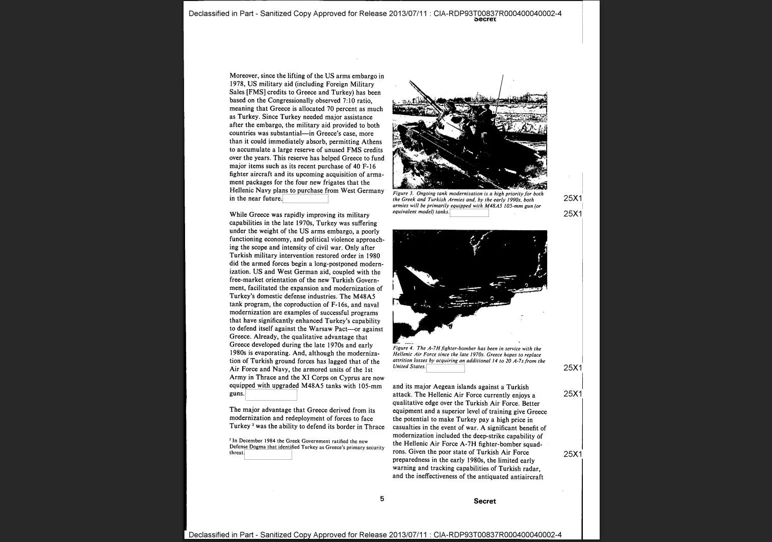
Another critical title in the documents revealed by Alper Karaşin from Kahramanmaraş Sütçü İmam University, Atatürk Principles and History of Revolution Department and published in the “Journal of History and Strategy” magazine under the title “Turkey-Greece War Scenarios in CIA Documents” in recent weeks is the effect of the arms embargo imposed by the USA on Türkiye on the military balance. It is clearly stated in CIA reports that the embargo created some weaknesses in the Turkish Armed Forces, especially in terms of its air force. It is noted in the documents that problems experienced in the supply of spare parts and ammunition limited operational capacity.
DOES NOT EXCEED TWO WEEKS
CIA analyzes also include evaluations regarding the duration of a possible war between Turkey and Greece. The documents state that, considering fuel and ammunition stocks, a large-scale war cannot be sustained for more than a week or two. However, it is stated that the period may be extended if the conflict intensifies only in the airspace or in limited areas.
(email protected)
