
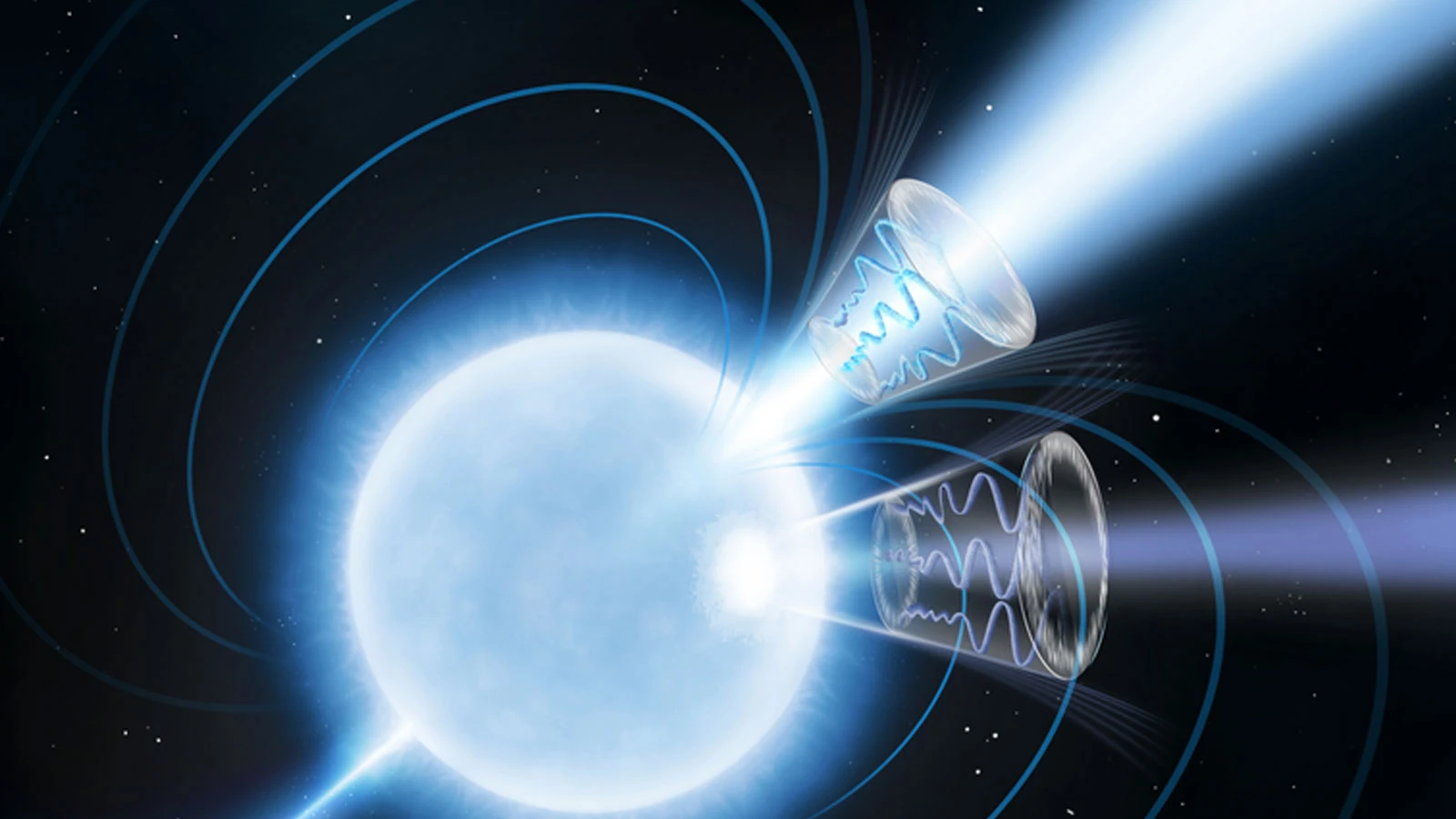
At the center of the research is a magnetar called 1E 1547.0-5408. Magnetars are extremely dense neutron stars left behind after the explosion of massive stars. But what makes them extraordinary is that they have some of the strongest magnetic fields known in the universe.
According to the results reached by scientists, even the vacuum of space can affect the movement of light in an environment where such a strong magnetic field exists.
This phenomenon is called “vacuum birefringence” in physics. While light passing through empty space is not expected to be subject to such an effect under normal conditions, according to quantum electrodynamics, extremely strong magnetic fields can change the optical properties of the vacuum. In other words, under certain conditions, space can act like an optical material or prism against light.
HEISENBERG PREDICTED IN 1936
The basis of the theory dates back to 1936. German physicist Werner Heisenberg and his student Hans Euler predicted that the environment defined as “emptiness” in the quantum world may not actually be completely empty.
According to quantum field theory, vacuum is not absolute nothingness in the classical sense. In this environment, which is the lowest energy state of quantum fields, measurable changes in the propagation properties of light can occur under the influence of strong electromagnetic fields.
However, it is extremely difficult to observe this effect directly. Because magnetic fields much stronger than those that can be produced on Earth are needed to make vacuum birefringence apparent.
At this point, magnetars turn into natural laboratories for scientists.
NASA’S IXPE TELESCOPE EXAMINED
The international research team used data from NASA’s Imaging X-ray Polarimetry Explorer (IXPE) space telescope. The researchers examined the polarization of X-rays from magnetar 1E 1547.0-5408 to determine which direction the light was vibrating.
Two important signs emerged in the results.
The polarization of X-rays from the magnetar was determined to be approximately three times stronger than predicted by standard neutron star models.
More importantly, the polarization direction of the X-rays appeared to be consistent with the direction of the magnetar’s magnetic field. According to the researchers, the co-occurrence of the two findings strongly supports the vacuum birefringence explanation.
THE STRONGEST EVIDENCE ON THE 90-YEAR-OLD PHYSICS PUZZLE
Some observational indications of vacuum birefringence have been obtained before. For example, similar polarization signs were observed around a neutron star by the Very Large Telescope in Chile in 2017. However, these measurements were not considered sufficient to definitively confirm the effect.
The new research is considered one of the strongest observational evidence ever obtained.
However, scientists are cautious. The study, published in Nature on August 5, 2026, states that vacuum birefringence is one of the long-predicted effects of quantum electrodynamics, but whose exact verification remains controversial. The researchers aim to strengthen the result with new and more sensitive observations.
THE UNDERSTANDING OF “NOTHING” IN THE UNIVERSE IS CHANGING
The importance of the research is not limited to just explaining how a magnetar behaves. The findings also show that physical conditions that cannot be created in laboratories on Earth can be tested using celestial objects in space.
If vacuum birefringence is conclusively confirmed by further observations, a fundamental quantum electrodynamics prediction made nearly 90 years ago will be supported by direct astrophysical observations.
And perhaps the most striking result of the study is this: The dark and “empty” space we see among the stars in the sky may not be a real nothingness in terms of physics.
