
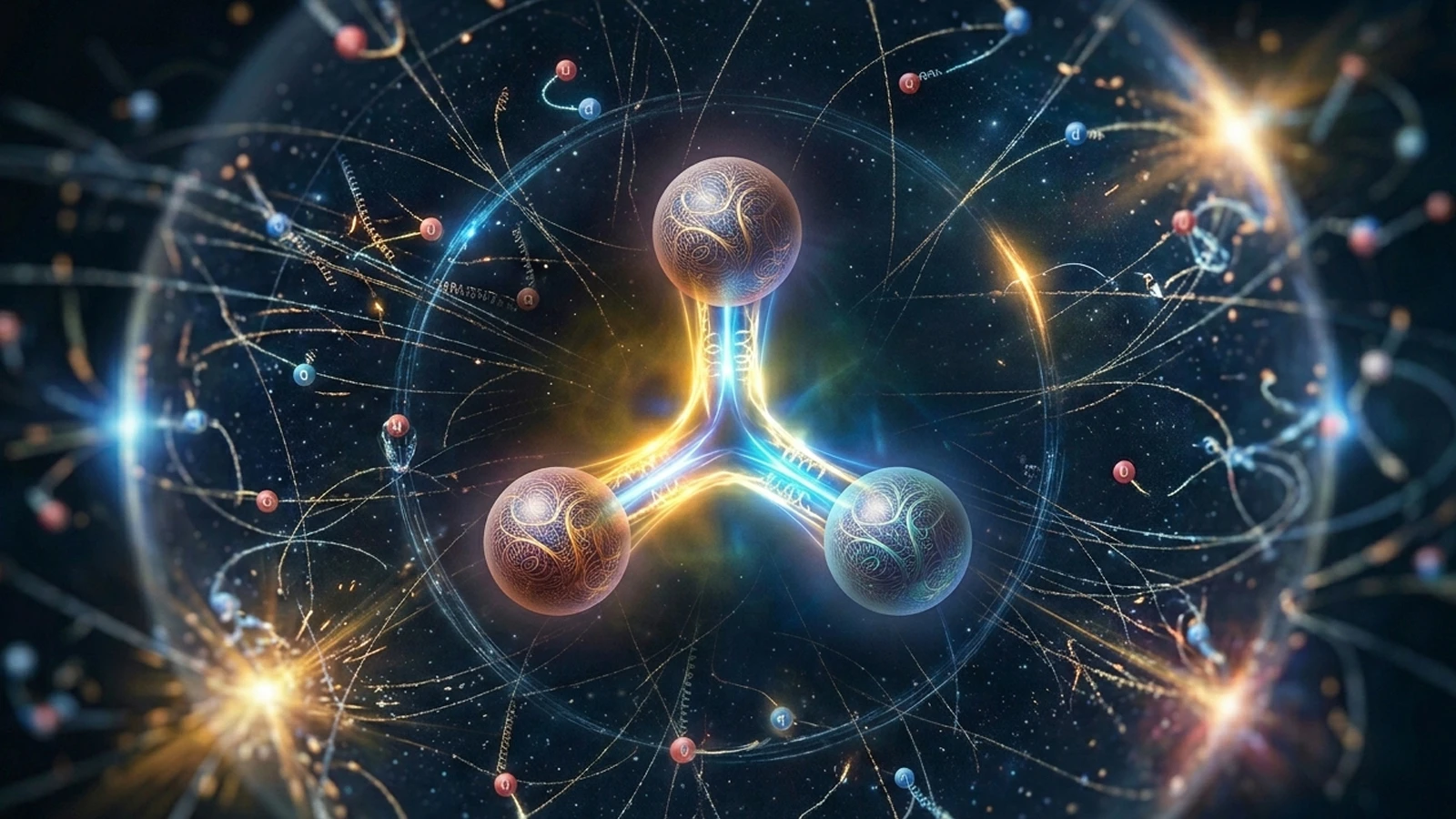
There has been a remarkable development in the debate about the most fundamental structure of matter, which has been going on for nearly 50 years in the scientific world. A new study published in the journal Science pointed out that the mechanism explaining the identity and stability of protons may be different from the traditional approach accepted to date.
Protons, one of the basic building blocks of stable matter in the universe, have been described for many years in terms of three “valence quarks” within them. However, new findings showed that the structure that determines the basic identity of the proton may be related to the gluon connection, thought of as a “Y” shape, that connects them rather than the quarks themselves.
50-YEAR-OLD THEORY TESTED IN Particle Collider
The research was conducted by the STAR Collaboration, based at Brookhaven National Laboratory in New York. Scientists examined the data obtained from subatomic collisions carried out at the Relativistic Heavy Ion Collider.
In the experiments, the nuclei of ruthenium, zirconium and gold atoms were collided at speeds close to the speed of light. By examining the distribution and motion of the resulting particles, the behavior of quarks carrying electrical charge and uncharged gluon structures during the collision was compared.
The results obtained showed that the electrically charged quarks were more affected and slowed down in the dense environment, while the uncharged gluon structure connecting the quarks could move more easily.
The researchers also studied interactions between photons and gold nuclei. It was determined that the data obtained as a result of the measurements were more compatible with the “baryon junction” theory put forward in the 1970s, rather than traditional models focusing only on quarks.
IT MAY HELP EXPLAIN THE DIFFERENCE BETWEEN MATTER AND ANTIMATTER
According to scientists, the findings are an important step in understanding how the strong nuclear force that holds subatomic particles together organizes stable matter.
Experts emphasize that the data obtained does not mean that the baryon junction has been directly observed, but it provides one of the strongest experimental evidence to date supporting the theory in question.
A better understanding of this mechanism may also provide new clues to the question of what kind of imbalance occurred between matter and antimatter in the early universe. The origin of this imbalance, which makes it possible for stars, planets and living things to exist today, remains one of the biggest questions of modern physics.
Researchers aim to examine this mechanism in the basic structure of protons in more detail and directly test the theory with experiments to be carried out at the new generation Electron-Ion Collider, which is under construction.
