
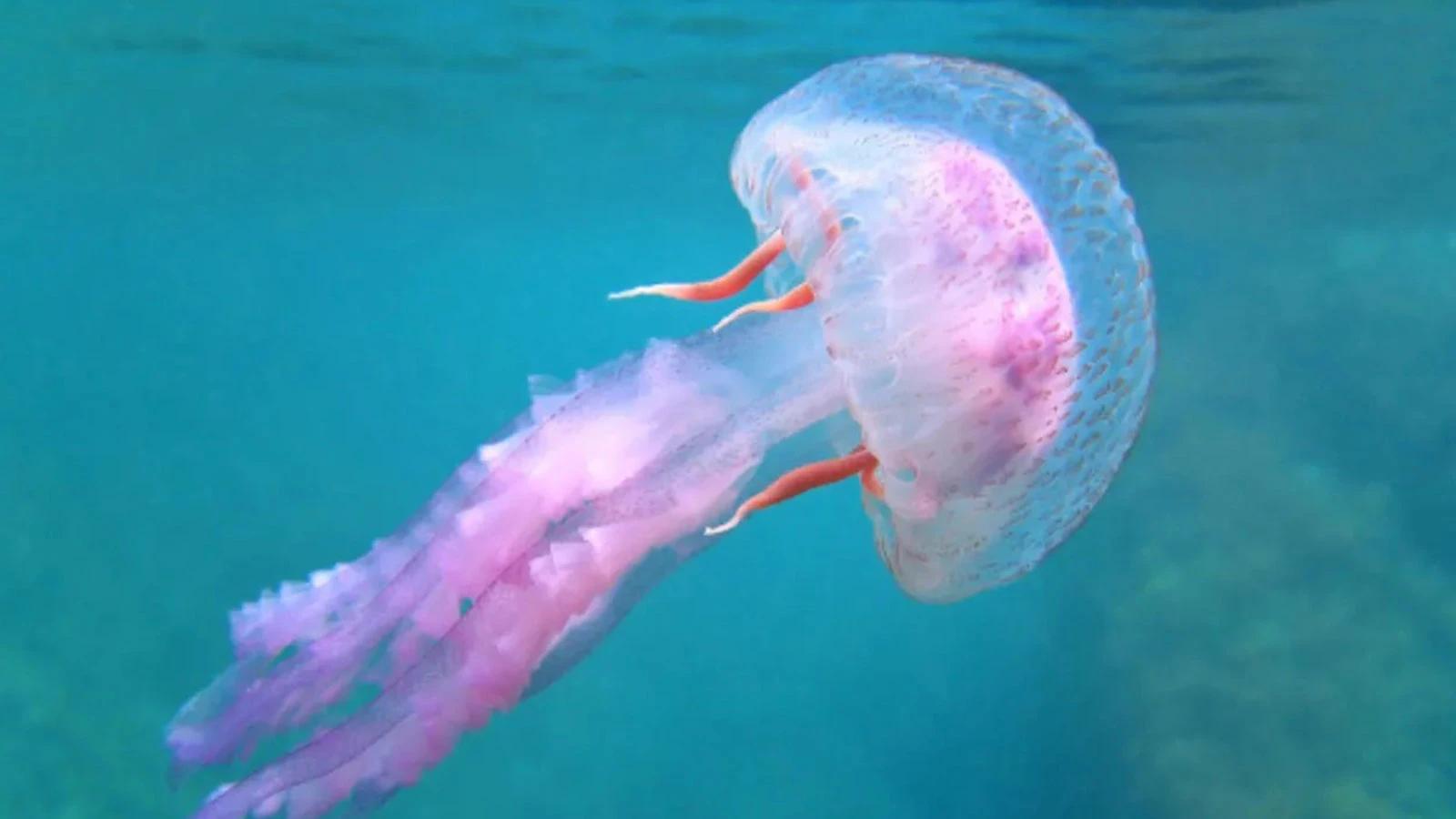
The compass jellyfish, which has been seen more frequently in Turkish seas in recent years, has reached a remarkable density, especially in the Marmara Sea and the Northern Aegean coasts. “What If It Burns?”, conducted by the Turkish Marine Research Foundation with citizen participation. Records submitted to the National Jellyfish Monitoring Program revealed that notifications of compass jellyfish have increased by nearly 70 percent in the past two years. So much so that 31 percent of the compass jellyfish notifications sent to the program in the last two years came from Çanakkale. Çanakkale was followed by Istanbul with 24.1 percent and Tekirdağ with 17.2 percent. Thus, the share of these three regions in total notifications reached 72.3 percent. While the rate of records sent from Balıkesir was determined as 13.8 percent, notifications from across the Marmara Sea remained at 6.9 percent. The rate of notifications coming from Kocaeli and Muğla was recorded as 3.4 percent separately.
CONCENTRATED IN THE STRAIT OF ÇANAKKALE
Figures show that the concentration of compass jellyfish occurs mainly in the Dardanelles, Northern Aegean and Marmara Sea lines. When Çanakkale and Balıkesir are evaluated together, the rate of notifications related to the North Aegean increases to 44.8 percent, and when Istanbul, Tekirdağ, Kocaeli and Marmara are calculated together, the share of records around Marmara increases to 51.8 percent. The distribution of the areas where notifications were made also reveals that jellyfish have become more visible on the coasts. 69 percent of the records were sent from coastal waters. 20.7 percent came from beached jellyfish, 6.9 percent came from the open sea, and 3.4 percent came from other regions.
NOT NEW FOR MARMARA
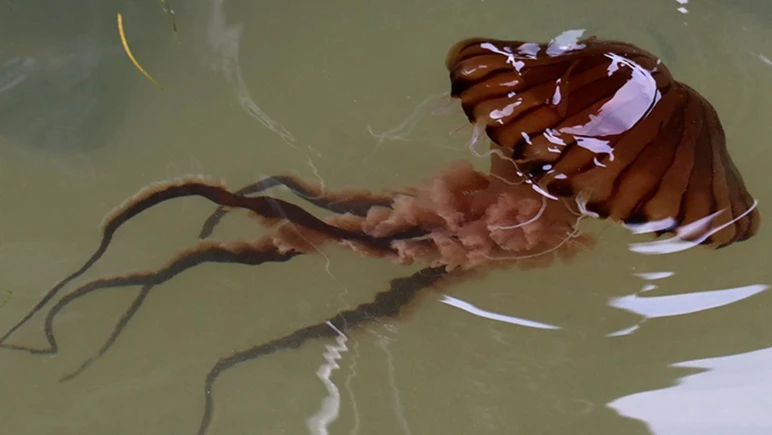
The compass jellyfish, whose scientific name is Chrysaora hysoscella, is not a foreign species that has reached the Turkish seas. It is known that the species, which has been seen in the Mediterranean and Aegean Seas for many years, has also been widely recorded in the Marmara Sea since the 2000s. The compass jellyfish, which can usually be seen in shades of brown, yellow and red, carries dark patterns resembling compass lines on its transparent bell. The species has four long mouthparts around its mouth, while the tentacles around the bell contain cells that can cause a burning effect upon contact. TÜDAV researcher and Istanbul University Marine Sciences and Management Institute Research Assistant Dr. While İlayda Destan Öztürk points out that notifications in the North Aegean and Marmara Sea have become more frequent, especially in the last two years, she says, “Therefore, the main development that scientists focus on is not the first time the species has been seen in Türkiye, but the increase in its density and visibility in certain regions.”
EFFECT OF HOT WINTERS
Experts also state that the increase in the number of Compass jellyfish cannot be explained by a single reason. The main environmental factors that experts focus on include hot winters, rising sea water temperatures, nutrient enrichment, sea pollution and changes in current systems. Sea water levels above seasonal norms can affect the life cycle and reproduction periods of jellyfish. Insufficient cooling of the water during the winter months may contribute to some species surviving longer, developing earlier, or spreading to larger areas.
INCREASE OF NITROGEN AND PHOSPHORUS
Istanbul University Faculty of Aquatic Sciences Faculty Member and Turkish Marine Research Foundation (TÜDAV) President Prof. Dr. While Bayram Öztürk points out that there has been a 70 percent increase in notifications in the last two years, he makes the following warnings: “This increase is an important ecological sign that shows that the changing environmental conditions in the Marmara and Northern Aegean should be closely monitored. The increase in nutrient salts such as nitrogen and phosphorus reaching the sea increases plankton production.”
CURRENTS CARRY
“The increase in the amount of plankton means more food for jellyfish. Particularly in seas where wastewater load is high, water circulation is limited and the temperature increases, suitable conditions are created for jellyfish to reproduce periodically. Currents and winds can also carry jellyfish in the open sea to certain bays or beaches in a short time. For this reason, seeing hundreds of jellyfish together in an area does not always indicate that there is a permanent population explosion in that area. “Some of the clusters may be caused by currents and winds gathering creatures on the same shoreline.”
(email protected)
